


It’s vogue these days for people to recommend turning off the news as a method of self-care.
And hey, I do understand that urge. It really can feel like an onslaught of despair. It isn’t really fair to accuse people of catastrophizing when there actually are so many catastrophes happening around us.
When you’re the ones doing the reporting, keeping up with it all is akin to what I can only imagine being trapped in quicksand might feel like.
But one of the things I love about being a local journalist is the feeling of making a difference in our corner of the world. Our KAXE News Team strives to keep our neighbors informed about what might affect them, give them the tools to engage with their governments and become involved in their communities, and to see the humanity and goodness that exists around us every day.
We published nearly 900 stories at kaxe.org in 2025, covering issues in more than 150 Northern Minnesota communities, from East Grand Forks to Grand Portage, and Warroad to Onamia. Almost one-third of those stories — an average of more than one per working day in the year — featured a byline from our team. That means we showed up. We were there in person, or we made the calls, or we sifted through the documents, or we added the context required from multiple sources to reveal a fuller picture.
On the surface, some of our Top 10 stories of the year may appear to fall under the label of catastrophe or at least “bad news.” But when I look a little deeper, I see people helping people — running chain saws, distributing food and water, fighting fires, safeguarding liberties. I see people stepping up to run for office, showing up to have their voices heard, standing up for those who cannot and asking tough questions that lead to change.

I’m reminded of a quote I long ago stashed away, from the book The Empathic Civilization by Jeremy Rifkin.
“Much of history that is written is about the pathology of power. Perhaps that is why, when we come to think about human nature, we have such a bleak analysis. Our collective memory is measured in terms of crises and calamities, harrowing injustices, and terrifying episodes of brutality inflicted on each other and our fellow creatures. But if these were the defining elements of the human experience, we would have perished as a species long ago. …
“The everyday world is quite different. Although life as it’s lived on the ground, close to home, is peppered with suffering, stress, injustices, and foul play, it is, for the most part, lived out in hundreds of small acts of kindness and generosity. Comfort and compassion between people creates goodwill, establishes the bonds of sociality, and gives joy to people’s lives.”

The world lost a dear former colleague and mentor of mine this year, Brainerd Dispatch photographer Steve Kohls. He showed me, through how he worked and lived, to think of the world this way. He saw the beauty and joy in everyday life like few people I’ve ever known.
Here are just a handful of stories and photo galleries from our team this year that emphasized joy or put people at the center:
- 'Breaking generational poverty': Leech Lake Financial Services' new affordable housing program
- Mrs. Sippi brings nonalcoholic bottle trend to Northern Minnesota
- GR fire chief rescues woman lying on floor inside burning house
- 4th generation Blackduck rancher shares her perspective from the farm
- Engelmans restore family legacy at Kitchi Landing Resort in Pennington
- Photo Gallery: 12 honored, 2 remembered at Bug-O-Nay-Ge-Shig graduation
- Mobility Mania and Judy Garland Museum attempt world record
- Meet Butch Eggen, Crane Lake guide, historian and 'hot dog'
- 'Power of community': Hundreds of Bemidjians gather for a night in Nymore
- Photo Gallery: Rice Rodeo kicks off Crow Wing County Fair with bulls and barrels
- 'An underlying stigma': Grand Rapids listening session focuses on mental health care
- Hill City soldier returns home 75 years after being killed in action
I’m so proud to lead this team of dynamic, thoughtful journalists, and to be part of a community radio station that cares about getting it right. I’m proud of the 19 (?!) awards we won this year (including a Regional Edward R. Murrow Award, among the most respected journalism awards in the world).

I’m proud of hosting our first intern, Dani Fraher (who absolutely kicked butt), and watching with awe the support roll in as our station faced major budget cuts after the defunding of the Corporation for Public Broadcasting.
I’m happy to report we’ve joined the Rural News Network, “a consortium of independent, nonprofit news organizations that, together, surface the most pressing issues confronting America’s rural communities.” We earned the financial support of 100+ Itasca Women Who Care after a newsroom presentation to the local AAUW gathering. We launched a new series, North Star Student, an extension of our growing coverage of high school sports and activities.
And we have several exciting things to come. I can’t wait to tell you more about our plans for 2026.
Reach us at news@kaxe.org with story tips, comments, concerns and more. Wishing you and yours a fantastic holiday season and a Happy New Year.

Here are the Top 10 stories we covered this year.
1. Severe windstorm wreaks devastation in the Bemidji area
2. Confusion, uncertainty reign amid federal funding freezes, layoffs, shutdown and more
4. U.S. Steel variance permit request reignites debate over wild rice sulfate standards
5. Budget cuts to libraries mean reductions to hours, staff, resources
6. Local sheriffs join forces with ICE
7. Large wildfires prompt evacuations, destroy hundreds of structures in St. Louis County
8. Automatic license plate reader technology beginning to proliferate Northland
9. PUC approves sale of Minnesota Power to private equity firms
10. Essentia Health advanced practice providers launch unfair labor practices strike
To hear these stories, listen to episodes of the Up North Report, to be posted Dec. 26-31, 2025.
1. Severe windstorm wreaks devastation in the Bemidji area

This summer brought some devastating storms across the country, including a hurricane-strength windstorm in the Bemidji area that dramatically changed the landscape.
An estimated 9 million trees came down around Bemidji in the windstorm on June 21, and a patchwork of tarped roofs and piles of brush could be seen for months on any of the city’s residential streets.
Winds exceeding 100 mph tore through the area in the middle of the night, knocking out power for thousands that lasted in some places nearly a week.







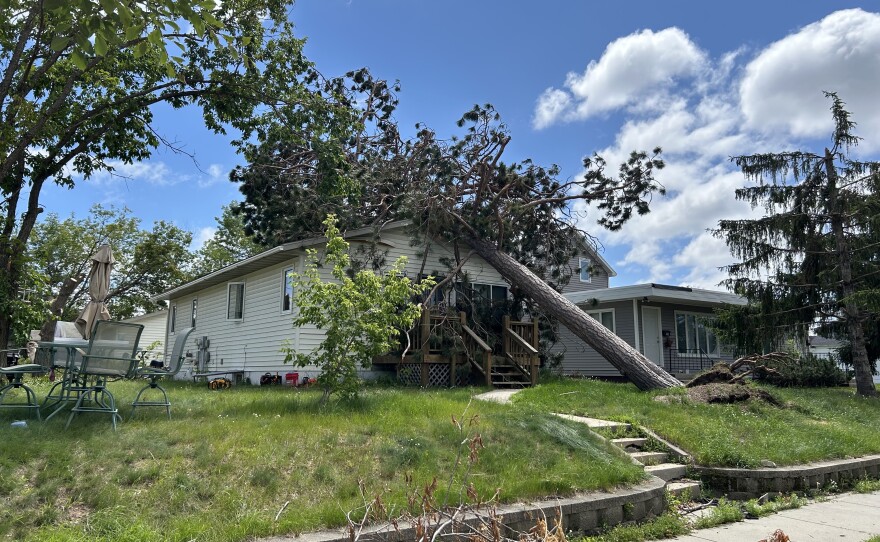

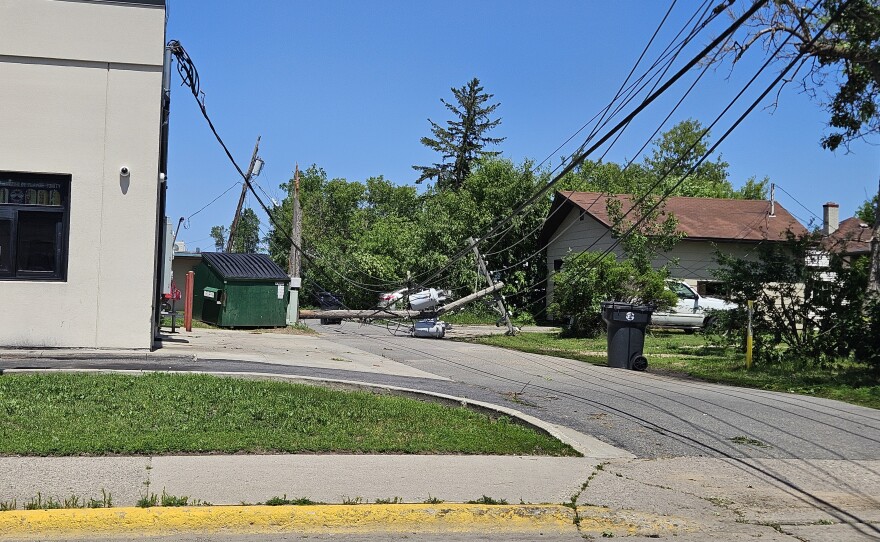


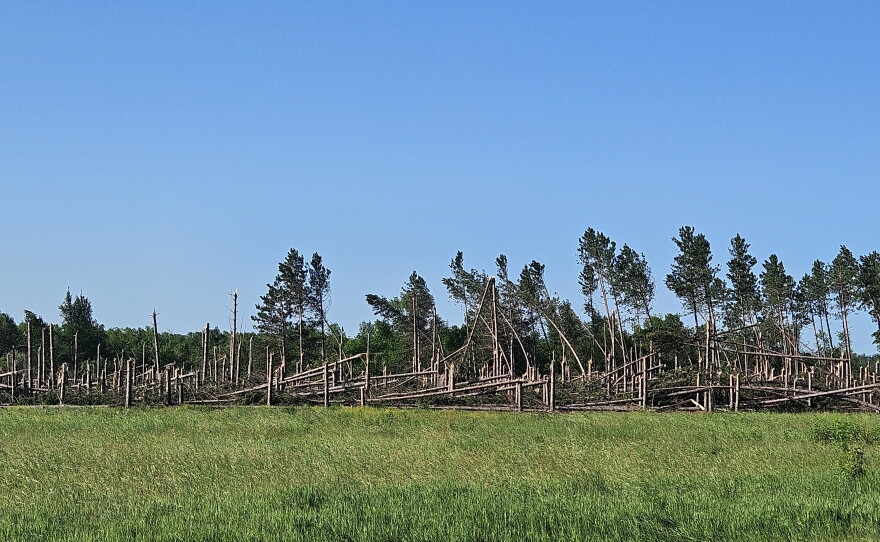
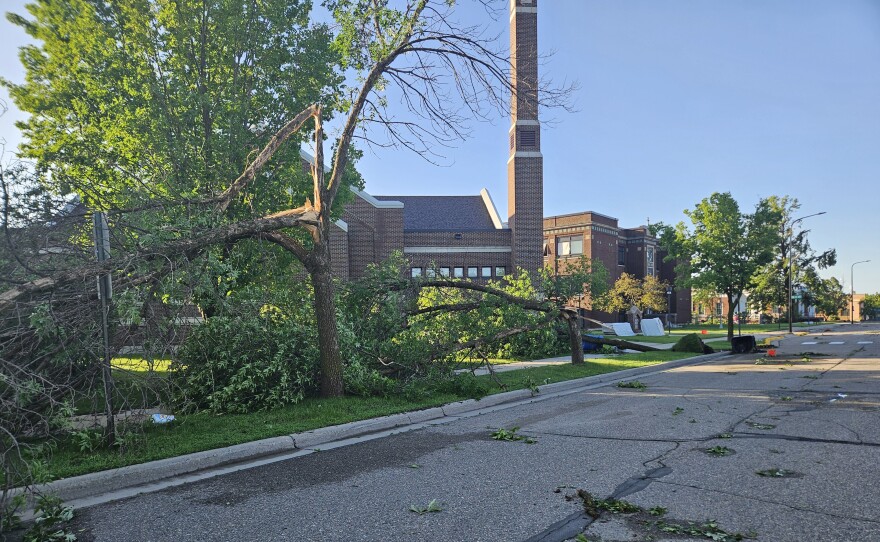


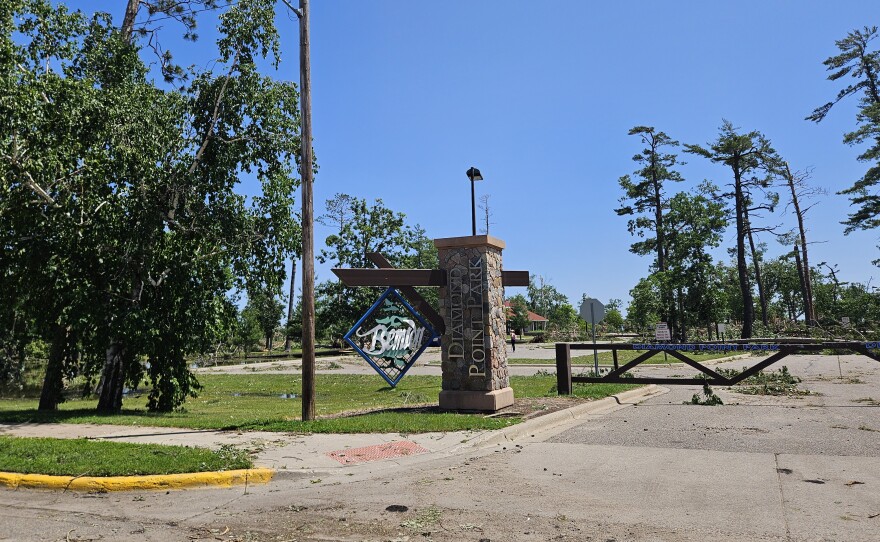
The damage and the timing led some officials to fear the worst: "And, you know, as I was seeing all this, honestly ... my first thought was, 'How many people have we lost? You know, how many people lost their lives?'"
That was Bemidji Mayor Jorge Prince, who left his house near the east side of Lake Bemidji around 5:30 that morning to survey the damage. No lives were lost as a direct impact of the storm, but local partners through Bemidji, Beltrami County and the United Way of Bemidji Area acted quickly to get resources where they were needed.


The Sanford Event Center, despite having major damage to the arena, opened its doors as an emergency shelter, providing 100 people with shelter the day after the storm.
Resources were quickly moved downtown at a pop-up community hub after demand for shelter waned, as explained by Beltrami County Public Health Director Amy Bowles in the aftermath.
"Since people are kind of now in action mode, and what we call the response mode right now, it's, 'OK, where can people come now that they can get out to get the resources and services that they need and get connected?” she said.
“So really, we're doing what Public Health does best, and that's connecting.”

One of Bemidji’s most picturesque parks, Diamond Point, was closed for weeks as crews worked to clean up debris from more than 200 trees destroyed in the storm.
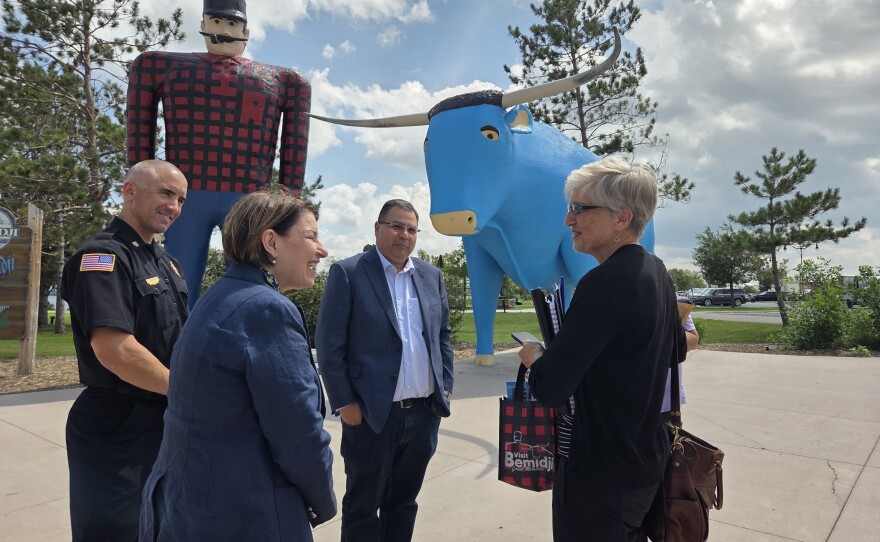
Local authorities immediately implemented peacetime states of emergency, and Gov. Tim Walz made the trek to Bemidji to survey damage before issuing a state emergency declaration. U.S. Sen. Amy Klobuchar also made a visit to Bemidji this summer.
While Beltrami County was just short of the threshold for relief from the Federal Emergency Management Agency, the Small Business Administration is providing low-interest loans for businesses and homeowners grappling with financial impacts.

The Leech Lake Band of Ojibwe secured FEMA assistance for band members and their descendants for storm recovery, announced in October.
Since the storm, “Bemidji Strong” campaign signs popped up around town, as the community came together to clean up parks, support local businesses, help their neighbors and replant Bemidji's trees.
Giving campaigns sprung up, like Bemidji State Alumni & Foundation’s Replant our Roots campaign and First National Bank’s Bemidji Canopy Project, that aim to replant some of Bemidji’s lost landscape.
Cleanup efforts from the storm are still underway, with Beltrami County offering “pick-your-own" mulch at its temporary debris site behind Bemidji’s Target. Logging efforts and brush burning commenced with winter's more favorable conditions.
While the region will probably never look the same again in our lifetimes, work is underway to bring it back better than before for future generations.
— Larissa Donovan
2. Confusion, uncertainty reign amid federal funding freezes, layoffs, shutdown and more

Surprising and fast-moving twists and turns to federal funding streams dominated headlines nationwide this year, and we covered the local impacts.
Our own station and other rural public media outlets, like Lakeland PBS, became part of the story when the Corporation for Public Broadcasting was defunded. And the nation also experienced the longest-ever government shutdown this fall.


Federal funding freezes impacted public sectors from tribal governments and colleges to city road construction, as the second Trump administration began with the short-lived Department of Government Efficiency.
Federal offices across the country were identified for closure, including in Bemidji. Federal workers locally employed by the Indian Health Service, the U.S. Forest Service and the Bureau of Indian Affairs were laid off or offered buyouts to downsize the federal workforce.
“Hardworking American people and their families are being squashed because of what they do and their career choice and what they believe in. That's not what I thought this country was about," said Alyssa Roberts on the KAXE Morning Show.
Roberts was unexpectedly laid off from the Chippewa National Forest, where she worked as a biological science technician on the wildlife surveying and monitoring team since 2016. State agencies like the health department also laid off employees.

Tribal colleges in the region had grants frozen after billions of dollars earmarked for Indian Country were identified as Diversity, Equity and Inclusion grants.
Dan King, president of Red Lake Nation College and Red Lake hereditary chief, said this move failed to recognize the government-to-government relationship owed to tribes.
"We're not like Black, Hispanic, Asian or any DEI group,” he said. “We have a legal relationship through that trust responsibility coming from the treaties and even acts of Congress.”

Public schools saw temporary freezes for after-school programs, arts events like the Lakes Area Music Festival in Brainerd grappled with promised grants disappearing, and even a long-planned road construction project in Bemidji was delayed by a year.
Many funds have since been released after dozens of lawsuits from states’ attorneys general, but the upheaval didn’t end there.
Then came the shutdown this fall, lasting 43 days and sending social services providers, who had already been affected by the uncertainties, into emergency mode.

KOOTASCA Community Action was one of those agencies.
“There’s families sitting across from us that are in distress,” said the provider’s Executive Director Marta Carrigan. “And it’s really hard to see. Sorry, probably get a little emotional here.
"And I worry for my staff because that takes a toll on them, too, to be wanting to help people and not have all of the resources or answers or things that people need."
Funding for things like food support benefits and heating assistance was held up by Congress’ inability to reach a deal on the budget, and community members stepped up, organizing events like a tailgate pantry in Bemidji or fundraising for food shelves.
As 2026 brings midterm elections and a new Congressional budget, KAXE will continue to keep an eye on the local impacts from Washington.
— Larissa Donovan, Megan Buffington, Chelsey Perkins
3. Police arrest state Sen. Justin Eichorn in prostitution sting, prompting resignation and special election

The Minnesota Legislature was the source of many news-making moments this year.
An election winner was found ineligible to serve, and a perfectly split House of Representatives prompted gridlock and a delayed start.
State Sen. Nicole Mitchell’s burglary trial loomed large.
Nothing grabbed headlines more — here and across the nation — than the shocking and heartbreaking assassination of former House Speaker Melissa Hortman and her husband Mark, along with the attempted killing of state Sen. John Hoffman and his wife Yvette, in June after the session’s conclusion.
Our No. 3 story of the year was the legislative storyline that our newsroom covered the closest, however.


It began in mid-March, when former state Sen. Justin Eichorn of Grand Rapids was arrested in a law enforcement sting operation.
In a federal criminal case, 41-year-old Eichorn is accused of attempting to hire an undercover officer he believed to be a 17-year-old for paid sex at a Bloomington hotel.
The Republican was first elected in 2016 and most recently represented Senate District 6. The married father of four has often described himself as a “Christian family man” and touted views of family values.

He resigned from the Senate three days after his March 17 arrest, prompting a special election to fill the remainder of his term.

The race drew eight interested Republicans and four DFLers. The local DFL endorsed Denise Slipy, leading the other three to drop out. The crowded Republican field meant there would be a special primary election.
It included some well-known names, like former state GOP chairwoman Jennifer Carnahan; Josh Gazelka, the son of former Senate Majority Leader Paul Gazelka; and Keri Heintzeman, whose husband Josh represents part of the same area in the Minnesota House.
Heintzeman emerged as the winning Republican candidate, both in the special primary and in terms of fundraising, where she raised nearly four times as much as the next closest candidate.
After emerging as the top GOP candidate, Heintzeman opted not to participate in a debate with her DFL opponent Slipy. She went on to claim the seat, earning 60% of the vote.
We’ll expect to see these names again on the ballot for Senate District 6, as both have made moves toward running in 2026. In fact, all the legislative seats and statewide offices will be on the ballot next year, and of course, you know KAXE will be helping you stay on top of it.

Meanwhile, Eichorn’s criminal case continues.
Eichorn had claimed he was singled out for a federal charge because of his status as a public official. But in late November, the judge rejected the defense’s claims of vindictive prosecution and attempts to suppress evidence.
— Chelsey Perkins
4. U.S. Steel variance permit request reignites debate over wild rice sulfate standards

Our No. 4 story was months in the making.
There were rumbles about sulfate standards in the Legislature in April, and three public meetings on the Iron Range in August and September.
It culminated in our lengthy story, placing the current debate around a permit for U.S. Steel’s Keetac mine in historical, political and environmental context.
Estimates vary, but at least 400 Rangers were at the Iron Trail Motors Event Center for the Minnesota Pollution Control Agency’s public hearing in September.

Environmental advocates called for enforcement of a 50-year-old standard meant to protect sacred manoomin, or wild rice.
Miners and politicians say enforcement could mean the end of mining on the Range, and if the Range falls, the rest of the state falls with it.
New wastewater permits for Keetac are the latest step in a complex, years-long saga that involves tribal sovereignty, local and international economics, governmental rulemaking and scientific debate.
The issue has come to a head at a difficult, uncertain time for the Range, with hundreds of Cleveland Cliffs miners laid off and U.S. Steel set to sell to a Japanese company.

The state’s wild rice sulfate standard has never really been enforced for various reasons. The 10 milligrams per liter limit is well below the drinking water limit of 250 mg/L. And there isn’t really anything comparable to it in the country.
Under current conditions, the standard can’t be changed. U.S. Steel leaders say compliance will cost hundreds of millions of dollars.
The only way out is a variance from the MPCA. The agency preliminarily denied U.S. Steel’s variance request, but that decision is what public comment was open for.
Public comment on the permits closed in late September. The MPCA said over 1,100 comments were submitted from many different viewpoints. The agency reviews and responds to every comment, either individually or in batches.
The state and U.S. Steel agreed to extend the timeline to make a decision on the variance request. The agency does not have an estimate for when the final decision will be announced, but know that when it is, we’ll be there to cover it.
— Megan Buffington
5. Budget cuts to libraries mean reductions to hours, staff, resources

In a year of upheaval for budgets and services at all levels of government, public libraries have not been spared.
For months after the city of Grand Rapids approached the Itasca County Board in May, the future of the Grand Rapids Area Library was still up in the air.
City officials knew they’d need to cut the budget this year.
To lessen the impact on the library, they wanted the county to increase its contribution.
Grand Rapids residents make up about 40% of library use, but the city supplied 84% of the budget.


Itasca County gives $50,000 more than the legal minimum toward libraries.
But some commissioners didn’t take kindly to the portrayal that it was the county’s fault that the library would need to limit its hours.
With no agreement, the city slashed the library budget by 22%.
It will be open for three, seven-hour days next year and have just one full-time employee.
Fundraising efforts aim to get hours back up in 2027, and city and county talks continue. But patrons will still see slower service and fewer programs in the new year.

Library woes were also a topic in Beltrami County.
The Beltrami County Board approved a 2026 budget that reduced the county’s contribution to the Kitchigami Regional Library System for the public libraries in Bemidji and Blackduck.


The move is expected to cut down on the days the Bemidji library is open from six to four and eliminate new materials for both places.
Starting in September, residents rallied to preserve library funds.
“I have not always been able to afford a lot of books for my child. I cannot afford to buy him a laptop,” said Bemidji parent Jessica Egelhof. “This is the one place that [students] know that they can go to work on their homework.”
But County Administrator Tom Barry said the county has had to account for state and federal cost shifts.
“We're going without police vehicles. We're reducing our staff. We're reducing all of these things as an operation,” he said.
The exact reasons for library cuts vary. But they’re generally being driven by rising costs and increasing burdens on local budgets, joined with outdated library funding legislation.
Unless something happens to reverse those trends, we might continue to see the number of impacted libraries grow in 2026.
— Megan Buffington, Larissa Donovan
6. Local sheriffs join forces with ICE

In March, the sheriff’s offices in Itasca and Cass counties became the first two Minnesota law enforcement agencies to sign on as force multipliers with U.S. Immigration and Customs Enforcement.
The move came under President Donald Trump’s renewed push for immigration enforcement.
In our No. 6 story of the year, we spoke with both sheriffs and an expert from the American Civil Liberties Union about the reopening of the abandoned 287(g) program.
Under federal law, ICE may delegate authority to state and local officers to interrogate people about their immigration status during routine police work.
Itasca County Sheriff Joe Dasovich and Cass County Sheriff Bryan Welk both agreed to participate in the task force model, one of three models of cooperation.

Dasovich said in March he believed the move would increase safety in the communities they serve.
“Priority is to keep our community safe. So I made the choice to become a [task force model] agency because of that," Dasovich said.
Welk agreed, but both sheriffs acknowledged that encountering undocumented immigrants in their counties is rare.

They emphasized their agencies would not proactively look for undocumented people, limiting their involvement with ICE to people otherwise under investigation for committing crimes.
“We would not be participating in raids or things like that," Welk said.
The complexity of immigration law, a lack of in-depth training and infrequent enforcement are some of the factors that make the program problematic, according to Ben Casper, ACLU Minnesota staff attorney.
Historically, it's led to concerns of racial profiling and exposed counties and states to legal liability over constitutional rights violations.
“It inevitably places law enforcement agents in their communities in the position of making judgments that do turn on race and national origin in ways that create very high risks of error," Casper said.
New legal guidance issued in December by the attorney general’s office said sheriffs cannot unilaterally enter into these agreements. Instead, the AG said only county boards may give approval.
Agreements in our region, which now includes Crow Wing County, were not approved by commissioners.
We’ll see what happens moving forward.
— Chelsey Perkins
7. Large wildfires prompt evacuations, destroy hundreds of structures in St. Louis County

Our No. 7 story is the second natural disaster on this year’s list.
Three spring wildfires burned nearly 30,000 acres in St. Louis County, an area larger than Lake Kabetogama.
Hot, dry and windy conditions had the entire state in extreme fire danger.
The first wildfire was reported the afternoon of Mother’s Day, May 11. A Duluth man was fined in September for failing to extinguish the fire that grew into Camp House.
The next day, less than 10 miles away, the Jenkins Creek Fire sparked, thought to have been caused by a cigarette thrown out of a car window.
The two fires exploded in size, burning thousands of acres each day and prompting evacuations in the remote communities of Brimson and Fairbanks.
The smaller Munger Shaw Fire also started May 12 near Cotton, burning over a thousand acres.
The three spring wildfires burned a combined nearly 30,000 acres in St. Louis County, an area larger than Lake Kabetogama.
We provided live updates for three days, sharing details on fire activity, impacts and evacuations.


After about a week, crews began to make progress as temps cooled, humidity climbed and some much-needed rain fell.
But confusion as to why it was taking so long for containment numbers to climb prompted an exploration into firefighting jargon.
“It is not an easy concept, by any means, for a general member of the public to understand,” explained Leanne Langeberg, public information officer for the Minnesota Interagency Fire Center. “Firefighting is a science.”


The fires combined for an estimated $2.35 million in property damage, most of which from the Camp House Fire. Seventy percent of properties were seasonal, but over 200 structures were damaged, and nearly all were total losses.
As you drive the remote roads between the Iron Range and the North Shore, the black fire scar is hard to miss.
But in one of their first stories, intern Dani Fraher captured the bright green birch shoots and ferns emerging in stark contrast on the scorched landscape.
— Megan Buffington
8. Automatic license plate reader tech

Ranking at No. 8 in the Top 10 stories of the year was our coverage of automatic license plate readers, or ALPRs.
The Paul Bunyan Drug Task Force installed 12 ALPRs in areas within its jurisdiction in May with the goal of furthering its investigations into drug trafficking.
The multi-jurisdictional agency headquartered within the Beltrami County Sheriff’s Office secured grant funding for the devices after Beltrami County received a federal designation as a “high-intensity drug trafficking area.”
Paul Bunyan Drug Task Force Commander Dave Hart explained the data collected could be used for more than investigating drug crimes.
“They also serve ... a huge benefit to our member agencies of the Paul Bunyan Drug Task Force to assist them in their investigations for serious crime, violent crime, missing persons and Amber alerts,” he said.

The Task Force uses technology from Flock Safety, a leader in ALPRs that boasts its network of 20 billion monthly license plate reads across 4,600 agencies. However, state law restricts the access of agencies using ALPRs to only a statewide data set.
“It's only supposed to really be pinging with the Minnesota license plate data file,” said staff attorney Alicia Granse with the American Civil Liberties Union of Minnesota. “The way that this statute is written, it's like, ‘No, you can't have this central repository.’ You're not supposed to have that. But they do.”
Granse also warned the data collected by individual agencies could be shared with federal agencies like Immigrations and Customs Enforcement.

In August, the Illinois Secretary of State issued an immediate stop to sharing all data with out-of-state agencies, after an audit revealed Flock Safety did not have proper safeguards for data sharing, and Illinois data was shared with federal agencies.
Flock Safety maintains it doesn’t own the ALPR data; the agencies and entities it contracts with own it, leaving data sharing decisions largely in the hands of local jurisdictions.
Since our reporting in August, more Northern Minnesota agencies have reported to the Minnesota Bureau of Criminal Apprehension that the technology is in place. The Itasca County Sheriff's Office has a reported 14 fixed license plate readers around Grand Rapids, Swan River, Cohasset, Deer River, S. Lake, Big Fork, Nashwauk and Keewatin.
— Larissa Donovan
9. PUC approves sale of Minnesota Power to private equity firms

Our coverage of the sale of Minnesota Power to two private equity firms spanned the entire year and also included its fair share of administrative and legal back-and-forth.


One of our first publications of 2025 was the public comment notice for the proposed sale. The sale closed on Dec. 15.
Minnesota Power’s parent company ALLETE sold for $6.2 billion in 2024 to the Canada Pension Plan Investment Board and Global Infrastructure Partners.
CPP Investments is one of the world’s largest national pension fund managers and private equity investors. GIP is a private equity fund owned by BlackRock, the world’s largest asset management firm.
ALLETE and the investors say the acquisition will provide the capital needed to make the clean energy transition required by Minnesota’s carbon-free electricity by 2040 law.
A unique opposition coalition emerged, including the attorney general’s office, environmental groups and 10 of Minnesota Power’s largest commercial customers, including UPM Blandin and U.S. Steel.
An administrative law judge sided with that coalition, opining in July that the Minnesota Public Utilities Commission shouldn’t approve the sale because it’s not consistent with the public interest.
But settlement agreements proposed by the Department of Commerce and PUC commissioners were enough for the commission to give its unanimous OK in October.
As part of the saga, Minnesota Power is in the process of amending its electricity plan to use less natural gas. We’ll continue our coverage in the new year.
— Megan Buffington
10. Essentia Health advanced practice providers launch unfair labor practices strike

Strike coverage isn’t new for KAXE, but this year brought more than ever before.
University of Minnesota workers picketed in September, and Essentia Health-Deer River’s service workers’ 49-day strike stretched into the new year.
But another atypical strike earns the No. 10 spot on our list.
Essentia Health’s advanced practice providers’ strike this summer was unique in a few different ways.
For one, the scale was immense: over 400 nurse practitioners and physician assistants from Brainerd to International Falls to northwest Wisconsin.
But while hundreds of clinicians were technically on strike, many still showed up to work each day, according to Essentia.
The strike was also preceded by a months-long, complex legal dispute, further complicated by dysfunction at the federal level.
And perhaps most unusual of all, the strike ended without a resolution, and there still hasn’t been one.
APPs voted to unionize in July 2024.


But Essentia refused to begin the bargaining process even after the unit was certified by the National Labor Relations Board. It’s challenging the makeup of the union and says it can’t bargain while it waits for a decision.
But the national board was at a standstill after President Donald Trump fired one of the board members, and the Minnesota Nurses Association says Essentia was violating labor law by not bargaining.
The clinicians ended their 13-day strike without any changes, and the case is still in limbo.
— Megan Buffington
Honorable mentions
Proposed data center in Hermantown raises environmental concerns

A proposed data center in Hermantown was shrouded in secrecy for a time, with public officials signing nondisclosure agreements and a vague description of “light industrial development.”
We kept an eye on the story as it developed into a wider discussion about the environmental review process in the state and whether it was adequate for a project of this scale.


Combined with tax credits and a cold climate, Minnesota is well-positioned to be the home of the next data center land rush.
Community members are raising concerns about noise pollution, air pollution, water availability and increasing electricity rates.
This is a story we’ll keep an eye on next year as legal challenges arise.
— Larissa Donovan
GoMARTI adds stops, expands into Leech Lake Reservation

Our other honorable mention this year is the expansion of the goMARTI autonomous transit program in Itasca County.
The on-demand, accessible transit system serves Itasca County. Like in much of rural Northern Minnesota, transportation can be a massive barrier for those without cars or with mobility issues.
There are now more hours of operation, 70 more stops, and it serves the Leech Lake Band of Ojibwe reservation. There are also three new, handicapped-accessible electric Volkswagen vans named Buzz, Polly and Pickle. And the program is entirely free. The service is paid for by state and federal funds, including a federal grant through the Department of Iron Range Resources and Rehabilitation that will allow it to run for free through 2028.


But the project is about more than providing transportation. “MARTI” stands for Minnesota’s Advanced Rural Transit Innovations, and it’s the northernmost autonomous vehicle service in the United States.
Every single ride helps to advance autonomous vehicle technology in a place where snow, ice and cold provide many chances for increased difficulty. This feature caught the attention of National Public Radio, which aired our piece on Morning Edition.
— Chelsey Perkins

