



This is the first story in the Overrepresented, Undercounted series.
While Indigenous people represent around 1% of the state’s population, they represent 9.4% of the adult prison population in Minnesota, and about the same rate across all jails in the state, according to information from the Minnesota Department of Corrections and the nonprofit Institute for Justice.
KAXE is exploring the underlying issues of the statistics through survey outreach, extensive research and in-person interviews.
The project was made possible by a grant from the journalism nonprofit Poynter.
BEMIDJI — If you’re having a mental health crisis, you may just end up in jail. If you lack the resources to navigate the criminal justice system, you could be held there pre-trial. And for Indigenous people, a culmination of these issues has resulted in disproportionate representation in the criminal justice system.
Across the country, Indigenous people are the most overrepresented ethnic group in U.S. prison and jails. Native women are particularly impacted, the nonprofit Indigenous Foundation wrote in February 2026, and structural inequities faced by Native communities because of the history of settler colonialism plays a significant role.
“Extreme poverty and other socioeconomic disparities, poor access and support for mental health and substance abuse care, as well as jurisdictional confusion that places Native defendants under harsher federal laws, all contribute to the high rate of imprisonment of Natives today,” according to the Indigenous Foundation.
“But without acknowledging the historical roots of such issues and addressing the symptoms of struggle within Native communities, a perpetual cycle of stereotyping and incarcerating Natives will continue.”
In Northern Minnesota — home to all six Minnesota Chippewa Tribe bands and the sovereign Red Lake Nation — a lack of mental health services and inpatient beds has led to jails and emergency rooms filling the gap for years.
The Red Lake Nation shares its geography with Beltrami County. The county seat of Bemidji is the geographical center of Red Lake and two more of the largest reservations in Minnesota: the White Earth Nation and the Leech Lake Band of Ojibwe.

“We have holding cells, and our jail is not equipped for mental health people,” said Calandra Allen, Beltrami County Jail administrator. “We don't want them in there. That's not the spot that they need. That's not how they get stabilized.”
Allen has worked in the jail for 15 years. She said in an interview at the Beltrami County Law Enforcement Center that many of the incarcerated people she sees are suffering from substance use disorder and mental illness.
The Prison Policy Institute, a nonprofit focused on researching criminal justice issues, found that people experiencing incarceration have much higher instances of chemical dependency and mental health issues than the population at large.

“Over half of people in state prisons reported some indication of a mental health problem,” the researchers wrote. “Women and Native people in prison are suffering from mental illness at even higher rates.”
For people with mental health issues, living behind bars can exacerbate the problems. But access to mental health services, especially in rural Minnesota, is a challenge.


Beltrami County Sheriff Jason Riggs said the need for mental health services is a longtime issue between local governments and the state. Addressing mental health for incarcerated people is a financial challenge for a high-poverty county like Beltrami, he added. The counties and their taxpayers can’t afford some of the proposals discussed in St. Paul that aim to increase mental health access in local jails, he said.
Beltrami County is the second poorest county in the state, with a 16.1% poverty rate. Statewide, the poverty rate is 9.3%. The poorest in the state is also in northwest Minnesota: Mahnomen County, where the poverty rate is 18.3%.
People living on reservations experience poverty at even higher rates. The average poverty rate on Minnesota’s reservations is around 23%. In Northern Minnesota, the reservation poverty rates can be even higher.
“Officers across the state have pushed back at the Minnesota Department of Corrections for this very reason. ... These staff that we hire in our facilities are not mental health workers,” Riggs said. “Therefore, we have to do the best that we can with what we have.”
States still provide psychiatric beds despite deinstitutionalizing mental hospitals since the 1980s, but the units are much smaller than the institutions of the past. University of Minnesota researchers wrote in 2015 that when Minnesota’s last large mental hospital closed, a different type of institutionalization was underway for people with mental health conditions inside jails and prisons.

Nationwide, those state psychiatric beds have declined, according to research from the nonprofit Treatment Advocacy Center. More than half of those beds are occupied by people who have been committed to the hospital by the criminal justice system, with the other percentage of folks committed by the civil court process.
“Thousands of inmates with serious mental illness languish in jail for months, or even years, waiting for a state hospital bed to open,” the researchers wrote.
“While incarcerated, such people often gain additional charges due to disruptive behaviors that are symptoms of their illness, get sicker as they spend extended periods of time without treatment, and even die from preventable and tragic causes such as dehydration.”
Cycles of crime and poverty — and a disproportionate impact
Poverty, drug use, mental illness, criminality: these issues coexist and overlap.
“So, you're going to have more need, you're going to have more crime, but you're going to have less resources to deal with it,” said Beltrami County Chief Deputy Jarrett Walton.
In 2024, the American Community Survey found on the Red Lake Nation, poverty rates are between 21% and 44%. On the White Earth Nation, poverty rates also vary widely, such as more than 63% living in poverty in the village of White Earth and 35% in Naytahwaush.
Census data indicates more than 9,000 Native people live in Beltrami County, making up nearly 20% of the population. More than half of them reside on the Red Lake Nation.
The Minnesota Bureau of Criminal Apprehension’s Crime Data Explorer details some arrest demographic details, but it may not paint the full picture. In 2025, more than half of all arrests in Beltrami County were of Native people. Of all Native people arrested in the county, nearly half were women.
Another 13% of arrests in the same time frame were categorized as race unknown. In surrounding counties, those numbers were even higher, ranging from one-quarter to one-third of all arrests in Hubbard, Cass, Itasca and Clearwater counties last year.Data from the BCA’s Drug Crimes Dashboard shows Becker and Beltrami counties have some of the highest per capita rates of drug-related crimes in the state. In 2024, Becker County’s rate was 461 offenses per 100,000 people, and Beltrami was 381.


For comparison, the drug offense per capita rate is lower in the metro area: Hennepin County’s drug arrest rate in 2024 was 252 per 100,000, and in Ramsey it was 330.
In the northern counties, a significant portion of those arrested are American Indian or Alaskan Native. From 2021 to 2025, a third of the 774 drug arrestees in Becker County were Indigenous. Another 47% had an unknown race reported. Only 7% of Becker County’s 35,000 people are Native, according to the latest Census data.
Law enforcement agencies in Beltrami County reported 632 drug arrests in the same time frame. Over half of those were Indigenous, and another 20% had no race reported.
But poverty and crime don’t always go hand in hand. New research from Columbia University found that in New York City, nearly a quarter of Asian Americans are living in poverty. Asians are the least represented group of people incarcerated and are arrested for violent crime at far lower rates than other ethnic groups, including whites.
“Throughout American history, different social groups have engaged in different amounts of violent crime, and no consistent relationship between the extent of a group’s socioeconomic disadvantage and its level of violence is evident,” writes City Journal’s Barry Latzer.
Researchers elsewhere suggest the correlation between crime and poverty is more nuanced, with multiple factors at play, including geography.
“Property crime is often more opportunistic and economically motivated, while violent crime is more closely tied to social disorganization and interpersonal conflict,” writes OpenCrime in its database analysis on poverty and crime.
'Trying to find a solution to a problem’
Natasha Kingbird is a Red Lake Band member of Bagley who formerly lived in Bemidji. She has spent years gaining insight into the prevalent issues Native people face. At the Northwest Indian Community Development Center in Bemidji, her work involved piloting the Healing House, which connects formerly incarcerated Native women back to their families, their communities and their culture. She received the Virginia McKnight Binger Unsung Hero Award in 2023 for those efforts.
Drug-related crimes are largely committed by people who use them, and Kingbird acknowledged the intense issues of addiction within Native communities.
“[People use to] numb some pain, find a different way out. And we don't know if it's from grief, sexual assaults, domestic violence, trauma, those kinds of things,” she said.

While no longer at the center, she continues to support and advocate for Native women and families through her work at Mending the Sacred Hoop — a Native-led nonprofit that provides resources for violence-impacted Native women — and MMIW 218. Kingbird helped co-found the latter organization, which stands for Missing and Murdered Indigenous Women, in the wake of the murders of two Indigenous women in Bemidji in 2015: Krista Fishermann and Rose Downwind. She continues to support families who have unresolved cases, even as her own family experiences the still unsolved disappearance of 15-year-old Nevaeh Kingbird.
Kingbird said the deep disparities in poverty, violence, substance use disorder and incarceration are all connected to the historic disconnect of culture for Indigenous peoples: removal orders, land allotments and residential boarding schools being part of a continuum of colonization she and others in her field are attempting to reverse.
“If you look at the inmate list, you know, sometimes in Beltrami County ... there's a little bit higher rates of Native women in there. There's Native women in the local surrounding counties: Red Lake, Hubbard County, Itasca County,” Kingbird said.
“If we're trying to find a solution to a problem, incorporating some of the natural history of our own lives, right, and incorporating some of those teachings to help us with that transition of life — because a long time ago, our ways, we had different things that would help us transition into that next phase of life.”
Kingbird, 44, shared that after our interview, she was headed to her first berry fast — a ceremony that should have taken place as she was an 11- or 12-year-old girl, per Anishinaabe tradition. But she didn’t get the chance while growing up.

She said the culture offers many ways to celebrate or recognize the different life stages people go through — such as becoming a parent or even losing their own — to help people stay on a good path.
“When women are coming home [from incarceration], they're at higher risk than the typical, normal person,” Kingbird said. “There's homelessness. There's substance use. And then the history of violence and domestic violence and sexual assault that [Native] women have endured.”
She said that history is what leads to many undercounts of Native women experiencing violence, among other data collection issues in Indigenous communities.
“The numbers, the statistics could be not right, because a lot of Native women don’t report because of the system, right? And always worried about having their kids taken away or, maybe putting them at risk of going to jail. So, there's a lot of different factors that kind of tie into that,” Kingbird said.


Kingbird also experienced incarceration as a youth and as an adult. She served time in Washington and Beltrami county jails and reflected that she missed her father’s funeral ceremony due to her incarceration. More than 15 years ago, she was convicted of felony check forgery and had some subsequent misdemeanor violations. She said her work with Healing House aimed to provide the things she didn’t have while reentering and grieving.
“There's a lot of different things that happen within our communities and our families,” Kingbird said. “You're learning about different things and the family separation, the loss, grief, learning how to adapt to society and working 8 to 4 and just really learning different tools to be in society.”
Undercounted
Collecting data within Indigenous communities can be fraught with issues.
“Data collection efforts in tribal communities face a number of problems that limit the data’s accuracy and comprehensiveness,” writes the Prison Policy Institute.
“According to the National Institute of Justice, issues such as difficulty in outreach, overlapping jurisdictions, and differences between tribal justice systems make the collection of data from these communities especially challenging. U.S. government policies and priorities also limit the data it collects and reports about Native populations.”
For example, hardly any data collected is separated by individual tribes, and in many instances, Natives are categorized as an “other” category.
"Distrust of the U.S. government, a youth-heavy population, nontraditional addresses, low internet access, language and literacy barriers, weather and road access issues, and high rates of poverty and houselessness” are just some of the factors the National Institute of Justice described as reasons for the undercounting of Native people.

“Until criminal justice agencies overcome the limitations on data collection — and until the offices that publish the data are willing to list Native Americans as a distinct demographic group, rather than a member of an 'Other' category — informational gaps will continue to make it difficult to understand how overcriminalization has impacted Native populations,” writes the Prison Policy Institute.
Kingbird said these undercounts underscore a significant gap in services.
"People choose not to report and survey themselves. It might just be a bad time for them,” Kingbird said. “It brings back a lot of other issues when there's violence in the home or traumatic experiences or drug and alcohol use is involved.
“There's people out there that might have an education level of sixth grade — that plays a factor in there. Like, ‘Can I read this document? Can I write it? I might have a learning disability,’” Kingbird continued.
“I think those are things that aren't tracked in the mental health situation within our county as well.”
Institutionalization, past and present
Beltrami County cites limited staff, funds and other resources as barriers to access to mental health and substance abuse treatment for incarcerated people.
“When you come to Northern Minnesota, we struggle with trying to meet these needs from a resource level, but we also struggle financially because we don't have an infinite pot of money,” Riggs said.
Kingbird said a lack of resources and support for mental health care for Native people today also stems back to the institutionalization era and the fears associated with it.


"Some of the stories that I did hear about pre-boarding school and — if you were considered ‘hearing voices,’ doing all this stuff, they would put you in an insane asylum. And you would either be killed, given shock treatment. They sterilized a lot of women. That history right there could be traumatic.”
Advocates for deinstitutionalizing mental health — an effort that began in Minnesota during the 1980s — pointed out the deteriorating conditions for care, describing the large, aging campuses as “warehouses” of people with disabilities.
Some hospitals housed people with conditions such as schizophrenia and Down syndrome, while others were historically positioned as “inebriate” placements for alcoholism or chemical dependency.
One federal change that prompted deinstitutionalization came from Medicaid and Medicare. State-run hospitals could not receive federal reimbursements to provide treatment as the nation shifted mental health funding into community-based and regional care, such as group homes.
Without additional state resources, Beltrami Jail Administrator Calandra Allen described some of the programs already in place at the jail to address some of the root causes of incarceration and reduce recidivism, including mental health treatment.
“A behavioral health therapist, psychiatry services, SUD [substance use disorder], which is licensed alcohol drug counseling, peer support,” Allen said, listing some of the partners of the EMBER program—which stands for embrace, motivate, believe, execute and remedy.
“It was an idea which came from, ‘How can we do this? ‘What partners we can partner with?’ And now it became a reality.”
Allen said other jail programming underway includes collaboration with the Northwest Indian Community Development Center on Native American cultural groups and a general education degree, or GED course. The kitchen staff is also working on a program to provide incarcerated people with food safety certification.

As Beltrami County is amid a multi-year construction of an $80 million new jail, Allen said the 243-bed facility will be better equipped for programming as well as the classification of incarcerated people.
At the current Beltrami County Jail, which is licensed to house 132 and has a $15 million a year budget, Allen said her staff are only able to configure seven supervision classifications.
“We need nine currently in our jail. And what the new jail can do [is] we can house up to 21 different classifications,” Allen said. “The versatility of the new facility and what corrections and the judicial system needs, for the community’s needs, it just doesn't even compare.”


Supervision classifications are in-house policies approved by state corrections that determine the levels of supervision each incarcerated person might require to maintain safety and security in a jail. Allen stated the new facility will also have additional space for volunteer-led programming with conference rooms and general use areas.
A guideline from the Minnesota Department of Corrections advises departments to use objective criteria for establishing its supervision classifications, such as level of offense, programming and security needs of an incarcerated person, and the safety of staff and others in the facility.
The new jail is slated to open in April 2027.
Beltrami County already implements DWI and drug courts, which are special diversionary courts that explore non-jail options for qualifying defendants in the criminal justice system. But Allen said there is a definite need for more resources in mental health and chemical dependency.

“They're coming in on addictions right and left, and then we cut them off of everything. They're trying to live off of oxygen and water, and it's a complete flush of withdrawal of everything,” Allen said.
Sheriff Jason Riggs said the original jails were designed to provide the colloquial “three hots and a cot,” but jail alone can’t rehabilitate people.
"Just locking people away isn't having an effect on reducing crime or enhancing public safety in our community,” Riggs said.
“Getting people help, and if we can start that process while people are in custody, and then with our reset program, give them a head-up, leg out, for two or three months after the fact, the wrap-around services? We're seeing an impact with the reduction in recidivism already.”

Kingbird said there is a lot of work to be done, but collaboration and connection across all cultures are key to addressing disparities across the board.
“There's a lot of people that are scared to be [holding] space because they don't want to feel like they're stepping on our toes,” Kingbird said. “There's room for everyone, and there's a respectful way. We can all get this done together.”
-
 The retired DNR forester gave a walking tour of his forest property as part of a Cass Soil and Water Conservation District forest management event.
 -
Plus: Aitkin's 68-year-old water tower is demolished; Demuth, Klobuchar will debate in the Brainerd lakes area; and we're partnered with ICTV to host school board forums.
-
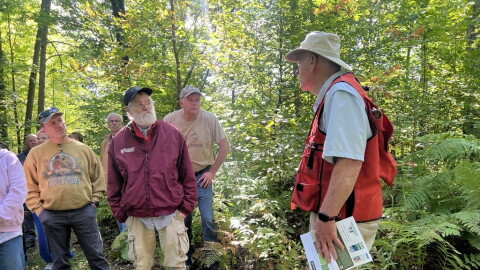 Stella Mayerhoff/KAXE / Report for AmericaRetired DNR forester Gary Anderson gave a walking tour of his forest property as part of a Cass Soil and Water Conservation District habitat management event.
 -
 Lorie Shaull/KAXEMichael L. LaFlex was convicted of first-degree premeditated murder by a Crow Wing County jury in 2024. He shot Bryce Brogle at a Merrifield storage facility in 2022.
 -
Plus: Demuth-affiliated political action committee receives $10 million infusion.
-
 Contributed/Michelle Griffith / Minnesota ReformerThe cash infusion suggests at least some big-money Republicans see glimmers of hope here in MN, where Dems have been weighed down by embarrassing stories about social services fraud.
 -
 Screenshot/BCA YouTube videoThe voluntary recommendations aim to help bring uniformity and consistency to sexual assault investigations and are related to victim support, evidence collection and post-conviction steps.
 -
Plus: Businesses in drought disaster area eligible for fed assistance, Bemidji tells a tale of two homecomings.
-
 Lorie Shaull/Special to KAXESmall businesses and private nonprofits may apply for up to $2 million in low-interest loan funding from the U.S. Small Business Administration before April 26, 2027.
 -
 Contributed/Hennepin CountyJustin Eichorn’s sentencing comes a year-and-a-half after his arrest as part of an undercover law enforcement sting operation during the 2025 legislative session.


