


The Democratic-Farmer-Labor Party will take control of both chambers of the Minnesota Legislature after riding a national wave of anti-Trump fervor that swept the country Tuesday, Nov. 3.
With Democrat Amy Klobuchar’s victory in the governor’s race, Minnesota will again have a DFL trifecta after two years of shared control with Republicans. While the exact margin of victory wasn’t clear by Wednesday morning, the party is expected to secure larger majorities than those that comprised the 2023-24 trifecta.
By 8 a.m., The Associated Press had called 34 Senate races in favor of Democrats, securing at least a one-seat majority in the chamber with the results in nine races still outstanding. Democrats lead in five of those races.
In the House, Democrats flipped several seats, and The Associated Press had called 72 races for the DFL, four more than the 68 they needed for a majority. Democrats were leading in five of the 12 races yet to be called.


“Minnesotans put their trust in us to fight for them,” Senate DFL Campaign Chair Nick Frentz said in a statement early Wednesday. “Much of that trust was built because we knocked on their doors, we answered their calls and we stood up for them in the face of harm coming from Washington.”
The DFL picked up seats in both chambers in metro suburbs and Greater Minnesota alike, giving them a strong mandate to continue Minnesota’s tradition of robust investments in education, health care and social services. Republican Reps. Aaron Repinski of Winona and Jeff Dotseth of Kettle River lost to DFL challengers. In the Senate, Democrats ousted Sen. Jim Abeler of Anoka and also won Maple Grove’s historically red District 37, long held by Sen. Warren Limmer, who is retiring.
State Rep. Brad Tabke, DFL-Shakopee, won his seat by more than 14 percentage points. Two years ago, he won by only 14 votes.
Once Democrats finish celebrating, they’ll soon face reality: The 2027-28 Legislature will face an uphill battle to pass ambitious progressive legislation, given that Klobuchar has promised voters no new tax increases. The state is spending more money than it’s bringing in, and federal funding cuts to safety net programs will place additional pressure on the budget.
Meanwhile, some of Minnesota’s most important institutions, which are also feeling the impact of federal cuts and policy changes, will be clamoring for cash from the state: universities, school districts, local governments and food banks, among others. The rising cost of healthcare means the state will pay more to insure its more than 50,000 employees and take care of the more than 1.2 million low-income and disabled Minnesotans enrolled in Medical Assistance, Minnesota’s version of Medicaid.


It’s a stark departure from the 2023-24 legislative session, the last time Democrats held both chambers and the governor’s office. Then, the DFL walked into budget negotiations with a $17 billion surplus and the political will, including from Gov. Tim Walz, to spend it and even raise taxes on metro residents for housing and transportation.
That historic session led to major investments in housing, education, transportation, tax credits to low-income families, free school meals and more.
During her victory speech, Klobuchar cautioned that some of her decisions may not be popular, including with members of her own party in the Legislature.
“Spoiler alert: You may not like every single thing I do,” Klobuchar said.
Minnesota Reformer is part of States Newsroom, a nonprofit news network supported by grants and a coalition of donors as a 501c(3) public charity. Minnesota Reformer maintains editorial independence. Contact Editor J. Patrick Coolican for questions: info@minnesotareformer.com.
-
 Colleen Bakken, Jenny Frenzel and Carol L. Johnson were the top three candidates in the Bemidji School Board election on Nov. 3, 2026.
-
 Graphic/KAXEWiener currently serves as the state representative for House District 5B and will begin his four-year term in January.
-
 Graphic/KAXEThe Senate District 6 race between Kari Heintzeman and Denise Slipy was a near-repeat of a special election in 2025.
-
 Graphic/KAXEVoters across Clearwater County cast ballots for the next Clearwater County Sheriff and Auditor-Treasurer.
-
 Plus: Sheriff Bryan Welk reelected in Cass County; Itasca County commissioner districts flip in rematches; and constitutional amendment passes, but local school funding measures fail.
-
 Graphic/KAXERepublican state Sen. Steve Green will return to St. Paul in January 2027 after beating out two challengers for his seat.
-
 Graphic/KAXERepublican state Rep. Ben Davis will return to St. Paul for a third term in January 2027.
-
 Graphic/KAXEThe school district will need to make budget cuts in the wake of the referendum failure. A trifecta of "common sense" candidates elected to the Board will help the district navigate the challenge.
-
 Lorie Shaull/KAXEIncumbent Neal Gaalswyk and newcomers Aaron Young and Tyler Seifert win County Board seats.
-
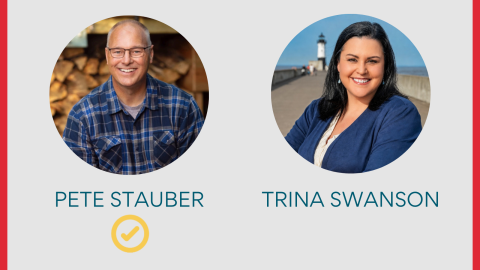 Graphic/KAXERepublican Rep. Pete Stauber will return to Washington for a fifth term on Capitol Hill.


