


GRAND RAPIDS — Itasca County authorities have removed all Flock Safety cameras under county jurisdiction.
Itasca County Commissioner Terry Snyder confirmed Tuesday, Sept. 15, the county took down its remaining automatic license plate readers. It also canceled all contracts with Flock Safety.
Itasca County operated over a dozen automatic license plate reader cameras across the county, according to the Minnesota Bureau of Criminal Apprehension.

"Several citizens had questions about the Flock cameras," Snyder said. "'What are they?' 'Are they still up?' So yeah, Itasca County has canceled our contract with that and all of our cameras are down."
Snyder first broke the news to Wabana Township residents during a Coffee with Commissioners event Thursday, Sept. 10.
Flock Safety produces automatic license plate reader cameras, or ALPRs, that have become commonplace surveillance devices for law enforcement. Many ALPR systems today use artificial intelligence to process license plate images into data files.
Public opposition against ALPRs has grown in the last few years, with opponents citing concerns about data security and personal rights.
Snyder said these concerns contributed to the removal of the Itasca County cameras.
"It grew into something much larger, that wasn't as beneficial, that people could see as maybe an infringement on their rights," he said. "The last thing we want to do is to portray that image."
According to Itasca County Sheriff Joe Dasovich, the county only possessed around five cameras at the time of removal after some were cut down or vandalized. Dasovich said Flock Safety wanted Itasca County to pay for new cameras following the incidents, further straining the office's relationship with the company.


Dasovich called the contracts and cameras "easy money to cut."
"These companies mine data, and we don't know what data it is or who they sell it to," he said. "We knew what data that we were provided by Flock and how valuable that was to law enforcement, but we were unsure what the company was doing with other data that it was collecting."

Snyder said residents may still see cameras belonging to other law enforcement agencies.
According to the BCA, the Grand Rapids Police Department operates nine ALPRs within city limits.
The department did not respond to a request for comment Wednesday.
In August, neighboring St. Louis County ended its Flock camera pilot project. The city of Duluth had earlier announced it would end its contract as of Sept. 7.
Other Minnesota agencies made similar decisions in recent weeks and months, including the police departments at the University of Minnesota, in St. Paul and in Winona. The Winona Police Department made the decision not to replace any of its cameras after all eight it operated were stolen.
-
 Lorie Shaull/KAXEThe Minnesota Pollution Control Agency is surveying people's fish-eating habits to help limit contaminants in water bodies and make fish safer to eat.
 -
 Contributed/Michelle BedfordGet to know the volunteers behind the mic on KAXE. This week we find out more from longtime On The River host and volunteer, Michelle Bedford.
 -
 Maria Hileman/KAXEKAXE's weekly list of concerts near you features Known Only Locally, The Brothers Burn Mountain, Tattletale and a Community Open House Jam.
 -
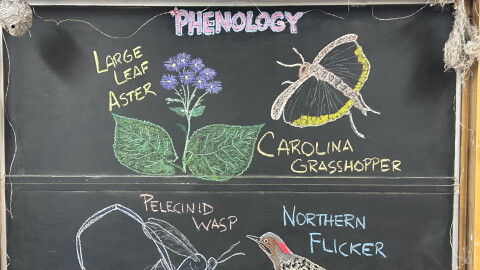 Contributed/Chad KaddatzDuring the week of Sept. 15, 2026, we enjoy reports of changing leaves and migrating birds and insects. Staff phenologist John Latimer responds.
 -
 Contributed/Grand Rapids PlayersGrand Rapids Players present the original play “Frankenfeldt” Sept. 25-27 and Oct. 2-4 at the Ives Studio Theater in the Reif Center. The director and two actors guest on “Area Voices.”
 -
 Contributed/Wild HorsesAttendees get an exclusive first listen to the latest album from Wild Horses, "The In Between," and hear a band interview by Music Director Kari Hedlund in Grand Rapids, MN.
 -
 Plus: Zebra mussels found at two lakes on the Leech Lake Band of Ojibwe Reservation; Pollution Control Agency seeks participants for fish consumption survey.
 -
 Leech Lake Band of Ojibwe staff also found starry stonewort in Six Mile Lake, near the city of Cass Lake.
 -
 Larissa Donovan/KAXEThe Bemidji Planning Board voted 6-1 to prohibit new developments of data centers greater than 10,000 square feet during its meeting Sept. 14, 2026.
 -
 Contributed/USFWS Midwest RegionDuring the Phenology Report for the week of Sept. 15, 2026, Staff Phenologist John Latimer discovers Nevada flora and fauna and notes seasonal transitions in Northern MN.


