Harvesters across the state are ready for the wild rice season to open, but the rice might not be.
The Minnesota Department of Natural Resources is reminding harvesters ahead of the Saturday, Aug. 15, season opener that rice must be ripe for legal harvest. Minnesota has the most naturally growing wild rice in the country. More than half of the state’s past or current wild rice acreage falls with Aitkin, Cass, Crow Wing, Itasca and St. Louis counties, according to a DNR assessment.
The plant serves as a health indicator for its wetland habitat and supports the survival of other species in its environment, according to the U.S. Fish and Wildlife Service.

Wild rice also holds cultural significance among many tribal nations and is known as manoomin in Ojibwe and psíη in Dakota.
Minnesota’s green rice law prohibits taking unripe rice — also known as “green” rice. This serves to protect the rice and is enforced year-round, including after the harvesting season opens.
“Even though the season opens on Aug. 15, that does not mean that the rice is ready. It does not mean it’s ripe,” said Ann Geisen, Minnesota DNR wildlife lake specialist.
The agency reports that 1,000-2,300 wild rice licenses are issued each year. Harvesters are responsible for being licensed as necessary, knowing where wild rice harvesting is restricted and checking that the rice is ripe.

Geisen said kernels can vary in ripeness even within one lake, so it’s important to continue checking the plants throughout the harvest. She suggests using three indicators that rice kernels are ready to collect.
First, the stems and leaves above the water should be brown. Wild rice is an annual plant, and this change in color occurs when the plant starts to die back and ripen.
Second, the kernels should snap open. If the kernel feels soft, bends or emits a milky substance, it’s not ready.
Finally, the kernels should fall off the plant seamlessly when the stalk is brushed or lightly tapped. Kernels that must be forced off the plant are not ready for harvest.
In fact, hitting the stalks forcefully to remove unripe rice can result in damage to the plant — and a ripple effect.

“It breaks the stalks. The kernels on the plant won't continue to get ripe. Those kernels won't feed people. They won't feed wildlife. They won't fall into the lake to grow rice plants next year,” Geisen said.
Fortunately, following the DNR’s guidelines can help keep the rice healthy, and the odds for successful ricing are looking good so far. Early reports from the DNR and tribal biologists suggest the conditions across central and Northern Minnesota range from fair to great.
However, the DNR said rice may be less accessible this year given lower water levels with recent drought conditions. Those able to get on the water but struggling to find ripe rice should “leave, wait a couple days, come back, give the kernels a chance to get ripe,” Geisen said.
The wild rice season runs until the end of September.
Stella Mayerhoff is a Report for America corps member, covering Minnesota’s headwaters region for KAXE in Grand Rapids, Minnesota. Report for America places talented journalists in local newsrooms to report on under-covered issues and regions.
-
 ContributedDr. Dania Kamp, who practices at the Gateway Family Health Clinic, is the 160th president of the professional organization representing physicians, residents and medical students.
 -
 Contributed/Adobe Stock via Minnesota News ConnectionAs demand for electricity soars, industry observers said increasing capacity on the power grid for sources like wind and solar is just one of many crucial needs.
 -
 Larissa Donovan/KAXERed Lake's charter school was one of many to commemorate Orange Shirt Day in honor and remembrance of children impacted by the residential school system.
 -
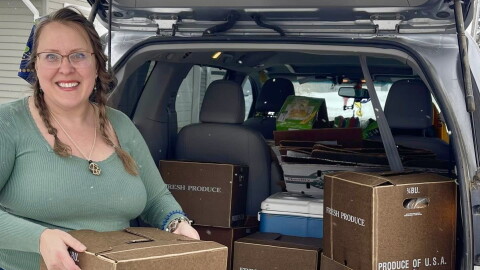 Contributed/Kristine JonasThe Minnesota Department of Agriculture announced its first Food to Farm Security Grant recipients on Sept. 28, 2026. The new grant provides funds to distribute local produce to communities for free.
 -
 Property Watch is designed to keep property owners informed and offer a head start to combat fraud.
 -
 The disease, which causes internal bleeding and sudden death, was confirmed Sept. 9, 2026. It does not affect humans.
 -
 Plus: Minnesota Department of Agriculture awards Farm to Food Security Grants
 -
 ContributedA statement of probable cause charges an officer at the Northwest Regional Correctional Center in Crookston with two counts of felony sexual assault.
 -
 Contributed/Courtesy Photo via Minnesota ReformerRepublican Ron Schutz owns more than $1.74 million of individual stocks, including in companies being sued by Minnesota.
 -
Essentia Health announces merger; Detroit Lake school board introduces 'viewpoint neutrality' policyPlus: Lost hunters rescued near Hibbing.