The Minnesota Pollution Control Agency’s Impaired Waters List draft is open for public comment through Wednesday, July 22.
Every two years, the agency lists bodies of water that fail to meet standards for fishing, drinking, wild rice protection or other uses.
Since the 2024 report, 46 lakes, rivers, streams and wetlands across the state were added to the list. Among them are Big Stony Lake near Park Rapids, Emily Lake in Crow Wing County, Birch Lake in Hackensack and Rabbit Lake in Aitkin County. The lakes are considered impaired due to mercury found in fish.
According to the 2026 Impaired Waters List draft, the most common impairments were related to biological diversity (32%), mercury (27%), bacteria (15%) and nutrients (11%). Waterbodies can be listed for multiple reasons and are only delisted when all impairments are addressed.
Although some added listings demonstrate new water concerns in an area, others are the result of expanded testing, said Leya Charles, the MPCA’s Impaired Waters List coordinator, during a public information session. With more testing comes more awareness of problems and an improved ability to address them.


The report also offers good news. Forty-five impairments were removed from the list — more than any other year. Segments of the Kabekona River northwest of Walker and Black River in Red Lake County, for example, were removed from the list. They were first categorized as impaired in 2016 for E. coli.
Charles explained that in the case of the Kabekona, thirsty cows were the culprits.
“There were some cattle that were down in the stream, and defecating in the stream and feeding that bacteria, that E. coli,” she said.
To address the E. coli in the Kabekona, the MPCA partnered with community members to create a controlled access barrier to keep cattle from entering the river. They also installed alternate water sources for the cattle.
“There isn’t a single person that’s necessarily responsible for tackling this issue,” Charles said. “It’s really on all of us to help clean up a waterbody and to do our part to keep our waterbodies clean and healthy.”
When it comes to prioritizing clean water, Minnesota was ahead of the game in 1972 with the passage of the federal Clean Water Act. The state had already formed the MPCA five years earlier. The list has been required by the Clean Water Act since 1992.
“I think it just shows how passionate Minnesotans are about protecting our vast number of waterways,” Charles said.
The MPCA uses the list to help restore waterbodies with impairments and protect others from being added to the list. The initiative is funded in part by the Clean Water Fund, established in 2008 through the Clean Water, Land and Legacy Amendment.
Lynn Anderson is a volunteer with the Tamarack Water Alliance and an Aitkin County resident. In a phone interview, she said she submitted a comment because Minnesota’s water is at risk.
“As one person said to me just this morning, ‘How can I enjoy my lake property and have my kids enjoy it if they can't come up and fish and wild rice and eat the fish and enjoy the scenery if the water isn't protected?’” Anderson said.
The drafted list and public comments will be sent to the U.S. Environmental Protection Agency for final approval.
You can view the list and submit a comment on Minnesota’s Impaired Waters List website.
Stella Mayerhoff is a Report for America corps member, covering Minnesota’s headwaters region for KAXE in Grand Rapids, Minnesota. Report for America places talented journalists in local newsrooms to report on under-covered issues and regions.
-
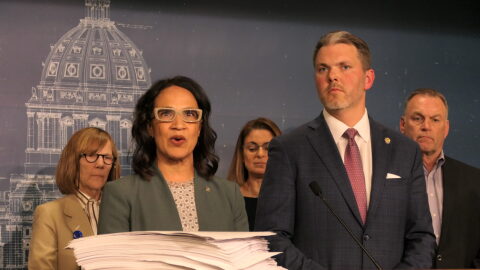 Contributed/Michelle Griffith / Minnesota ReformerThe lawsuit aims to invalidate parts of a 1,400 page mega-bill passed at the end of the 2024 legislative session, based on the Minnesota Constitution requirement that bills address a single subject, and bear a title reflecting that subject.
 -
 Plus: Longtime North Country priest designated a "Servant of God."
 -
 Contributed/Timberjay via Diocese of DuluthThe longtime North Country priest now holds the designation of “Servant of God.”
 -
 KAXE Graphic/Screenshots of candidates' social media videosThe complaint by Deputy Aaron Ammerman against Sheriff Bryan Welk alleges inappropriate sharing of nude images and video. Welk says these claims are false and politically motivated.
 -
Plus: Cass County sheriff candidates issue video statements addressing a January 2026 complaint; and Minnesota's public defenders are struggling under heavy caseloads.
-
 Lorie Shaull/KAXEFamily memories, farming education and a bucket list swim make for a fruitful day at the Minnesota Cranberry Co.’s harvest in Palisade on Oct. 8, 2026.
 -
 Larissa Donovan/KAXEAmid conflicting statements about high-profile resignations in the wake of federal allegations of the tribe's child welfare program, members are invited to a community-wide listening session.
 -
 Emma Krab/KAXELeaders from Aitkin, St. Louis and Itasca counties and the Leech Land Band of Ojibwe named permitting reform, encouraging private-public partnerships and bolstering workforces as top economic development priorities.