


Despite this week's taste of winter, Minnesota lakes will soon lose their ice cover.
Ahead of the seasonal change, crews are deploying the latest strategies to restore lake ecosystems overwhelmed by invasive plants, with hopes of making boating and other water activities easier.
Minnesota implemented a higher surcharge on boat licenses this year to help local entities pay for controlling aquatic invasive species.
Meanwhile, in Scott County, the Cedar Lake Improvement District hired PLM Lake and Land Management to drill holes through the ice and insert an herbicide that specifically targets invasive plants, such as curly-leaf pondweed.
Patrick Selter, vice president for PLM's Midwest Region, said this plant grows throughout the winter, wreaking havoc when boating season arrives.


"About mid-to-late May, early June, that plant will top out," he said. "You can't navigate through it, it's hard to fish in, it really limits your recreational use of the lake."
The nutrients that float away create a higher risk of toxic algae blooms. Selter said getting an earlier start on targeted removal gives them a stronger chance to effectively manage invasive weeds over the course of an open-water season. The progress they make allows native plants to grow.
The Department of Natural Resources has said available grant dollars for local prevention efforts more than doubled this year, to $1 million, but there's strong competition for that money, and it can't fund all applicants.
Over the past decade or so, Selter said, the response to aquatic invasive species in Minnesota lakes has shifted from weed control to restoration.
"The native plants – they are our biological control," he said. "We don't have biological controls for some of these [invasive] species, and our only biological control is our native plants.
The group Minnesota Lakes and Rivers applauds efforts like these. It says when the Legislature makes additional funding available to protect natural resources, citizens respond with wonderful innovation. The DNR adds it's trying to bring more technical expertise to lake associations as they familiarize themselves with available solutions.
-
 Contributed/Daniel DewaldCisco and other cold water fish died by the thousands in the large, shallow lake as water temperatures soared to an average of 77 degrees in late July and early August 2026.
 -
 Lorie Shaull/KAXEThe walk on July 25, 2026, spanned 13 miles from Big Sandy Lake in McGregor to Tamarack, with women taking turns carrying a bucket of water.
 -
 Contributed/Bridget Bennett / MinnPost / CatchLight Local / Report for AmericaAs wildfires burn, they release a mixture of toxic compounds like heavy metals, mercury and carcinogenic chemicals that form from burning organic matter.
 -
 Forty-six lakes, rivers, streams and wetlands were added, including Big Stony Lake near Park Rapids, Emily Lake in Crow Wing County and Birch Lake in Hackensack.
 -
 Contributed/Koochiching Soil and Water Conservation DistrictThe plan will guide the implementation of voluntary conservation projects and programs in the northeastern Minnesota watershed over the next decade.
 -
 Erin Bowman/KAXEA bipartisan appropriations bill included $10 million in federal funding toward Northland infrastructure projects, $1 million of which will fund Hib-WATER.
 -
 Chris Walker/KAXEThe Hibbing Gas Manufacturing Plant was torn down in 1980, but the industrial processes of the past left contamination in the soil, groundwater and nearby surface water.
 -
 Contributed/Wolf Ridge Environmental Learning CenterA conservation easement will protect the property spanning forests, wetlands, cliffs and streams. Half of the protected acreage is considered to be "high biodiversity."
 -
 Contributed/C-SPANAs the U.S. Senate prepares to vote on reversing a 2023 mining ban in the Superior National Forest, Minnesota Sen. Tina Smith spoke on the Senate floor April 14, 2026.
 -
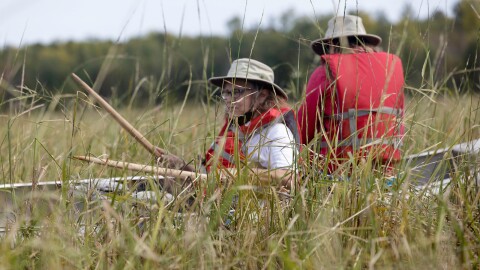 The bill seeks to integrate wild rice waters into the ag department's pesticide management plan, developing better practices to monitor pesticide distribution, use and disposal.


