


BRAINERD — Immigration and Customs Enforcement agents stationed in the Brainerd lakes area used identical license plates attached to at least two different unmarked vehicles, with long-expired or nonexistent registrations.
The vehicles, which also failed to display front plates, were observed by KAXE side by side in a Baxter parking lot on Wednesday, Feb. 11. The next day, one of those vehicles was observed parked behind Crow Wing County Community Services, next door to the sheriff’s office.
This appears to be part of a pattern of license plate use by immigration agents since they were deployed in Minnesota as part of Operation Metro Surge. All of these license plate practices violate state law, according to a Minnesota Department of Public Safety spokesperson, and there are no exceptions for law enforcement personnel.
The state operates an undercover vehicle registration program instead, historically used by the Department of Homeland Security and other law enforcement agencies. This ensures vehicles are titled and licensed while preserving anonymity for officers performing sensitive work, a December 2025 letter to DHS Secretary Kristi Noem stated. And within the scope of that program, transferring plates between vehicles is also not allowed.

When asked about the vehicles and their license plates, however, Crow Wing County Sheriff Eric Klang had a different take. He also explained they were parked in a county lot because “they’re using our facility.”
“Well, they’re acting in an official capacity of their law enforcement duties,” Klang said during a Thursday interview. “So no, that’s not the right way to do it, but because things were happening so fast, I suppose they just grabbed some plates that they got from — I don’t know, maybe they got them from us. I don’t even know.”
Presented with the specifics of this situation and Klang’s responses, DPS reiterated its take on the law.
“Based upon what I’ve read and heard in our legal conversations the last couple of weeks, I don’t think that’s a legitimate use of those plates,” the spokesperson said. “It’s my understanding that the state of Minnesota’s Department of Public Safety is the only agency that can distribute plates and they have to be specific to a [single] vehicle.”
Pressed on the issue, Klang remained unbothered. He said when he worked undercover, he’d drive around with just one headlight to blend in more, so he understood why the ICE agents would want to use plates in this way.
“They’re concerned about being doxed and being followed and being hassled and stuff, and they just want to blend in and not make a big deal here,” he said.
In a statement to the Minnesota Star Tribune, Assistant DHS Secretary Tricia McLaughlin also pointed to the safety of officers but declined to address the specifics of license plate usage. She told the Star Tribune “there’s been an increasing number of officer vehicles being rammed and followed, along with assaults.”
A culture of cooperation
On Thursday, Klang explained the agents would be leaving the Brainerd area on Friday, in conjunction with a planned drawdown of immigration agents in the state.
During the half-hour interview in the lobby of the sheriff’s office, Klang made a number of revealing statements about the depth of cooperation between his office and immigration enforcement agents, beginning with the fact the agents assigned for enforcement in the Brainerd lakes area appear to have been based directly from the sheriff’s office facility.
Federal agents, including some from the IRS, he said, have also helped his office with other cases. The ICE agents assigned to enforcement in the Brainerd lakes area were even checking in with Klang on how they should do their jobs here.

“Well, I know how these guys are working. I mean, because they’re asking me, ‘What’s off limits? What can we do? What can’t we do?’” Klang said. “So I’m — from my perspective, things have been great. We have a great relationship with the feds. And it’s not — I hear about all that stuff down in the Cities. I’m not experiencing that.”
Crow Wing County’s informal cooperation is in addition the two 287(g) agreements he unilaterally signed to assist ICE with enforcement and serving administrative warrants, and the County Board-approved contract with the U.S. Marshals Service for the use of beds in the county jail — a contract that’s being utilized by ICE, with as many as 50 immigrants detained there at a given time.
In late January, his office also assisted with a Homeland Security Investigations team operation, which resulted in four arrests of employees of El Potro Mexican Restaurant in downtown Brainerd. Two of those arrests were made without warrants. Court records for the other two arrests showed they were wanted for immigration-related offenses. Otherwise, decades-old, minor alcohol-related crimes were noted in a news release from ICE.
In an interview less than two weeks before this occurred, Klang said his office would not go out with ICE to target individuals, unless “you have a warrant for your arrest for a crime against our citizens.”
“People who are here that don’t have criminal charges against them? No, we’re not going after them and we’re not — we have no interest in that, whatsoever,” Klang said Jan. 15.


Asked Thursday to explain why his office would participate, after he made those previous statements, Klang said there was more to the El Potro story than what’s known in the public, but he couldn’t say more because of an ongoing investigation. He said if another law enforcement agency asks for his office’s assistance, he will assist them.
He sought to illustrate the point that just because someone is detained for an immigration crime, doesn’t mean they haven't committed or aren’t planning to commit other crimes — by invoking 9/11 conspirator Zacarias Moussaoui.
“You know why there’s only 19 hijackers during 9/11? Because the 20th one was sitting in Sherburne County ... on a civil detainer,” Klang said. “And was he the ‘worst of the worst?’ He was just here illegally.”
Klang expressed steadfast support for federal law enforcement when asked whether he had any concerns about choosing to work so closely with them on immigration, even after being provided numerous examples of problematic behavior in Minnesota. That included defiance of nearly 100 court orders to release detainees, which Klang said he wasn’t aware of: “I’m trying to stay away from the news, because it’s pretty toxic right now.”
[As the Minnesota Reformer recently put it: “Since the beginning of the year, immigration agents have shot three people, killing two; racially profiled people, asking them to produce proof of legal residency; detained legal immigrants and shipped them across state lines, including young children; caused numerous car crashes; deployed chemical irritants on public school property; smashed the car windows of observers and arrested them before releasing them without charges; charged journalists and activists while stymieing investigations of federal agents, leading to an exodus of prosecutors from the U.S. Attorney’s Office, among other high-profile incidents.”]
Klang said he wasn’t concerned about any legal liability or costs to be covered by local taxpayers, if Crow Wing County were named in litigation because of its agreements and cooperation with ICE.
“No, I’m not. I trust our federal partners, that they’re doing the right thing. And that’s — I mean, I don’t know what else to say,” Klang said. “I mean, I trust them, that they’re doing the right thing, and they’re not going to arrest people just randomly.”
-
 Contributed/Adobe Stock via Minnesota News ConnectionAs demand for electricity soars, industry observers said increasing capacity on the power grid for sources like wind and solar is just one of many crucial needs.
 -
 Events this week include a Celebration of Nations in Brainerd, a candlelit adventure at Lake Bemidji State Park and an open house at the Grand Rapids Fire Hall.
 -
 Contributed/Minnesota Department of Natural ResourcesThe Minnesota Forestry Association hosts the first Great Minnesota Woods Walk on Oct. 3, 2026, to explore local forests, learn about forest management and enjoy autumn.
 -
 Larissa Donovan/KAXERed Lake's charter school was one of many to commemorate Orange Shirt Day in honor and remembrance of children impacted by the residential school system.
 -
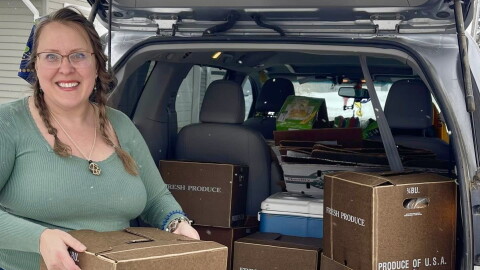 Contributed/Kristine JonasThe Minnesota Department of Agriculture announced its first Food to Farm Security Grant recipients on Sept. 28, 2026. The new grant provides funds to distribute local produce to communities for free.
 -
 Contributed/Madison McVan / Minnesota ReformerAttorneys for Good’s family called the lawsuits “historic” and framed them as an opportunity to hold the Trump administration accountable for Operation Metro Surge.
 -
 Lorie Shaull/KAXELocal leaders say it's fine to still mail in your ballot, but no matter how you vote, they stress making a plan.
 -
 Lorie Shaull/KAXEAmerican farmers say importing large international supplies sends the wrong message to ranchers, and a Minnesota dairy farmer says the ripple effects could extend to his operation.
 -
 Property Watch is designed to keep property owners informed and offer a head start to combat fraud.
 -
 The disease, which causes internal bleeding and sudden death, was confirmed Sept. 9, 2026. It does not affect humans.


