


ST. PAUL — Nathan Burr, a member of the Minnesota National Guard, went to a resort near Ely called Veterans on the Lake for the first time in 2019 to reconnect with his wife and two young children, fresh from a year-long deployment in the Middle East.
“I've done four deployments but only one with kids, and it's a completely different thing,” Burr said.
A year later, Burr heard the organization that runs the resort needed board members, and after conferring with his wife, decided to give back to the organization after a stay that had meant so much to him and his family.
“It gave us a new shared experience, if that makes sense. It gave us a memory that we could continue to build off of,” Burr said. “We had good memories and everything before, but there's a lot of trying times when one parent figure has been gone for that long, and it gave us that dedicated time to reconnect.”
Veterans on the Lake is a nonprofit resort in the Boundary Waters Canoe Area Wilderness featuring accommodations that allow veterans and their families to connect with nature, according to its website.


The resort is one of two nonprofit organizations focusing on veterans’ mental health that could receive state funding if three bills introduced in the Minnesota Senate this year become law.
Two bills written by Sen. Grant Hauschild, DFL-Hermantown — one co-authored with Sen. Robert Farnsworth, R-Hibbing — would appropriate money to support Veterans on the Lake.

One would grant $100,000 over the next two years to fund therapy, transportation and accessible activities at the resort. The second bill would provide $200,000 to repair the resort’s outdated septic system. The resort cannot occupy the facility until the system is updated, said Andy Berkenpas, general manager of Veterans on the Lake.
If the septic system grant is not approved, Berkenpas said the resort would have to redirect funds from a project currently in progress: a six-bedroom, fully wheelchair-accessible building, the last structure on the grounds that has not been fully renovated.
Another bill introduced by a bipartisan group of senators would provide $500,000 from the state over fiscal years 2026 and 2027 to fund outdoor activities and mental health training for staff at a nonprofit called Hometown Hero Outdoors.
The organization that focuses on veterans’ mental health was founded in 2019 by Christopher Tetrault, according to its website. Based in Stillwater, Hometown Hero Outdoors provides outdoor activities and trips for active military members, veterans and first responders.

Tetrault, who served in the National Guard for nine years and has been in law enforcement for 16 years, said when he founded Hometown Hero Outdoors, he immediately saw the positive effect bonding in nature had on veterans struggling with their mental health.
As the organization began to expand, Tetrault said members began to open up outside of the trips and reach out to the organization's staff when they were going through a mental health crisis.
Money from the state would be used to train staff to help people at risk of suicide.
Seventeen veterans die by suicide every day in the U.S., according to a 2023 report from the Department of Veterans Affairs' Suicide Prevention Office of Mental Health and Suicide Prevention. Nearly half of veterans who died by suicide in 2022 had not received mental health care from the VA in 2021 or 2022.
Sen. Judy Seeberger, DFL-Afton, a paramedic for 11 years whose husband is in the Navy, said mental health and wellness for veterans and first responders is often overlooked. Coming from a military and first responder family, she understands the issue firsthand.
“We're making strides within the profession to be able to raise our hand when we need some support and make ourselves vulnerable in that way, but there's still a long way to go,” Seeberger said.
Seeberger said funding organizations like Hometown Hero Outdoors is a step in the right direction to destigmatize mental health issues and make sure people are getting the support they need.
“We need to first and foremost keep talking about it and keep making it okay to raise your hand when you're not okay,” Seeberger said.
Report for Minnesota is a project of the University of Minnesota’s Hubbard School of Journalism and Mass Communication to support local news in all areas of the state.
-
 Contributed/Adobe Stock via Minnesota News ConnectionMinnesota officials and clean energy organizations feel confident state law will serve as a shield from federal rollbacks of greenhouse gas emissions in the power plant sector.
 -
 Contributed/Alyssa Chen / Minnesota ReformerHospitals are gearing up for what could be a bruising budget year at the Legislature in 2027, as efforts to counteract federal Medicaid cuts will run into the state’s own long-term fiscal challenges.
 -
 The complaint details Cass County’s decision to designate elected officials as employees for the purposes of public data classification, in response to a KAXE data request.
 -
 Contributed/Chad KaddatzDuring the week of Oct. 20, 2026, we enjoy reports of falling leaves, lingering insects and flocks of migrating birds. Staff phenologist John Latimer responds.
 -
 Contributed/Bemidji Area Arts EndowmentBemidji Area Arts Endowment presents the Art Legacy Celebration featuring an online auction and local artists' performances Saturday, Oct. 24, 2026.
 -
 Lorie Shaull/KAXEThe candidates for governor were in the Brainerd lakes area Oct. 19, 2026, for a debate hosted by the Minnesota Chamber of Commerce. It was a rare opportunity for direct contrast.
 -
 Lorie Shaull/KAXEGet to know the volunteers behind the mic on KAXE. This week we find out more from Green Cheese host and On The River volunteer, Shannon Anttila.
 -
 Lorie Shaull/KAXEEarly Voting, a method allowing voters to cast their ballot early in a traditional manner, opened Oct. 16, 2026. Minnesotans already cast over 202,000 ballots in the first four weeks of absentee voting, which began Sept. 18.
 -
 Malachy Koons/KAXEThe KAXE Music Team on new releases from Charlie Parr, Jess Williamson, The Reverend Shawn Amos, Valerie June, Joy Oladokun, Silvana Estrada & M. Ward, ALA.NI and Adrian Younge and Bob Dylan in '76.
 -
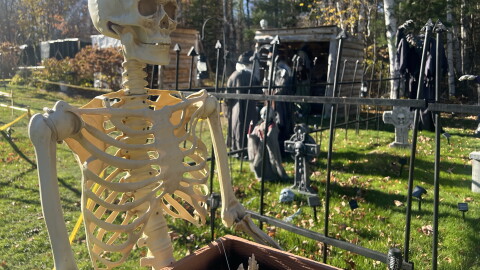 Stella Mayerhoff/KAXE / Report for AmericaJeffrey Broking keeps expanding his Halloween display just south of Grand Rapids. In 2026, he is raising money for St. Jude's Children's Hospital.


