



North Shore Community School near Duluth
“Hello from North Shore Community School on the north shore of Lake Superior. This is the Phenology Report for the week of May 16, 2026. Our names are Braelynn and Azalea, and we are your phenologists for this week!
"On Monday, May 25, the North Shore wildfire was officially contained from the great amount of rain Sunday and Monday. On Tuesday, May 19, there was a freeze and frost warning for our area. On Thursday morning, May 21, Ms. Jackson’s bird bath had frozen water in it.
"On Tuesday, May 19, the preschoolers found flowering yellow violet, wild ginger, marsh marigold and wood anemone. They found other plants too, like bluebell, bellflower, rose-twisted stalk and meadow-rue.
"On Sunday, May 17, Ms. Urban saw a Blackburnian Warbler, a Black-throated Green Warbler, and a Magnolia Warbler at Lester Park. On Monday, May 18, Ms. Urban heard a Northern Waterthrush singing by the stream. She also observed Nashville Warblers, Yellow Warblers, Harris Sparrows and White-crowned Sparrows at Park Point. On Tuesday, May 19, Avett saw Baltimore Orioles eating oranges he put out at his house. On Wednesday, May 20, Avett saw Rose-breasted Grosbeaks eating the oranges. And on Thursday, Avett saw a few Cape May Warblers eating the oranges! On the morning of Friday, May 22, Ms. Jackson spotted her first Baltimore Oriole. Also, Ms. Urban saw the pair of bluebirds had returned to school, and were flying up to and around the nesting boxes.
"On Monday evening, May 18, Ms. Jackson’s neighbor spotted a moose in the woods near their home. On May 20, Azalea spotted a group of female white tailed deer eating grass in a field.
"On Friday morning, May 22, Ms. Rolfe reported seeing tadpoles in the swale on the school playground.
This concludes the phenology report. Have a great week and be observant!"
Long Lake Conservation Center near Palisade
This report is brought to you by Elsa and the students from Hamilton Elementary in Coon Rapids.
“During our trip on May 17-18, the low temp was a chilly 34 degrees and the high was 60. Thunder, lightning and rain drenched us at night. The rain was much needed and helped put out the wildfires in the area.
“Between the rain drops, we saw lots of great stuff, including the first Canada Goose goslings of the season. On a hike we saw a Common Loon on the nest. We learned that both the male and female loons take turns sitting on the eggs. We also found a nest of turkey eggs, and saw two Trumpeter Swans. They must not be on their nest yet.
“Using the Merlin App, one of our adults identified 12 different species of birds, including Rose-breasted Grosbeaks, orioles, Blue Jays, American Robins, Ovenbirds, and Gray Catbirds. At the feeders we saw a Red-bellied Woodpecker eating an orange.
“Our group saw a muskrat and a beaver on the lake, and a deer out of our cabin window. Naturalist Beth spotted the first prairie smoke of the season.
“We had a great time exploring nature and we want to remind everyone to unplug, get outside and LIVE CONNECTED!”
This report is brought to you by Lizzie, Nakota, Mila, Savana and the students from Lincoln Elementary School For the Arts in Anoka and Morgan, Lily and the students from Central Elementary in Norwood Young America.
“The low temp was a chilly 34 degrees and the high was 67.
“The bog is springing to life and after the recent rain is extra wet and ‘boggy.’ Marsh marigolds are in full bloom, cotton grass fluffs are up, leatherleaf and bog laurel are flowering, and lady slippers are leafing out.
“In the woods, wood violets and wild strawberries are blooming and ferns are about to sprout. We saw a garter snake and a beaver on the land at night. The frogs were very loud and we thought they sounded like crickets.
“The loon is still on its nest, and we saw a muskrat in the lake and an eagle fly overhead. The loons didn’t seem happy to see the eagle.
“We saw lots of birds at the feeders and in the woods, including a Red-headed Woodpecker. It’s the third year in a row they’ve been on campus.
“We had a great time exploring nature and we want to remind everyone to unplug, get outside and LIVE CONNECTED!”
Little Falls Middle School
“This is Emily and Maegen reporting from Little Falls Middle School. This is our phenology report for the week of May 24.
“The lilac flowers are starting to bloom, and we are keeping an eye on the plants that made flowers last fall during that warm snap to see if they still produce flowers this spring.
“We have seen cormorants flying near lakes or perched on branches overlooking the water.
“This past week we have had Scarlet Tanagers showing up everywhere. We don’t remember ever seeing so many of them.
“We have had a couple of observations of bats that are up and flying around.
“A classmate found a Red Bellied Snake out sunning itself.
“There were large pillar like swarms of small insects, we are guessing a type of gnat. They looked like little tornados of bugs.
“We had a sighting of an Orchard Oriole, feeding on grape jelly along with the Baltimore Orioles.
“There were multiple Kestrel sightings on power lines overlooking fields.
“The Painted Turtles are being found away from ponds as they are looking for a place to lay their eggs. We did learn about the unique way that the sex of the new turtles is determined by the incubating temperature.
“We have been finding Jack-in-the-pulpits in the woods, and learned how to identify if they are male or female based on the number of leaves they have.
“Another brand new bird for us, a Lark Sparrow, became our 121st bird in our year-long bird count.
“Classmates tried some fiddleheads and were not impressed. We are guessing that not all species are equal when it comes to eating.
“Mr. Ballou has a family of Great Horned Owls by his house, and he has spotted 3 owlets peeking out at him from their tree, with the parent perched nearby.
“That is our report for this week, until next week, keep exploring, keep discovering, and keep connecting with the great outdoors.”
What have you seen out there? Let us know: email us at comments@kaxe.org or text us at 218-326-1234.
For more phenology, subscribe to our Season Watch Newsletter and podcast or visit the Season Watch Facebook page.
Funding for this project was provided by the Minnesota Environment and Natural Resources Trust Fund as recommended by the Legislative-Citizen Commission on Minnesota Resources (LCCMR).
-
 Contributed/Adobe Stock Image via Minnesota News ConnectionThe National Wildlife Federation recognizes October as "Leave the Leaves Month," when homeowners are encouraged to move some of the leaves they have cleared into garden beds.
 -
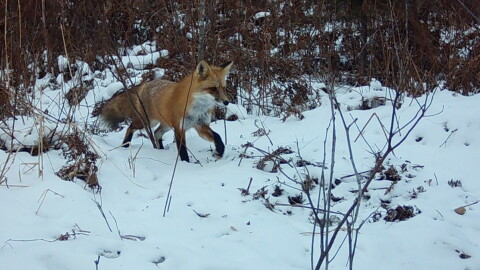 Grace Malinowski, program coordinator, discusses the Offal Wildlife Watching Project. The Community Science series is produced by Mark Jacobs.
 -
 The disease, which causes internal bleeding and sudden death, was confirmed Sept. 9, 2026. It does not affect humans.
 -
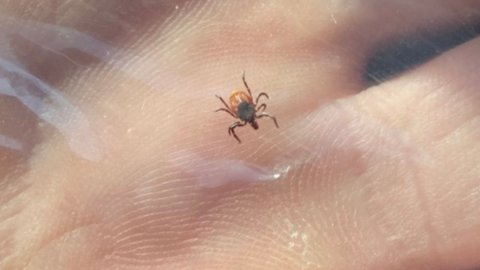 ContributedDozens of ticks as part of a study with the Marshfield Clinic Research Institute were submitted from the Bemidji area.
 -
 Christopher Smith, conservation committee chair for the Minnesota Herpetological Society, discusses how salamanders use dead and dying trees. The series is produced by Mark Jacobs.
 -
 Lorie Shaull/KAXEThe Minnesota Pollution Control Agency is surveying people's fish-eating habits to help limit contaminants in water bodies and make fish safer to eat.


