


The U.S. Senate is expected to dig deeper into the next farm bill later this summer, following House approval in April.
Minnesota dairy farmer James Kanne hopes politics stay out of the final push and that fairness for noncorporate operations becomes a priority.
Kanne, who farms in Renville County, recently traveled to Washington, D.C., to push for provisions in the sprawling agricultural policy package. He said the process in recent years has become so fraught with partisan approaches that smaller, independent operations like his are left fighting for scraps.
“We're just playing Whack-A-Mole,” Kanne said. “We're just trying to bat down the biggest of the problems, and to support maybe one or two things that we can add to the farm bill that would be a positive.”
In the Senate version, Kanne said he would like to see language that compels federal agencies to enforce existing antitrust rules covering agriculture. He and like-minded farmers also want mandatory country-of-origin labeling for beef.
In defending their version, House Republicans say it bolsters risk management for food producers, supports rural communities and addresses foreign investment in U.S. farmland.
In last year's “One Big Beautiful Bill Act,” congressional Republicans addressed other elements of the farm bill, including controversial changes to the Supplemental Nutrition Assistance Program. Moves were also made related to conservation funding.
Kanne said work is still needed to get healthy land-management support in the right hands.
“There is simply not enough funding for the amount of demand,” Kanne said. “You need to have caps on what people can get under some of those programs, because that is part of what's funding the concentration in agriculture.”
Kanne said it might be a lofty goal, but he also wants Congress to get to the bottom of the health-insurance affordability crisis in farming communities.
The chair of the Senate Agriculture Committee said that activity on the farm bill could gain steam after the July Fourth holiday.
-
 Plus: Beltrami County officials tour the under-construction jail facility slated to open in May 2027.
 -
 Contributed/M StateThe closure announcement comes as the Minnesota State system announces plans to "right size" its operations over 50 campuses amid financial challenges.
 -
 Larissa Donovan/KAXEA public open house will be announced before the new Beltrami County Adult Corrections Center opens in May 2027.
 -
Complaint accuses Cass sheriff of sharing nude images; Nevis man sentenced for social services fraudFind more stories from KAXE News at kaxe.org/local-news.
-
 Screenshot/Minnesota Department of Natural ResourcesThe agency announced its decision to require supplemental environmental review Oct. 8, 2026, for the copper-nickel project planned between Babbitt and Hoyt Lakes.
 -
 Contributed/Sora Shimazaki via PexelsVincent Bellomo, 76, was sentenced in September 2026. He originally faced six felonies after investigators found he had large sums in his savings accounts while he was applying for benefits.
 -
 Megan Buffington/KAXEDeputy Aaron Ammerman, who is running for Cass County sheriff, filed the complaint against Sheriff Bryan Welk in January. An investigation was closed with no apparent action.
 -
 Contributed/Trina Swanson for CongressWhile Democrats running for the U.S. House have an advantage this year, Stauber has positioned himself well in the Iron Range district.
 -
Plus: MPCA’s draft Minntac permit at issue at information session.
-
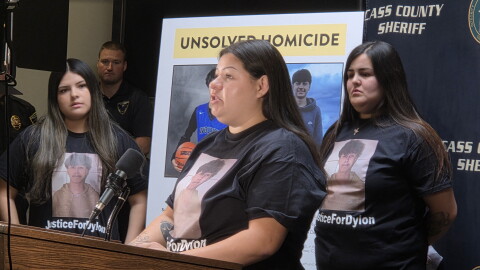 Larissa Donovan/KAXEThe family of Dylon Oothoudt, the Leech Lake Band of Ojibwe and the Cass County Sheriff's Office hosted a press conference Oct. 7, 2026, as the homicide investigation continues.


