


ST. PAUL — A Republican state representative and several farm and clean energy groups have posed a question to lawmakers: Why should Minnesota import most of its fertilizer if it can be manufactured inside the state?
Rep. Paul Anderson, R-Starbuck, the co-chair of the House Agriculture Finance and Policy Committee, brought the question to the committee on Wednesday, April 8, for an informational hearing.
Ammonia is the key to nitrogen fertilizer, and almost all ammonia in Minnesota, nearly 1 million tons per year, is imported from Gulf Coast states and internationally, according to the Minnesota Made Ammonia Coalition.


With the current war in Iran, ammonia costs farmers $1,000 per ton, up from $750 per ton in February, said Tristan Wilmes, vice president of agronomy at Central Farm Service, a farm cooperative based in southern Minnesota.
Nitrogen fertilizer is made by separating hydrogen from water and pulling nitrogen from the air. The hydrogen and nitrogen are combined to make ammonia, and the process can be powered by wind, according to the University of Minnesota.
Wilmes said most, if not all, of the ammonia needed by farmers here could be generated in Minnesota.
“Minnesota farmers should not be dependent on global markets for one of our most essential imports,” he said. “This project is about affordability, it’s about certainty and it’s about taking control of our supply chain.”
TalusAg, an agriculture technology and infrastructure company, created the first commercial, modular green ammonia systems to produce ammonia using renewable power at or near the site it is needed, according to TalusAg’s website. The technology has been deployed in demonstration systems in the U.S., Spain and Kenya, and the first commercial-scale system is under construction in Eagle Grove, Iowa, said Tristan Peitz, the company’s head of business development.


Peitz said the technology is made to last a minimum of 10 years and could last decades.
TalusAg has proposed a project to build two facilities to create anhydrous ammonia in Blue Earth, Minnesota. The facility would produce approximately 10,000 tons to 14,000 tons of ammonia per year at a lower cost than importing the ammonia, filling 5% of the state’s needs, Peitz said.
The project would use money from the Minnesota Renewable Development Account, which is paid for by Xcel Energy ratepayers.
Proposed legislation asks for $8 million from the account in 2027.
Rob Davis, the chief growth officer at CleanCounts, a firm that tracks renewable energy investment, said local production of ammonia would help stabilize wind energy production in Minnesota.
“This helps ensure productive use of assets that have already been built and help stabilize tax revenue for rural counties,” Davis said.
Rep. David Gottfried, DFL-Shoreview, questioned whether appropriating grants to a for-profit company like TalusAg, and nonprofits such as CleanCounts and the Great Plains Institute, is the right strategy.
“What I do have heartburn over is granting specifically to named non-profits and what I believe is a for-profit entity in TalusAg, without any sort of request for proposal,” Gottfried said. “To me that doesn’t feel like good business.”
Peitz said deployment of the project would begin in 2027 and have ammonia ready for use in 2028 if funding is approved.
Report for Minnesota is a project of the University of Minnesota’s Hubbard School of Journalism and Mass Communication to support local news across the state.
-
 Cranberry harvest in Northern Minnesota.
 -
Minnesotans across the state will have a constitutional amendment on their ballots asking to increase the yearly allotment from the Permanent School Fund. For some, the measure is 20 years in the making.
-
Plus: Beltrami County officials tour the under-construction jail facility slated to open in May 2027.
-
 Contributed/Tom PageAn open community jam in September 2026 was centered around the history and legacy of four families in Grand Rapids with deep musical ties to the area.
 -
 Contributed/M StateThe closure announcement comes as the Minnesota State system announces plans to "right size" its operations over 50 campuses amid financial challenges.
 -
 Larissa Donovan/KAXEA public open house will be announced before the new Beltrami County Adult Corrections Center opens in May 2027.
 -
 Lorie Shaull/KAXETune in to the KAXE Morning Show on Monday, Oct. 12, 2026, for conversations with Indigenous people and find area celebrations of Indigenous Peoples Day.
 -
 Co-hosts Charlie Mitchell and Julia Schrenkler opine about the weird and endearing American Woodcock, a love of strange science, and much more.Send us a voice memo through SpeakPipe!
 -
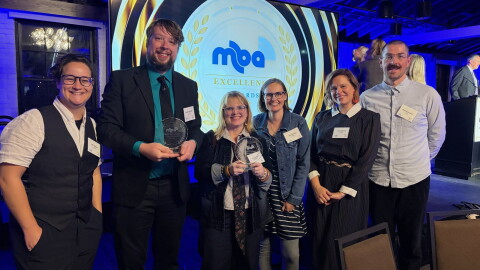 ContributedThe Minnesota Broadcasters Association's Excellence Awards spotlight work that demonstrates the power of local radio and television, moving Minnesota communities forward.
 -
Complaint accuses Cass sheriff of sharing nude images; Nevis man sentenced for social services fraudFind more stories from KAXE News at kaxe.org/local-news.


