


More than 3,700 immigrants were arrested by Immigration and Customs Enforcement in Minnesota during Operation Metro Surge, according to newly-released agency data obtained by the Deportation Data Project.
The data, obtained via a Freedom of Information Act request, provides the clearest picture yet of the operation. The data doesn’t contain the names of detainees, but provided their age, nationality, date and location of arrest.
The operation’s intensity peaked in early January, when the 3,000 agents here were arresting more than 100 people per day. By Jan. 23, arrests dropped to fewer than 100 per day, and continued to decline as former Border Patrol Commander Greg Bovino left and border czar Tom Homan took over as head of the operation.
Even during the most intense immigration enforcement in Minnesota, however, immigration authorities were arresting nearly triple the number of immigrants in Texas. The discrepancy underscores what critics of Operation Metro Surge said all along: That Minnesota, home to just 130,000 undocumented immigrants, was a curious place for such intense immigration enforcement — 1.7 million undocumented immigrants live in Texas.
There were fewer than 10 arrests per day between Feb. 17 and March 11, the last date in the database.
There are some limitations to the data, however. Around 15% of the arrests in the Deportation Data Project’s database are missing the state in which the arrest was made — some of those may have occurred in Minnesota.
The data also doesn’t include arrests of U.S. citizens, two of whom were killed and many of whom were arrested while protesting or observing ICE. A 2021 audit by the U.S. Government Accountability Office found that ICE doesn’t systematically track citizen arrests, and that the agency didn’t know “the extent to which its officers were taking enforcement actions against individuals who could be U.S. citizens.”
According to the report, ICE collects and maintains data on citizen arrests as of February 2025.
While the Trump administration initially said Operation Metro Surge would target Somali Minnesotans — who the president has called “garbage” — Somali people accounted for less than 3% of arrests. The vast majority of detainees were from Ecuador, Mexico and other Latin American countries.
The Trump administration’s stated purpose for Operation Metro Surge shifted in January to focus more on “criminal illegal aliens” of all backgrounds. The ICE data show, however, that less than one-quarter of those arrested during the operation had been convicted of a “crime” — the agency’s definition of a crime includes misdemeanors, such as unauthorized entry into the country or traffic violations. Thirteen percent of people arrested had pending criminal charges.
Several hundred ICE agents remain in Minnesota. There were around 150 in the state prior to the surge.
Minnesota Reformer is part of States Newsroom, a nonprofit news network supported by grants and a coalition of donors as a 501c(3) public charity. Minnesota Reformer maintains editorial independence. Contact Editor J. Patrick Coolican for questions: info@minnesotareformer.com.
-
 ContributedDr. Dania Kamp, who practices at the Gateway Family Health Clinic, is the 160th president of the professional organization representing physicians, residents and medical students.
 -
 Contributed/Adobe Stock via Minnesota News ConnectionAs demand for electricity soars, industry observers said increasing capacity on the power grid for sources like wind and solar is just one of many crucial needs.
 -
 Larissa Donovan/KAXERed Lake's charter school was one of many to commemorate Orange Shirt Day in honor and remembrance of children impacted by the residential school system.
 -
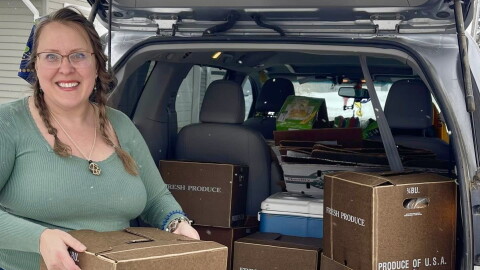 Contributed/Kristine JonasThe Minnesota Department of Agriculture announced its first Food to Farm Security Grant recipients on Sept. 28, 2026. The new grant provides funds to distribute local produce to communities for free.
 -
 Property Watch is designed to keep property owners informed and offer a head start to combat fraud.
 -
 The disease, which causes internal bleeding and sudden death, was confirmed Sept. 9, 2026. It does not affect humans.
 -
 Plus: Minnesota Department of Agriculture awards Farm to Food Security Grants
 -
 ContributedA statement of probable cause charges an officer at the Northwest Regional Correctional Center in Crookston with two counts of felony sexual assault.
 -
 Contributed/Courtesy Photo via Minnesota ReformerRepublican Ron Schutz owns more than $1.74 million of individual stocks, including in companies being sued by Minnesota.
 -
Essentia Health announces merger; Detroit Lake school board introduces 'viewpoint neutrality' policyPlus: Lost hunters rescued near Hibbing.


