


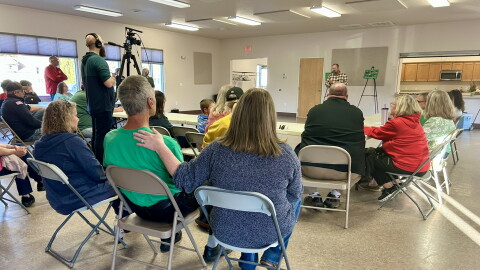
EMILY — The gymnasium in Emily City Hall was full Tuesday night, July 21.
City staff pulled in extra chairs as the room steadily filled, the small-town small talk rising in volume. But attendees listened with rapt attention to a little over an hour of updates on a proposed manganese mine planned for 2 miles from downtown, many diligently taking notes.
The rest of the three-hour meeting was spent with community members asking tough questions of North Star Manganese, the company behind the proposal, and other experts in mining, permitting and geology.

Fauntel Deshayes started her turn like many others, introducing herself, recounting her family's long history in Emily and explaining which of the city's lakes she lives on.
Then, she got straight to the point.
"I think a lot of us just feel really powerless when it comes to this project," she said. "So, my first question is: Would we be able to stop this from moving forward as a community? And if we could, how?"
Those in the room laughed and clapped, alongside a chorus of "good question!"
As presenters emphasized Tuesday, right now, there is no project. Nothing has been formally proposed to the Minnesota Department of Natural Resources, a yearslong process once begun.

Late last year, North Star Manganese said an Emily mine and outstate chemical processing plant would be financially viable.
CEO Rick Sandri said that just means the company can start spending more money on the long process of studying the list of potential impacts on water, air quality and the community.
Some of the first exploratory drilling in Emily occurred decades ago, in the late 1940s and early 1950s. Various drilling efforts by different mining companies — including in 2023 by North Star — gave insight into what’s locked deep below the earth: billions of pounds of rich manganese ore.
An accelerated push toward clean energy alternatives and a growing market for electric vehicles and other battery-powered technologies reignited interest in the site’s potential. Manganese is one of the metals used in battery production, combined with nickel and cobalt to increase energy storage capacity.
While the element is one of the most plentiful on the planet, a small sliver appears to be pure enough for battery use. And signs so far point to Emily’s deposit containing that high-quality ore.
But on Tuesday, North Star didn't have many updates to share, which frustrated much of the audience. Since completing its economic assessment, the company has done a review of past water studies, completed a mineral study and conducted an ore sorting test.
Potential Emily mine next steps for 2026-27, according to North Star Manganese
- Begin Baseline Environmental Study
- Design and implement a new drill program for hydrologic studies
- Undertake step-out drilling in the western part of the property
- Conduct geologic, mining, metallurgy, transport, labor, environmental, social and economic studies to begin the Scoping EAW, the step before a full Environmental Impact Statement
It's looking for someone to do the Baseline Environmental Study, which covers that long list of impacts, but hasn't started it yet.
Sandri said Emily Mayor Tracy Jones asked them to come to the meeting.
"And sometimes you show up when the principal asks you, and sometimes you go into the principal's office because you want to talk to the principal," Sandri said. "And this time we got asked by the principal to come to their office."
Jones said he wanted to have the meeting so the community could learn more and ask questions after a "contentious" City Council meeting in November.
He thinks the mine could be a good thing for the city, but he also knows people are concerned about water quality.
"I think it's a long ways off. I think there's a lot of confusion," he said. "I don't know. I sit on the fence."
Lack of answers fuels skepticism
"We don't know yet," was a common answer to community members' questions.
Brian Savage, president of North Star Manganese's parent company Electric Metals, and Ruth Lake property owner Mike Nordvall went back and forth after Nordvall tried to ask about impacts to property values and roads.
"All of these things that you're talking about are going to be studied in a whole lot more detail as we move through a feasibility study and pre-feasibility study," Savage said. " ... We can't tell you what the noise potential is until we select a piece of equipment that we'll be using. We have to go through that whole process."
Julie Lucas, executive director of the trade group MiningMinnesota, jumped in, trying to explain that right now, the question is, 'Is the rock there?' And the company isn't thinking of specifics. In the past, a mining company wouldn't have even had a meeting at this phase in the project, she said.
"They aren't trying to be shady," she said. "They just aren't at that phase in the project where they've actually figured this stuff out."

Past attempts by other businesses to mine Emily's manganese deposit have left a sour taste in the community’s mouth.
And while Emily is geologically on the Cuyuna Range, it doesn't have a history of mining like nearby Crosby. But it's close enough to have seen the way the end of mining in the 1980s devastated the town, which has only really begun to recover in the last decade.


"What are we going to get out of it if they come in and take over our community?" Emily resident Kelly Robinson said. "And when they're done, what kind of community are we going to have left? Is anyone wanting to be here? It is going to be a ghost town?"
Robinson and her husband Michael ducked out toward the end of the meeting. Only about 40 of the 130 attendees stayed for the full three hours.
The Robinsons live within a half-mile of the proposed mining site, and Kelly said they're also worried about their water and property values and how a mine would impact housing and jobs.
In an interview after the meeting, CEO Sandri said the community's skepticism is warranted. The only places he's gone that people have been excited about a new mine are dying mining communities.
But he believes there's a balance. Manganese is a critical mineral, and right now almost all of it is imported to the U.S. Sandri said if you've got to have it, you'd better do it right.
"It takes a real challenge to do it right. It takes a lot of money," he said. "It takes a lot of time, and it takes a lot of meetings like this where people don't necessarily like you to be there."
-
 Emma Krab/KAXEThe Blandin Foundation announced a $250,000 grant for the Greenway Community Fund on Oct. 21, 2026. The Greenway area covers 10 small cities and townships on the western side of Minnesota's Iron Range.
 -
 Contributed/Adobe Stock Image via Minnesota News ConnectionThe National Wildlife Federation recognizes October as "Leave the Leaves Month," when homeowners are encouraged to move some of the leaves they have cleared into garden beds.
 -
 Larissa Donovan/KAXEMuch of DOGE’s funding cuts to tribal communities came to programs focused on environmental efforts, agriculture and economic development, the Brookings study found.
 -
 Events this week include a book sale in Brainerd, an Indigenous storytelling event in Grand Rapids and an author talk in Virginia.


