


BEMIDJI — A judge denied a motion to dismiss charges filed last year against a correctional nursing director following the 2018 death of a man in Beltrami County Jail custody.
In a denial order filed Thursday, March 12, Beltrami County Judge Jeanine Brand said the state attorney general’s office showed sufficient probable cause to allow the case against Michelle R. Skroch, 38, to move forward.
Hardel Sherrell died September 2, 2018, two days after serious symptoms — high blood pressure, numbness from the waist down, trouble swallowing and weakness — resulted in him being transported to the hospital.
The doctor who discharged the 27-year-old wrote care instructions listing several symptoms that should have prompted Sherrell to seek additional immediate care.
Instead, according to the criminal complaint, Sherrell received very little care, despite him exhibiting nearly all the symptoms listed, and his health rapidly deteriorated.


Skroch was the nurse in charge at the Beltrami County Jail when Sherrell died. She was also the director of nursing for MEnD Correctional Care, responsible for reviewing and approving the company’s care policies and overseeing all its nurses across multiple jails.
She faces three felonies: second-degree manslaughter due to culpable negligence; criminal neglect through knowingly depriving a vulnerable adult; and criminal neglect over an extended period of time.
Brand based her denial on more than 3,000 pages of documents and two hours of video footage submitted as evidence by the prosecution. The judge opined that despite knowing Sherrell was just in the hospital, Skroch never took his vitals, ignored him for hours at a time and yelled at him that he was “faking it.”
During one of her interactions with Sherrell, according to court documents, Skroch tried to pour apple juice in his mouth when she observed he appeared dehydrated. He was unable to swallow the juice, and Skroch allegedly took no other steps to assess his dehydration or to document his trouble with swallowing, which appeared on the list of discharge symptoms requiring immediate follow-up care.
“[Sherrell] exhibited and Defendant observed at least five of the listed discharge symptoms that should have resulted in emergent care: drooping face, incontinence, difficulty swallowing, difficulty standing, and worsening weakness,” Brand wrote.
“ ... The policies and other nurse duties placed several obligations upon Defendant to assess, to care for, and ultimately, to refer [Sherrell] for emergent care. By failing to follow the policies and duties, and failing to treat [Sherrell], there is sufficient evidence to show her culpable negligence caused his death.”


Sherrell’s cause of death was pneumonia and cerebral edema (brain swelling), according to the Ramsey County Medical Examiner’s Office. These were likely complications of the autoimmune disease Guillain-Barre Syndrome, according to an analysis by Dr. Todd Wilcox, an expert witness on correctional health care.
Dr. Todd Leonard — who founded MEnD and served as its president and chief medical officer — described Sherrell’s symptoms as classic of the syndrome to a different nurse in the jail the day Sherrell was ultimately transported to the hospital.
In seeking the dismissal, Skroch’s defense team argued her conduct did not deviate from the lawfully permissible standard. They also argued the state failed to prove she intentionally neglected Sherrell while knowing medical care was necessary. Instead, Skroch’s medical assessment at the time was that he was “okay and perfectly fine.”
“This may have been objectively unreasonable, it may have been factually wrong, it may have resulted from a negligent process — but the state presents no evidence that this wasn’t her honest but mistaken state of mind,” the defense’s memo stated.
“This case has been litigated through civil lawsuits, administrative licensure hearings, county investigations, state investigations, federal investigations with myriad depositions. Nothing has indicated Ms. Skroch believed Mr. Sharrell [sic] needed to go to the hospital.
“The State wants to frame this as a lack of compassion or a misanthropy towards inmates, but even if it were to establish this it does nothing to allege culpable negligence or intentionally neglecting [Sherrell] while knowing the health care was necessary.”
A plea hearing in the case is set for 10 a.m. on Monday.
-
 Megan Buffington/KAXEDeputy Aaron Ammerman, who is running for Cass County sheriff, filed the complaint against Sheriff Bryan Welk in January. An investigation was closed with no apparent action.
 -
 Contributed/Trina Swanson for CongressWhile Democrats running for the U.S. House have an advantage this year, Stauber has positioned himself well in the Iron Range district.
 -
 Plus: MPCA’s draft Minntac permit at issue at information session.
 -
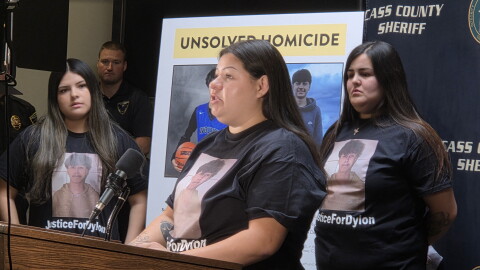 Larissa Donovan/KAXEThe family of Dylon Oothoudt, the Leech Lake Band of Ojibwe and the Cass County Sheriff's Office hosted a press conference Oct. 7, 2026, as the homicide investigation continues.
 -
 Matt C/UnsplashThe rechargeable batteries are used in nearly every home and are generally safe but can be dangerous.
 -
 Maria Hileman/KAXEThe Grand Rapids Police Department is investigating a prank call about a fabricated shooting at Old Central School on Oct. 6, 2026.
 -
 Canva ProThe highway had been closed since May for construction.
 -
 Contributed/Anna Paige for MinnPostState Sen. (and meteorologist) Rob Kupec and GOP challenger Austin Peterson are squaring off in the race to represent the Moorhead area in St. Paul.
 -
Plus: Highway 71 has reopened between Turtle River and Tenstrike; and lithium-ion battery safety highlighted during Fire Prevention Week.
-
 ContributedRepublican-aligned groups are spending heavily on Andrea Zupancich's campaign for the state Senate District 3 seat.


