


The Trump administration recently said it’s permanently denying over $112 million of Medicaid money to Minnesota, part of the $259 million it had threatened to claw back in February.
The denied payments are for services provided from July 2025 to September 2025 and have largely been paid out. Minnesota will now be on the hook for paying that money back, unless the denials are somehow reversed.
The federal government has repeatedly threatened to freeze or claw back payments, but this sum is the first time the administration has permanently denied payments. It’s the latest episode in a yearlong fight between the Trump administration and Minnesota over Medicaid funding.
Here are a few things to know, plus a timeline to get caught up.
The funding fight centers around 14 Medicaid services deemed high-risk to fraud, waste and abuse
Medicaid is a sprawling public insurance program. It’s known for providing medical insurance for low-income people, but it also pays for nursing homes and long-term care services for seniors and disabled people. It’s jointly funded by federal and state money, but administered by the state.


The ongoing funding fight centers around 14 Medicaid services that were deemed in October 2025 by the Walz administration to be high risk for fraud, waste and abuse. Those services largely provide critical long-term care to disabled and elderly people.
Federal investigations have found that in the high-risk Medicaid services, some providers billed for services they didn’t provide. For example, an autism service provider is alleged to have paid kickbacks to families for enrolling their children while delivering a fraction of the services billed. One of the services, Housing Stabilization Services, was considered so riddled with fraud that the Walz administration shut it down in 2025.
Since then, the state has created a slew of program integrity measures, such as a prepayment claims review process and a re-screening of all providers in those 14 services.
Though federal funding actions have focused on those specific services, state officials have said that the freezes could deliver a serious blow to the state’s budget, health facilities and Medicaid enrollees in general. Medical Assistance, which is what Minnesota calls its Medicaid program, cost $20 billion in 2025, and is projected to outpace the state’s growth in tax revenue.
The funding actions are separate from Medicaid provisions in the 2025 One Big Beautiful Bill Act, which will result in less federal funding for the state. The OBBBA may also result in some possible savings, since some Minnesotans will lose their Medicaid coverage due to new, administratively burdensome work requirements.
The federal government extrapolated from a small group of claims when deciding how much to deny
The federal Centers for Medicare and Medicaid Services, known as CMS, looked at just 330 invoices from over 6 million Medicaid claims submitted by providers. CMS found that 78 of the 330 claims were deficient, according to an official notice from the federal agency.


CMS then extrapolated from the 78 deficient claims — which totaled about $112,000, according to Minnesota Department of Human Services Temporary Commissioner John Connolly — to conclude that over $112 million in claims was deficient.
The deficiencies include missing provider signatures in agreements and missing notes in treatment plans.
It’s unclear how the agency chose the 330-claim sample, which it described as “statistically valid” despite scant explanation. It’s also unclear how the agency extrapolated to $112 million in deficient claims.
Connolly, in a Tuesday email to his agency, said that the state human services department has “more questions than answers right now,” and called the denials “deeply concerning.”
“We remain concerned about the transparency and fairness of the process CMS is using to deny reimbursements for claims the state has already paid,” Connolly wrote.
In the notice, CMS also said it was releasing the remaining $131 million it deferred in February.
A timeline
The publicly available view of the fight is largely through official letters sent between CMS and the state’s Department of Human Services, and videos posted to CMS Administrator Mehmet Oz’s X account. Starting in January, the two agencies have also had regular virtual meetings.
December 2025: CMS ordered Minnesota to propose and implement a “corrective action plan,” i.e., an anti-fraud plan. Minnesota sent its first plan later that month.


January 2026: On Jan. 6, the Trump administrationrejected Minnesota’s first corrective action plan.
In the Jan. 6 rejection, the administration said that it intended to withhold $2 billion of annual funding toward the high-risk Medicaid programs. Connolly said that was an overestimation of what the programs cost, which is $1.2 billion per year.
In the rejection, Oz wrote: “The withholding will end when the Minnesota Medicaid agency fully and satisfactorily implements a comprehensive (corrective action plan)” for the high-risk Medicaid services.
The state submitted a revised plan on Jan. 30.
February 2026: CMS announced that, in addition to the $2 billion withholding, it would defer $259 million from Minnesota. In the deferral process, the federal government can withhold funding when questioning the justification of specific claims already billed to Medicaid. The questioned claims were from July 2025 to September 2025.
The process has previously been used for individual claims and not entire service areas, the state noted in a press release.
Of the $259 million, $242 million comes from the 14 Medicaid services deemed a high risk for fraud and found questionable by the feds. Most of the rest come from services given to people who, according to CMS, lack “satisfactory immigration status.”
March 2026: Minnesota state officials sued the Trump administration over the $242 million, arguing that deferring the money before a hearing for the $2 billion freeze effectively denies Minnesota due process. That lawsuit is ongoing.
The federal government approved Minnesota’s corrective action plan later that month.
The federal approval of Minnesota’s plan appeared to be good news for Minnesota’s Medicaid funding. Oz had said that the government would let go of its funding threats after Minnesota proposes and implements a corrective action plan.
April 2026: CMS deferred $91 million more, stemming from services from October to December.
July 2026: CMS deferred $199 million more, for services from January to March of 2026.
October 2026: Connolly sent a letter to CMS on Oct. 2, asking for more clarification of how CMS identified high-risk providers, among a slew of other questions that were unanswered as of Oct. 30.
November 2026: The Trump administration permanently denied $112 million of the February deferral.
Eric C. Tostrud, chief judge for the District of Minnesota, has given CMS and the state human services department until Jan. 4 to try to resolve the lawsuit.
Minnesota Reformer is part of States Newsroom, a nonprofit news network supported by grants and a coalition of donors as a 501c(3) public charity. Minnesota Reformer maintains editorial independence. Contact Editor J. Patrick Coolican for questions: info@minnesotareformer.com.
-
 Contributed/Chad KaddatzStaff phenologist John Latimer responds to nature reports from around the state. On Nov. 10, 2026, we hear of heavy rainfall, first frosts, and cold-hardy insects.
-
 During the Phenology Report for the week of Nov. 10, 2026, Staff Phenologist John Latimer remarks on introduced trees, migratory birds, and the beef between red and gray squirrels.
-
 KAXE/Heather JohnsonKAXE is always mixing up the recipe for a good day through our music, programming and hosts. Your support is the key ingredient! Our Fall Membership Drive runs Nov. 12-19, 2026.
-
 Contributed/Dawn RossbachPark Rapids artist Dawn Rossbach's latest work "The Blind Mind" will be on display at the Watermark Art Center in Bemidji from Nov. 13, 2026-Jan. 30, 2027.
-
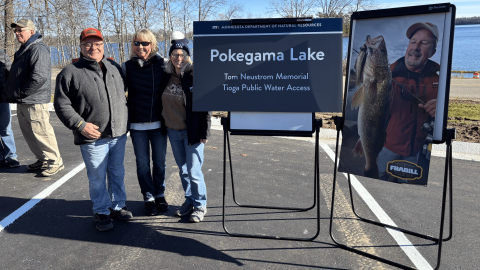 Contributed/Minnesota Department of Natural ResourcesThe Pokegama Lake access is now the Tom Neustrom Memorial Tioga Public Water Access.
-
 Contributed/Hape Monaheng via PexelsThe MPCA says Crosslake Construction Demolition Debris Facility, Inc. had multiple violations during facility inspections between 2020 and 2022.
-
 Contributed/Park Rapids Panthers Cross CountryPark Rapids senior Christian Thorson and junior Jack Mitteness also medaled from the Northland.
-
 Contributed/Polina Tankilevitch via PexelsIn Minnesota, 139 cases of measles have been reported in 2026 as of Nov. 5. Most cases are concentrated in Todd County.
-
 Contributed/Aitkin FootballMountain Iron-Buhl returns to state after missing last year while adjusting to a new class. Also returning for the 2026 tournament from the Northland are Grand Rapids, Cromwell-Wright, Kittson County Central and Cook County.
-
 Contributed/Full Range MediaEast Grand Forks and Sacred Heart will compete in the tournament, set for Nov. 11-14, 2026, along with Chisholm and Pine River-Backus.


