


Friday is “ICE Out of Minnesota: Day of Truth & Freedom,” a general strike supported by Minnesota’s unions, progressive faith leaders, Democratic lawmakers and community activists.
The “ICE Out” day proponents are encouraging all Minnesotans to stay home from work, school and refrain from shopping — suspensions of normal orders of business to protest the presence of federal immigration agents in Minnesota.
A general strike is a work stoppage across multiple industries. The overall goal is to pause economic activity to compel change. General strikes are uncommon in modern America but were once a staple of protest politics and are still frequently employed in Europe.


Citing the killing of Renee Good by federal agent Jonathan Ross, the “ICE Out” day organizers say the general strike is intended to be a day of nonviolent reflection.
“It is time to suspend the normal order of business to demand immediate cessation of ICE actions in Minnesota, accountability for federal agents who have caused loss of life and abuse to Minnesota residents and call for Congress to immediately intervene,” the website states.
Demonstrators will march and rally in downtown Minneapolis Friday starting at 2 p.m.
Over 100 businesses, restaurants and co-ops in the Twin Cities have announced plans to close Friday, according to Bring Me The News, which is keeping a running list.
Minneapolis was home to a landmark general strike nearly 100 years ago that was organized by truck drivers with the Teamsters Local 574. Minneapolis then was a non-union town thanks to a business advocacy group called the Citizens Alliance.
Many companies had refused to recognize Teamsters Local 574, despite the union’s 5,000 members. On May 16, 1934, workers began a strike, demanding recognition of the union, wage increases and fewer hours. The union organized warehouses, coal yards and drivers.
The strike caused Minneapolis’ industrial area — now the North Loop neighborhood — to shut down. Trucks couldn’t go in or out, and tensions grew.
On July 20, 1934, police shot 67 picketing workers — most of them were shot in the back — and two were killed. One hundred thousand people attended the funeral procession for one of the strikers. The governor dispatched the National Guard, and the Citizens Alliance eventually agreed to the union’s demands, making the general strike a success.
Today, general strikes are rare in the U.S. largely because they are difficult to coordinate. But lawmakers and the courts for decades have also restricted the power of unions.
The two largest general strikes in U.S. history are the Seattle General Strike of 1919, where the city of 315,000 people stopped working, and the Oakland General Strike of 1946, where nearly 130,000 workers refused to work and shut down commerce throughout the area.
Minnesota Reformer is part of States Newsroom, a nonprofit news network supported by grants and a coalition of donors as a 501c(3) public charity. Minnesota Reformer maintains editorial independence. Contact Editor J. Patrick Coolican for questions: info@minnesotareformer.com.
-
 Screenshot/Minnesota Department of Natural ResourcesThe agency announced its decision to require supplemental environmental review Oct. 8, 2026, for the copper-nickel project planned between Babbitt and Hoyt Lakes.
 -
 Contributed/Sora Shimazaki via PexelsVincent Bellomo, 76, was sentenced in September 2026. He originally faced six felonies after investigators found he had large sums in his savings accounts while he was applying for benefits.
 -
 Megan Buffington/KAXEDeputy Aaron Ammerman, who is running for Cass County sheriff, filed the complaint against Sheriff Bryan Welk in January. An investigation was closed with no apparent action.
 -
 Contributed/Trina Swanson for CongressWhile Democrats running for the U.S. House have an advantage this year, Stauber has positioned himself well in the Iron Range district.
 -
 Plus: MPCA’s draft Minntac permit at issue at information session.
 -
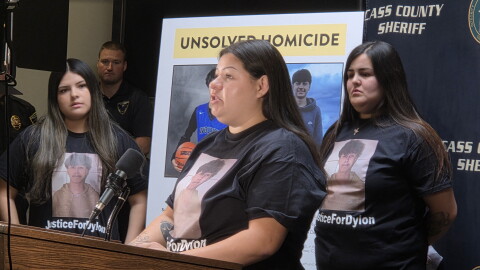 Larissa Donovan/KAXEThe family of Dylon Oothoudt, the Leech Lake Band of Ojibwe and the Cass County Sheriff's Office hosted a press conference Oct. 7, 2026, as the homicide investigation continues.
 -
 Matt C/UnsplashThe rechargeable batteries are used in nearly every home and are generally safe but can be dangerous.
 -
 Maria Hileman/KAXEThe Grand Rapids Police Department is investigating a prank call about a fabricated shooting at Old Central School on Oct. 6, 2026.
 -
 Canva ProThe highway had been closed since May for construction.
 -
 Contributed/Anna Paige for MinnPostState Sen. (and meteorologist) Rob Kupec and GOP challenger Austin Peterson are squaring off in the race to represent the Moorhead area in St. Paul.


