


ST. PAUL — The Democratic-Farmer-Labor-led Senate is creating a subcommittee to study the impact of the Republican megabill signed into law in July.
The Select Subcommittee on Federal Impacts on Minnesotans and Economic Stability will have Republican and DFL members, and will travel around the state to hear from Minnesotans impacted by the recent changes to federal law: farmers, hospital administrators, people reliant on food or medical assistance, and more.
The new law, signed by President Donald Trump on July 4, contains many of the president’s policy and budget priorities: cutting taxes, particularly for the wealthiest Americans; boosting funding for Immigration and Customs Enforcement; and slashing funding for health care and food assistance programs, among others.


“We think it’s important for us to understand from a budget perspective, what the Congress has done, but more importantly, we need to prepare, and help Minnesotans prepare, for what could be a hard economic hit and a lack of stability,” Senate Majority Leader Erin Murphy said Tuesday.
The subcommittee will meet weekly beginning Sept. 18, and plans to alternate meetings in St. Paul with visits to affected communities around the state.
The new mandates for major programs are taking effect while the supervising federal agencies are short-staffed, causing a lack of clarity and oversight for the local people charged with enforcing the new rules, said Sen. Lindsey Port, DFL-Burnsville, who will chair the committee.
“We need to understand what those unanswered questions are, so that we can help to try to provide some stability moving forward, and work in partnership with the cities, the counties, the school boards, with our farmers and teachers and nurses,” Port said.
Republican Sens. Carla Nelson of Rochester, Jordan Rasmusson of Fergus Falls, Mark Koran of North Branch and Paul Utke of Park Rapids will join Democrats on the committee.
Minnesota Reformer is part of States Newsroom, a nonprofit news network supported by grants and a coalition of donors as a 501c(3) public charity. Minnesota Reformer maintains editorial independence. Contact Editor J. Patrick Coolican for questions: info@minnesotareformer.com.
-
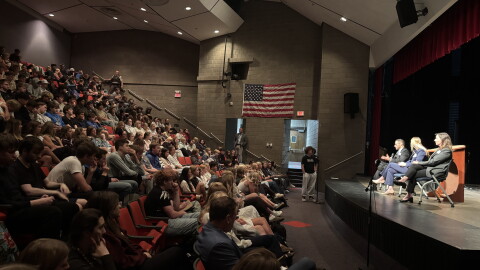 Megan Buffington/KAXEThe Minnesota Court of Appeals heard oral arguments at Pequot Lakes High School on Sept. 22, 2026, in front of 300 upperclassmen.
 -
 Contributed/Adobe Stock via Minnesota News ConnectionFederal safety net program cuts are on the minds of economists with new data on last year's median incomes, official poverty rate and holistic poverty rate.
 -
 Plus: Early voting opened Sept. 18, 2026, for all eligible voters Minnesota; and Northern Minnesota tribes are among groups receiving Clean Water Legacy grants.
 -
 Contributed/Bemidji Fire DepartmentThe Bemidji Fire Department responded to a mobile home fire in Northern Township on Sept. 20, 2026. One occupant had escaped while another was unaccounted for at the time of the report.
 -
The Iron Range offers a window into communities reckoning with how their identities must change for the betterment of future generations as schools increasingly collaborate.This reporting is part of a collaboration with the Institute for Nonprofit News' Rural News Network and Big Local News at Stanford University, with data journalist Cherry Salazar’s analysis helping anchor the reporting. Six nonprofit newsrooms were involved: BenitoLink, KAXE, Mat-Su Sentinel, Mississippi Today, Oxford Free Press and The Texas Tribune. Support from the Walton Family Foundation made this project possible.
-
Plus: Minnesota's archery deer season opens Sept. 19, 2026; and health experts caution that disease-carrying ticks surge in fall.
-
 ContributedDozens of ticks as part of a study with the Marshfield Clinic Research Institute were submitted from the Bemidji area.
 -
 Contributed/MN DNRBow hunters harvested more than 30,000 deer during the 2025 archery season — an all-time high. The 2026 season runs from Sept. 19 through Dec. 31.
 -
 Emma Krab/KAXEThe mining company celebrated a $770 million federal loan and the production of its first concentrate at a blast event Sept. 17, 2026. Two days earlier, it announced the "next phase of investment" at an Itasca County Board meeting.
 -
 Contributed/Minnesota SenateProsecutors are calling for five years in prison for the former Grand Rapids state senator. His defense team is arguing for time already served, plus five years of supervision.


