


Planned spongy moth management in Carlton, Itasca and St. Louis counties is canceled because of federal funding challenges, the Minnesota Department of Agriculture said.
There is only a short window in the spring when aerial insecticide treatment is effective. MDA did not receive the necessary federal funds in time to conduct its proposed operations.

Spongy moth, formerly known as gypsy moth, is a destructive invasive pest that threatens forest health. MDA had planned treatment for nearly 3,000 acres across the state, including areas near Grand Rapids, Cromwell, Moose Lake, Cloquet and on the Fond du Lac Reservation.
In a news release, MDA Commissioner Thom Petersen said the spongy moth populations will likely increase and spread in the cancellation areas, making future treatment more complex and costly.
"For decades, a partnership between the MDA, ten states and the USDA Forest Service, the national Slow the Spread (STS) program has effectively reduced the spread of spongy moth populations; an invasive and destructive forest pest, by greater than 60%," the MDA stated on its spongy moth webpage.
The agency is still planning additional management, though that is also reliant on federal funding. The MDA says it will receive initial funding for its spongy moth survey, but the status of additional aerial management funds is unknown.
-
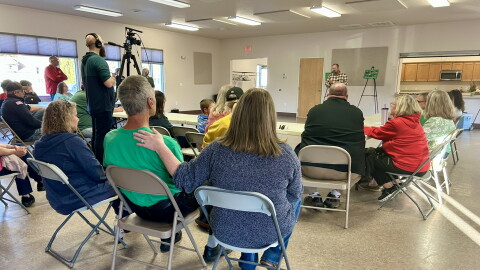 Emma Krab/KAXEThe Blandin Foundation announced a $250,000 grant for the Greenway Community Fund on Oct. 21, 2026. The Greenway area covers 10 small cities and townships on the western side of Minnesota's Iron Range.
 -
 Contributed/Adobe Stock Image via Minnesota News ConnectionThe National Wildlife Federation recognizes October as "Leave the Leaves Month," when homeowners are encouraged to move some of the leaves they have cleared into garden beds.
 -
 Larissa Donovan/KAXEMuch of DOGE’s funding cuts to tribal communities came to programs focused on environmental efforts, agriculture and economic development, the Brookings study found.
 -
 Contributed/Max Nesterak / Minnesota ReformerRepublican Michele Tafoya and Democrat Peggy Flanagan sparred over foreign policy, immigration, violent crime, fraud and healthcare.


