


Democracy is messy.
As of today, we're only days away from the end of another campaign season. The finish line is in sight, and you can feel it everywhere.
People are exhausted. We're tired of television ads, and social media arguments, fundraising texts, fliers in the snail mail, and yard signs planted across every neighborhood.
This is the point where the rubber meets the road.
It is also a moment when it helps to remember that what feels exhausting is actually evidence that democracy is important, and we're taking it seriously.
The noise, the disagreement, the competition of ideas, and even the frustration are all part of this constitutional republic we have inherited and are responsible for sustaining.
That doesn't mean campaign season always brings out the best in us. Too often, it does the opposite. We become quicker to assume bad intentions. Less willing to listen. More likely to see our fellow citizens as members of a political party rather than complicated, nuanced, individual neighbors.

Every election season seems to test not just our political convictions, but our character. So knowing, that as human beings, we're probably going to lean into our worst instincts instead of our best, we're going to need a backstop.
One of those backstops is journalism. Real journalism — not blogs, or social media opportunists, and not people who write essays and op-eds.
I'm raising my hand here, because I fall into that last category. I'm not a journalist, and I don't pretend to be. Because I have a very specific bias and point of view. My goal is to raise a perspective, and hopefully persuade you that I'm right.
But journalists do what journalism is meant to do: pursuing verifiable truth. And that deserves a pause.

Campaign season can be incredibly frustrating for candidates, volunteers and voters alike. Few experiences are more maddening than believing there is a damaging story about an opponent and watching a news outlet decline to run it. When that happens, many people immediately assume bias.
Now, sometimes bias does exist. Journalists are human beings, and every human being carries biases. The more important question is what people do to manage them.
Professional journalism has long relied on a code of ethics built around verification, accountability, independence and fairness.
Good journalism requires more than suspicion.
It requires evidence. It requires sources willing to stand behind claims. It requires facts that can be verified. So when a story isn't published, the most useful question may not be, "Why won't they report it?"
The better question may be, "What's missing?"
Can the information be verified? Are sources willing to go on the record? Is there corroborating evidence? Is this issue genuinely newsworthy to the public, or only valuable to someone trying to embarrass an opponent?
Those questions matter because journalism, at its best, is not a tool for campaigns.
It is a service to the public.
Fairness matters too. Not because every claim deserves equal credibility, but because people deserve the opportunity to respond to allegations and because complex stories rarely fit neatly into a single narrative.
But when the sun comes up on November 4, we will still share the same communities, schools, houses of worship, businesses, and neighborhoods.
Democracy depends on institutions, and our neighbors all doing their jobs well. From election judges following laws, to candidates and volunteers acting in good faith, to journalists pursuing the truth, democracy also depends on citizens extending each other a measure of grace.
That can be as simple as giving people the benefit of the doubt. Leaving campaign signs alone. Refusing to assume that political disagreement is evidence of personal failure or bad character.
And it means remembering something that will be true long after the final votes are counted.
On election night, somebody will celebrate. Somebody else will be disappointed.
But when the sun comes up on Nov. 4, we will still share the same communities, schools, houses of worship, businesses and neighborhoods. We will still serve on the same nonprofit boards, coach the same teams and stand in the same lines at the grocery store.
If we're going to have a bias, let's embrace this one: we still want to be neighbors on Nov. 4.
And perhaps that commitment is the most important civic responsibility of all.
-
 Events this week include a book sale in Bemidji, local theater in Gilbert and the First Friday Art Walk in Grand Rapids.
-
 Emma Krab/KAXEThe project proposed by Calumet Reclamation Co. would entail processing legacy stockpiles and tailings for hematite and involve demolishing some historic properties.
-
 The Hermantown City Council moved the meeting to Oct. 30, 2026, after originally scheduling it for Oct. 27, citing concerns about conflicts with early voting. Protests postponed the original Monday meeting.
-
 Lorie Shaull/KAXEThe federal low-interest loans are for small businesses and nonprofits in the Minnesota Arrowhead damaged by 2026 summer wildfires. Applications close July 22, 2027.
-
 Plus: Federal loans available for businesses affected by Boundary Waters summer wildfires.
-
 During the Phenology Report for the week of Oct. 27, 2026, Staff Phenologist John Latimer remarks on sandhill cranes in Aitkin county, active chipmunks, deer scrapes and the colors of the family of willows.
-
 Maria Hileman/KAXEKAXE's weekly list of concerts near you features Brothers Burn Mountain, MorningBird Trio, Noxious Ghoul, Foxby, Blackfishbleu, KMRE, and a Halloween dance party.
-
 Contributed/Julie GuthJulie Guth’s second children's book "Nikki the Nice, Nikki the Naughty” is out now. She joined "Area Voices" to discuss how the book came to be.
-
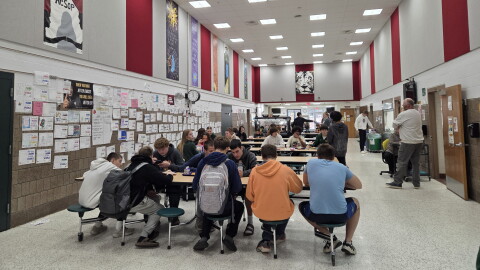 Larissa Donovan/KAXEThe Nevis School District is asking voters a three-part question in the 2026 election, representing a $17 million ask to improve its cafeteria, kitchen, entrances and more.
-
Plus: Hwy 210/Washington Street reopens in Brainerd.


