


Minnesota has something unusual that most people don’t think about until they’re standing in a voting booth. Every local elected office in our state is legally nonpartisan. City councils, mayors, school boards, county commissioners, township supervisors, soil and water boards — all of them.
When you vote, you won’t see party labels printed next to their names. And in primaries, the top vote‑getters overall advance, not the top candidate from each party.
In a moment when national politics seems to seep into every conversation, this structure isn’t just a technical detail. It’s a deliberate civic choice — one that shapes how our communities function.

And as we move through election season — with early voting available now — it’s worth remembering what “legally nonpartisan” actually means. It doesn’t mean candidates don’t have political leanings. Many do. And it doesn’t mean local party units can’t endorse. They can, and they often do.
In fact, when California tried to ban party endorsements in nonpartisan races back in the 1980s, the courts struck it down as unconstitutional. Political parties have the same First Amendment rights as any other organization that’s legally allowed to participate in campaigns. A few groups, like 501(c)(3) nonprofits and churches, are prohibited from endorsing candidates — but parties aren’t.
So nonpartisan doesn’t mean apolitical. And it certainly doesn’t mean parties disappear from the landscape.
But it does mean something important: the office itself is not designed to function through a partisan lens.
There’s a difference between legally nonpartisan and functionally nonpartisan. Legally nonpartisan means the ballot doesn’t list party labels. Functionally nonpartisan means the work — the day‑to‑day governing — isn’t driven by partisan identity. And that’s where things get complicated, especially when so many of us think about politics as “D versus R.”
When a city council starts behaving like Congress, residents lose something important: the ability to see their leaders as neighbors first and partisans second.
Local government deals with the issues closest to home: parks, public safety, zoning, street repairs, water systems, libraries. These aren’t ideological debates. They’re practical responsibilities. Sometimes boring ones. They require collaboration, problem‑solving, and a willingness to listen to neighbors who may disagree with you on national politics but still want the same pothole filled or the same playground updated.
Partisanship, by design, divides. It sorts people into teams. It encourages the question: “Are you one of us, or one of them?” In legislative bodies, that division is formalized — majority caucus, minority caucus, party whips, partisan agendas. But at the local level, importing that structure can make governing harder, not easier.


For candidates knocking on doors, the question “What party are you?” becomes a shorthand for voters — but it also creates confusion when the office they’re running for is supposed to be nonpartisan.
And when a city council starts behaving like Congress, residents lose something important: the ability to see their leaders as neighbors first and partisans second.
George Washington warned against political parties in his Farewell Address, cautioning that “the spirit of party” could distract public servants from the public good. He wasn’t arguing for a world without disagreement. He was arguing for a world where allegiance to a party didn’t eclipse allegiance to the community.
Legally, Minnesota’s local offices are nonpartisan. Functionally, they’re only as nonpartisan as the people who run for them — and the voters who elect them — allow them to be. That’s the tension we live with. But it’s also an opportunity.
When we choose leaders based on their judgment, their community involvement, and their commitment to service — rather than the letter that would appear next to their name if the law allowed it — we strengthen the part of democracy that happens closest to home. And we remove one more barrier that might otherwise contribute to division in our neighborhoods.
Local government works best when it works for everyone, not just for a party.
And that’s why nonpartisan local offices matter — now more than ever.
KAXE is partnering with Majority in the Middle for election coverage, civic engagement and outreach. Majority in the Middle is a Minnesota nonprofit described as an objective, outside force for systemic change to improve transparency, participation and civility within political and civic life.
Listen to Executive Director Shannon Watson's essay above.
Find more information on November 2026 elections from the KAXE news team here.
-
 Malachy Koons/ContributedThe KAXE Music Team on new releases from The Mary Wallopers, Humbird, Leon Bridges, Julia Jacklin, Jake Bugg, Kelley Smith, and Kings of Leon and Petty's debut as our Pick Of '76.
 -
 Contributed/Book covers—publisher websites; Tracy KampaChildren's librarian Tracy Kampa reviews new books by Sophie Blackall, Chelsea Lin Wallace, Steve Sheinkin and Meaghan McIsaac.
 -
 Plus: Aitkin's 68-year-old water tower is demolished; Demuth, Klobuchar will debate in the Brainerd lakes area; and we're partnered with ICTV to host school board forums.
 -
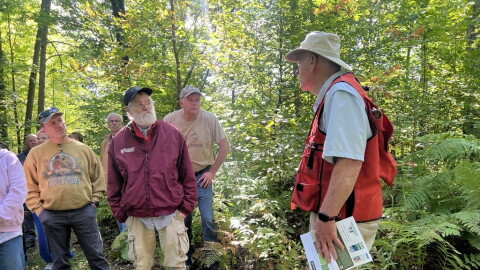 Stella Mayerhoff/KAXE / Report for AmericaRetired DNR forester Gary Anderson gave a walking tour of his forest property as part of a Cass Soil and Water Conservation District habitat management event.
 -
 Contributed/Illustration by Christopher Larson / Photo by Liz Fish, Little Movie CompanyMinnesota James Beard Award-winning author and chef Amy Thielen along with KAXE Director of Content and Ham Radio sidekick Heidi Holtan divulge their mistakes in the garden and the kitchen this fall.
 -
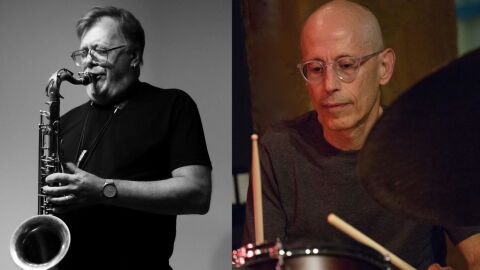 Contributed/Steve Hirsh and Nathan HansonMusicians Steve Hirsh and Nathan Hanson perform on the drums and saxophone in concert 7 p.m. Sept. 25, 2026, at Headwaters School of Music and Arts in Bemidji.


