


KAXE contacted each candidate at least twice to invite them to participate in our Election Guide, using contact information submitted to the Secretary of State's Office.
Candidate responses have not been edited and are published exactly as submitted, including typos and formatting.
As necessary, our news team added contextual information clearly marked with an "editor's note" and in italics. We will make every effort to make note of inaccuracies if they come to our attention.
Please contact our news team at news@kaxe.org with questions or comments or to report any errors.
KAXE's Election Guide includes contested races in communities with at least 100 people. Visit our full list of who's running for office in Northern Minnesota to see who else will be on the ballot in November.
About this race
The Minnesota Legislature passes laws and sets the state budget. It is made up of 67 senators and 134 representatives.
State House District 2B includes Mahnomen County, and portions of Beltrami, Clearwater and Cass counties. It includes the cities of Bagley, Mahnomen, Cass Lake, Blackduck and Walker.
Republican Rep. Matt Bliss of Pennington is running for a fourth, non-consecutive term. He was first elected in 2016. He co-chairs the Veterans and Military Affairs committee in the House.
The winner of the election will begin their two-year term in January.
Click the tabs below to learn more about the candidates

Website: emilythabesformn.com
Party: DFL
Age on Election Day: 46
Community: Bagley
Employment: Beltrami County Historical Society, Executive Director
Please share any prior experience and education that you believe qualifies you for office.
I hold master’s degrees in library and information science and in interdisciplinary leadership and have spent most of my career running institutions that answer to the people who fund them. As Executive Director of the Beltrami County Historical Society, I manage the budget, grants, staff, and volunteers, and I guide our board. Every dollar I spend is publicly accounted for. I also worked on Capital One's fraud team, training associates to detect and prevent fraud.
I am the daughter of a nurse practitioner, a teacher, and a career veteran. I grew up in a rural West Virginia farming community depressed by the decline of the coal and dairy industries. I know the value of rural communities and the culture and economic contribution they bring to a state. I will bring those values, my education, my experience, and my drive to improve life for everyone here to the House.
Why are you running?
I was moved to action when bad actors in the federal government terrorized and killed people in our communities while Minnesota's own state representatives looked on, and in some cases egged it on. I could no longer stay out of it. I learned in childhood that people only get through by taking care of each other. I am a librarian by trade, responsible for serving all without asking who 'deserves' help.
Why should voters elect you?
My leadership philosophy is the pursuit of wisdom and excellence in service of others. I live out that philosophy by preserving and sharing our community history, serving on and alongside community organizations, and caring for the land and water I live on. I live in this district by choice. I show up. I have knocked on doors across seven counties and listened to what people carry: childcare that costs more than a mortgage; health care out of reach for elders and folks with chronic illness; housing nobody can afford; and farms and resorts alike leaving family hands. I run a public institution on a tight budget. I believe in transparency and in developing smart systems that keep working when needs change. My campaign is funded by individual donors and organizations whose members share our values. I will bring that accountability to the House and keep communicating after the election.
What are your top three priorities, if elected? Please describe specific policy goals.
Care people can access. Childcare families can afford, and providers can survive on, with families choosing the provider that works for them. An elder care ombudsman with real authority. Keeping rural hospitals and clinics open, starting with the unfunded balance on the new Mahnomen facility.
Clean water. Protecting water at the source in the Headwaters, cleaning up the Cass Superfund site, and protecting manoomin as both a treaty obligation and a measure of water health.
Cost pressure on households. Local Government Aid and County Program Aid have sat at $644.4 million since 2024, pushing the difference onto local taxpayers. I would fund both in full and tie them to inflation. More of the money should come through the state formula, so schools are funded equally whether the surrounding property wealth is high or low.
Name a public leader you admire and explain why.
Mary Gibbs. In 1903 she became commissioner of Itasca State Park at twenty-four, after her father died in the job, and she was the first woman in the country to run a state park. A logging company had dammed the water at the headwaters, and the flooding was killing the old pine the park was created to protect. She told them to open the gates. They refused. She came back with the sheriff and a warrant, and a man at the dam said he would shoot anyone who touched the levers. The gates were opened.
She lost the position within weeks, and she left Minnesota not long after.
She was right, she was outnumbered, and she opened the dam anyway. Water at the headwaters belongs to everyone living downstream of it. I would stand where she stood.
What natural resources policies do you support?
Water first. I support protecting water at the source in the Headwaters, which means no new sulfide mining or pipelines that put it at risk, and publicly funded decommissioning of dangers and abandoned infrastructure. I support defending Amara's Law and its broad PFAS definition, and extending protection to soil, groundwater, private wells, and biosolids limits.
County Aquatic Invasive Species Prevention Aid is set to drop from $10 million to $5 million for aid payable in 2027. That cut is already in statute and lands in the first session of this term. I would work to restore it and fund the DNR at a level that matches expected outcomes.
What policies do you support to address concerns of widespread fraud in state-run programs?
Fraud is real, and it thrives in the same conditions: overworked staff, thin training, and weak systems. Past budget cuts reduced the number of investigators and integrity staff, while the problems they monitor grew. Governor Dayton's 2017 veto letter named 87 positions on the chopping block, including staff responsible for investigating fraud. I would fund prepayment and risk-based verification, interagency data matching, and enough trained staff to carry the caseload.
Audit findings need teeth. Corrective action plans with deadlines, follow-up verification by the auditor, agency heads testifying on the record, and a hold on discretionary funds until fixes are confirmed.
We must also audit what the state currently cannot see. The Legislative Auditor found the state can directly examine only about a quarter of the autism services program. I would extend state audits to managed care and make repayment mandatory, not optional, under the claw-back statute.
What policies would you champion to help alleviate growing property tax burdens on residents at the local government level?
Your property tax is based on your share of a local budget, and your share depends on what the assessor says your property is worth compared to everyone else's. Three high lakeshore sales can reprice an entire shore and shift costs onto neighbors who never sold anything. Your statement will not show any of that.
I would push for a full review of how the tax is calculated, aimed at a system people can understand and that accounts for ability to pay. Right now, I would expand the refunds people already qualify for and tie them to inflation, spread large valuation increases over several years rather than landing them in a single bill, and simplify the class rates.
The homestead exclusion also demands revision. It lowers one home's taxable value without the state paying for it, so the relief comes off one bill and onto the neighbors.
What does representative democracy mean to you?
Representation is a relationship, not a title. It requires someone to show up between elections, in townships and on reservations and in places where nobody is running for anything, and to report back on what they did with their trust.
I meet people at their doors who do not know what district they are in or who represents them. That is not on them. Lines moved, numbers changed, and nobody came out here to tell them. When people cannot name their representative, the representation has ceased to function.
Our infrastructure must match the promise: An independent citizens' redistricting commission that keeps communities and reservations whole. Disclosure of independent spending, so people can see who is trying to persuade them. Voting access in rural townships and on reservations, where distance and mail service already make it harder.
We are obligated to one another, and so is our government.
Still have questions for the candidates? Contact information for all those who've filed to run for office can be found at candidates.sos.state.mn.us.
-
 Contributed/Book covers—publisher websites; Tracy KampaChildren's librarian Tracy Kampa reviews new books by Sophie Blackall, Chelsea Lin Wallace, Steve Sheinkin and Meaghan McIsaac.
 -
 The retired DNR forester gave a walking tour of his forest property as part of a Cass Soil and Water Conservation District forest management event.
 -
Plus: Aitkin's 68-year-old water tower is demolished; Demuth, Klobuchar will debate in the Brainerd lakes area; and we're partnered with ICTV to host school board forums.
-
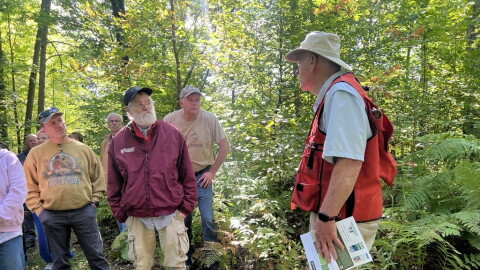 Stella Mayerhoff/KAXE / Report for AmericaRetired DNR forester Gary Anderson gave a walking tour of his forest property as part of a Cass Soil and Water Conservation District habitat management event.


