


KAXE contacted each candidate at least twice to invite them to participate in our Election Guide, using contact information submitted to the Secretary of State's Office.
Candidate responses have not been edited and are published exactly as submitted, including typos and formatting.
As necessary, our news team added contextual information clearly marked with an "editor's note" and in italics. We will make every effort to make note of inaccuracies if they come to our attention.
Please contact our news team at news@kaxe.org with questions or comments or to report any errors.
KAXE's Election Guide includes contested races in communities with at least 100 people. Visit our full list of who's running for office in Northern Minnesota to see who else will be on the ballot in November.
About this race
The Minnesota Legislature passes laws and sets the state budget. It is made up of 67 senators and 134 representatives.
State House District 1B includes Norman, Polk and Red Lake counties, as well as portions of Clay County. This district includes the cities of Crookston, East Grand Forks, Fosston and Ada.
Republican Rep. Steve Gander is running for reelection. He was first elected in 2024.
The winner of the election will begin their two-year term in January.
Click the tabs below to learn more about the candidates

Party: DFL
Age on Election Day: 38
Community: East Grand Forks
Employment: Nonprofit, Family Resource Coordinator
Please share any prior experience and education that you believe qualifies you for office.
I earned an Associate Degree in Liberal Arts with a focus in Social Work and Political Science and am continuing my education at Minnesota State University, Mankato in Applied Leadership and Nonprofit Leadership.
I work as a Family Resource Coordinator, connecting Northwest Minnesota families with resources and support while seeing firsthand how state policies affect their everyday lives.
I serve on a statewide health and human services membership association and recently began co-chairing its Public Policy and Advocacy Committee. I have also served on statewide advisory councils, including the Community Resource Center Advisory Council and Minnesota’s Advisory Task Force for Justice Impacted Women and Girls. I am also a Certified Peer Recovery Specialist and 2024 ACLU Smart Justice Fellow Graduate.
Why are you running?
I’m running because I believe government should work for the people who live here, and too many people in my community feel like it doesn’t.
I’ve spent years working with families and communities, and I’ve seen what happens when systems are designed without listening to the people who have to navigate them. I’ve experienced those systems myself. I know what it’s like to need help, hit barriers that shouldn’t be there, and watch problems get worse because support came too late.
I love this place. I grew up here, built my life here, and believe rural Minnesota deserves to be heard. I’m not running to be another politician. I’m running to be a neighbor in the Legislature.
Why should voters elect you?
I think voters should elect me because I’m willing to listen, learn, and actually do the work.
I’m not a career politician, and I don’t have a perfect answer for every problem. What I do have is years of experience working with families, navigating systems, advocating for change, and bringing people together around problems that affect our communities. I know what it feels like to not be heard. I also know how much can change when someone finally listens. I’ll bring that with me to St. Paul. I’ll ask hard questions, speak up when something isn’t working, and remember who I’m there to represent.
Most importantly, I’ll never forget that this job belongs to the people of District 1B, not to me.
What are your top three priorities, if elected? Please describe specific policy goals.
Action. Affordability. Accountability.
Action: Make Community and Family Resource Centers a permanent part of Minnesota’s human services system. They meet families where they are, connect them to resources, build confidence and community, and help prevent small problems from becoming crises. We know this model works. It’s time to invest in it.
Affordability: I want people to be able to work, raise a family, buy a home, and stay in the communities they love. That means investing in rural economic development and housing, lowering healthcare costs, and strengthening workers’ rights and unions. People who work hard deserve a fair wage, a safe workplace, and a voice at work.
Accountability: Government should be willing to admit when something isn’t working. I want better communication, fewer silos, and policies that actually improve people’s lives
Name a public leader you admire and explain why.
Paul Wellstone is the kind of public leader I want to be.
He understood that government is supposed to belong to the people. He wasn’t polished, wasn’t afraid to make people uncomfortable, and believed regular people had something important to contribute. I see a lot of myself in that. I’m not a career politician, and I don’t want to become one. I care deeply about people and the communities I come from. I’m willing to ask hard questions, say the uncomfortable thing, admit when I’m wrong, and keep showing up.
I don’t want to go to St. Paul and become part of the machine. I want to go there and remember exactly who sent me.
What natural resources policies do you support?
I grew up learning to love Minnesota’s outdoors. My family didn’t have a lot, but my parents made sure we experienced the beauty in our own backyard, from the Chippewa National Forest and the headwaters of the Mississippi to the lakes and small towns along Highway 2 between East Grand Forks and Duluth.
I support protecting Minnesota’s water, forests, wildlife, and public lands because they are part of who we are and what makes rural Minnesota special. I also believe conservation and responsible resource use can exist together. Timber, mining, agriculture, and other natural resources are important to our rural economy. We should be able to safely and responsibly harvest our resources while protecting the land and water we depend on for generations.
What policies do you support to address concerns of widespread fraud in state-run programs?
Fraud hurts everyone, but especially the people who actually need these programs. I don’t have all the answers yet, and I don’t think anyone should pretend they do. Before we decide how to fix this, I want to understand how we got here in the first place.
I think we need better communication between agencies and fewer silos. We have information and technology that should help us catch problems sooner, and we need to actually use them. When someone is stealing taxpayer money, there should be consequences. But I don’t want the answer to be putting more hoops in front of families who are already struggling. We need to get better at finding fraud while keeping these programs accessible to the people who truly need them. We can do both.
What policies would you champion to help alleviate growing property tax burdens on residents at the local government level?
Property taxes are an issue I’m still learning more about, but they are absolutely a priority for me. I know that simply telling local governments to “lower property taxes” doesn’t solve the problem when they still have to pay for essential services.
I want to look at how the state funds schools, counties, and cities and whether we are putting too much of that responsibility on local property taxpayers. I support strengthening state support for local governments, looking for ways to reduce the cost of providing services, and making sure rural communities aren’t carrying an unfair share of the burden.
I also want to listen to local leaders and taxpayers before pushing a one-size-fits-all solution. We need to understand what is driving these increases and find sustainable ways to keep people in their homes, farms in families, and rural communities thriving.
What does representative democracy mean to you?
To me, representative democracy starts with community. I believe there is real strength when people come together, share what they know, and decide what they want their community to look like.
Being elected doesn’t mean I suddenly have all the answers. It means I have a responsibility to listen to the people who sent me there and bring their voices into the room. The people closest to a problem often understand it better than the people writing the policy.
I’ve seen what happens when people who have felt overlooked find their voice and realize they can actually make a difference. That is powerful.
I don’t expect everyone to agree with me. I do expect myself to listen, be honest about what I know and what I don’t, admit when I’m wrong, and keep showing up.
To me, democracy works best when people aren’t just represented. They’re involved.
Incumbent
Website: stevegander.com
Party: Republican
KAXE did not receive a response from this candidate.
Still have questions for the candidates? Contact information for all those who've filed to run for office can be found at candidates.sos.state.mn.us.
-
 Contributed/Book covers—publisher websites; Tracy KampaChildren's librarian Tracy Kampa reviews new books by Sophie Blackall, Chelsea Lin Wallace, Steve Sheinkin and Meaghan McIsaac.
 -
 The retired DNR forester gave a walking tour of his forest property as part of a Cass Soil and Water Conservation District forest management event.
 -
Plus: Aitkin's 68-year-old water tower is demolished; Demuth, Klobuchar will debate in the Brainerd lakes area; and we're partnered with ICTV to host school board forums.
-
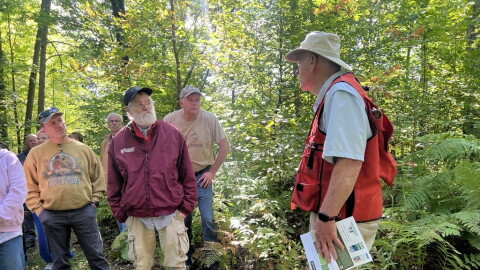 Stella Mayerhoff/KAXE / Report for AmericaRetired DNR forester Gary Anderson gave a walking tour of his forest property as part of a Cass Soil and Water Conservation District habitat management event.


