


KAXE contacted each candidate at least twice to invite them to participate in our Election Guide, using contact information submitted to the Secretary of State's Office.
Candidate responses have not been edited and are published exactly as submitted, including typos and formatting.
As necessary, our news team added contextual information clearly marked with an "editor's note" and in italics. We will make every effort to make note of inaccuracies if they come to our attention.
Please contact our news team at news@kaxe.org with questions or comments or to report any errors.
KAXE's Election Guide includes contested races in communities with at least 100 people. Visit our full list of who's running for office in Northern Minnesota to see who else will be on the ballot in November.
About this race
The Minnesota Legislature passes laws and sets the state budget. It is made up of 67 senators and 134 representatives.
State House District 1 includes Kittson, Marshall, Pennington, and Roseau counties, and the cities of Warroad, Roseau and Thief River Falls.
Rep. John Burkel is the incumbent in this race. He serves as co-vice chair for the House's environment and natural resources finance and policy committee. He was first elected in 2020.
The winner of the election will begin their two-year term in January.
Click the tabs below to learn more about the candidates

Incumbent
Website: burkelforhouse.com
Party: Republican
Age on Election Day: 59
Community: Badger
Employment: Self employed - agriculture
Please share any prior experience and education that you believe qualifies you for office.
I am a fourth-generation turkey producer with decades of agricultural and industry leadership. I served 20 years on the board of Northern Pride, Inc., our processing and marketing cooperative in Thief River Falls, chairing it from 2016 through 2020.
I served on the Minnesota Turkey Growers Association Board from 1999 through 2009 and chaired the organization in 2005. I served on the National Turkey Federation Executive Committee from 2007 through 2017 and was chairman in 2013.
My wife, Joni, and I are active at St. Mary’s Catholic Church in Badger, serving on the church council, teaching religious education and participating in music ministry. In 2007, we represented Roseau County in the Red River Valley Emerging Leadership Program.
I am in my sixth year representing House District 1A, serving on the Agriculture, Environment and Natural Resources, and Legacy committees. I have also served four years on the Lessard-Sams Outdoor Heritage Council.
Why are you running?
I am running because I believe my responsibility is to represent the culture, values, and common sense of the people of northwest Minnesota. I want to continue being a strong voice for the families, farmers, businesses, schools, and communities I represent in Kittson, Marshall, Pennington, and Roseau counties.
Why should voters elect you?
I believe voters should elect me because I bring practical, real-world experience to the Legislature and understand rural Minnesota. As a farmer, business owner, community leader, and legislator, I know government must be accountable for every tax dollar. Minnesota’s widespread fraud has damaged public trust and diverted resources from the people they were meant to serve. I will keep pushing for stronger oversight, real consequences, and greater transparency.
Fiscal responsibility also means understanding rural realities. Families need child care so parents can work, employers need workforce housing to attract and retain employees, and homeowners, farmers, schools, and local governments need relief from rising property taxes. Solutions designed for the Twin Cities do not always work in northwest Minnesota. I will continue being a strong, common-sense voice for accountability, affordability, and the people I represent.
What are your top three priorities, if elected? Please describe specific policy goals.
My top three priorities are improving education, restoring accountability in state government, and keeping Minnesota’s agriculture and energy sectors strong.
First, Minnesota already invests heavily in education. I want those dollars focused on student achievement, supporting teachers, empowering parents, and keeping decisions local—not expanding bureaucracy or imposing unfunded mandates.
Second, we must confront fraud with stronger oversight, enforceable accountability, and leadership committed to protecting taxpayers. Agencies must act on warning signs, control spending, and have the tools to investigate and prosecute abuse—including a longer statute of limitations for social-services fraud.
Third, Minnesota’s farms, businesses, and families need reliable, affordable, and competitive agriculture and energy policies. Farmers should help drive agricultural policy through regulatory relief, streamlined approvals, stronger profitability, and voluntary, site-specific conservation. We also need an all-of-the-above energy strategy built around reliability, affordability, and safety while ensuring major developments such as data centers pay their own infrastructure costs.
Name a public leader you admire and explain why.
One public figure I admire is Norman Borlaug. He grew up on an Iowa farm, studied at the University of Minnesota, and never lost sight of agriculture’s most important purpose—feeding people. Through persistence, science, and practical innovation, his work dramatically increased food production and helped prevent hunger around the world, earning him the Nobel Peace Prize.
What I admire most is that Borlaug was focused on results rather than recognition or ideology. He understood that farmers, researchers, and technology can improve lives when they are given the freedom and tools to solve problems. As a fourth-generation farmer, I appreciate his respect for production agriculture and his belief that environmental stewardship and feeding a growing population can work together. His life demonstrates how one person, grounded in agriculture and willing to tackle difficult problems, can make an extraordinary difference.
What natural resources policies do you support?
As vice chair of the House Environment and Natural Resources Committee, my priority is protecting Minnesota’s land, water, and wildlife while allowing responsible development, recreation, and local decision-making.
We have made progress by expanding electronic permit submissions, reducing duplicative reviews, and improving agency coordination. Next, we need clearer timelines, greater transparency, and real accountability when agencies delay decisions. Responsible mining, energy, agriculture, and development proposals should proceed through established environmental review rather than blanket political bans.
I also opposed HF1012 because its additional restrictions and review requirements could undermine locally supported ATV and UTV trail systems. These trails are more than recreation; they bring visitors to northern Minnesota and support resorts, restaurants, dealers, and other small businesses. Environmental protection should be balanced with local knowledge, responsible trail management, and the economic realities of rural communities.
What policies do you support to address concerns of widespread fraud in state-run programs?
Minnesota must restore public trust by preventing fraud before taxpayer dollars are lost. Too often, state agencies failed to enforce basic controls, investigate red flags, or stop suspicious payments. Similar warning signs appeared across programs, yet action often came only after media reports or federal investigations.
I supported the Office of Inspector General bill passed last session because Minnesota needs independent oversight, meaningful investigative authority, stronger spending controls, and real accountability. I also supported—and will continue supporting—updates to Minnesota’s MNIT systems and the Social Service Information System (SSIS). Our state agencies and counties need modern, compatible software that can share information, identify unusual payment patterns, and catch fraud earlier.
We must also extend the statute of limitations for social-service fraud so complex cases can be investigated and prosecuted. Fraud steals from taxpayers and from the Minnesotans these programs were created to help.
What policies would you champion to help alleviate growing property tax burdens on residents at the local government level?
I would start by recognizing that property taxes are local, but decisions made in St. Paul have a direct impact on those bills. Minnesota property-tax levies increased nearly $900 million in 2026 alone.
We need to stop passing unfunded mandates and expecting counties, cities and schools to simply raise property taxes to pay for them. I support Lisa Demuth’s plan to provide $150 million in property-tax relief, allow schools and local governments greater flexibility to opt out of costly unfunded state mandates, and return portions of future state surpluses directly to taxpayers through property-tax rebates.
We also need to build on the $125 million in property-tax relief we delivered this past session.
Long-term relief requires controlling state spending and properly funding the responsibilities we require of local governments. If the state mandates it, the state should help pay for it.
What does representative democracy mean to you?
Representative democracy means people choosing someone from their community to be their voice in government while always retaining the power to hold that person accountable. Elected officials are not the people’s masters; they are temporary stewards of limited authority who should protect individual liberty, uphold the rule of law, respect private property, and keep decisions as close to families and communities as possible.
Government does not have all the answers. A great deal of wisdom and practical knowledge exists in our homes, farms, businesses, churches, and civic organizations. Government’s role should be to establish fair rules and create opportunities—not control every outcome. We should also work to ensure that property, opportunity, and economic power are widely shared rather than concentrated in government or a few large institutions. Representative democracy works best when citizens stay engaged, local institutions remain strong, and elected officials genuinely listen to the people they serve.
Still have questions for the candidates? Contact information for all those who've filed to run for office can be found at candidates.sos.state.mn.us.
-
 Contributed/Book covers—publisher websites; Tracy KampaChildren's librarian Tracy Kampa reviews new books by Sophie Blackall, Chelsea Lin Wallace, Steve Sheinkin and Meaghan McIsaac.
 -
 The retired DNR forester gave a walking tour of his forest property as part of a Cass Soil and Water Conservation District forest management event.
 -
Plus: Aitkin's 68-year-old water tower is demolished; Demuth, Klobuchar will debate in the Brainerd lakes area; and we're partnered with ICTV to host school board forums.
-
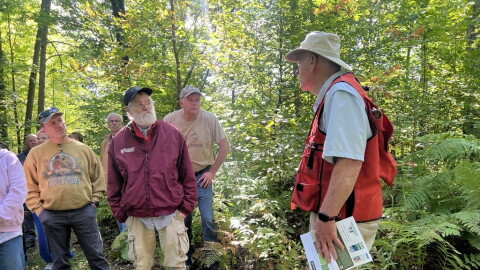 Stella Mayerhoff/KAXE / Report for AmericaRetired DNR forester Gary Anderson gave a walking tour of his forest property as part of a Cass Soil and Water Conservation District habitat management event.


