



North Shore Community School near Duluth
“Hello from North Shore Community School on the north shore of Lake Superior. This is the Phenology Report for the week of Sept. 26, 2026. My name is Ella, and I am your phenologist for this week!
“When Finn has been driving home after football practice this week, he has seen a lot of trees that have had their leaves change color. Dani has seen the older pine needles falling off of the pine trees at her house. Mrs. Rolfe's class noticed that by shelter 2 that about 70% of the leaves have changed color. That is a 65% increase from last week!
“Sam saw a Peregrine Falcon in a thermal above his house on Sunday, Sept. 27. Ms. Jackson spotted a Wild Turkey on the side of the road on her drive to school Monday morning, Sept. 28. Also on this day, Nora noticed a Red-tailed hawk flying over her house and Elsie saw a Blue Jay at her house exploring. I noticed many Black-capped Chickadees by my bird feeder. On Wednesday, Sept. 30, Ms. Urban noticed Woodcocks were flying around her yard right at dusk and calling.
"On Monday, Sept. 28, Natahlia and her older brother were dirt biking and a six-point buck ran across the road with velvet on its antlers. Also on this day, Cruz saw a black bear eating his garbage and making a trail out of it. On Tuesday, Sept. 29, Nora noticed a squirrel gathering bird seed from her bird feeder. Also on Tuesday, Mrs. Rolfe saw a fox run across the Lismore Road on her way to school. On Wednesday, Sept. 30, Asher spotted a black bear cub on his way to school and Elsie noticed that a bear had dug into her dumpster during the night. On Thursday, Oct. 1, she also saw a black bear cross Ryan road on her way to school. On Wednesday, Sept. 30, Nora saw a big buck on a hill while she was in the car.
"On Monday, Sept. 28, Natahlia was mowing her lawn and a garter snake slithered under the mower.
“On Sunday, Sept. 27, Mrs. Rolfe saw several mountain pine beetles on the outside of her windows at her home. On the morning of Thursday, Oct. 1, a mosquito followed Ms. Jackson into her house.
“This concludes the phenology report. Have a great week and be observant!”
Long Lake Conservation Center near Palisade
This report is brought to you by Hayden, Sarah, Colton and the students from St. Mary's School in Alexandria.
“During our trip from Sept. 28-30, the low temp was 53 degrees, the high was 73, and 0.54 inches of rain fell on Sept. 29.
“A beaver was seen on campus, dragging a branch toward the water. It was described as round and busy, but nonchalant. Beavers are busy preparing for the winter, but we were told it’s unusual to see them on campus and that far away from shore. We named the beaver Big Tim.
“Leaves are turning rapidly and we estimate that we’re about 25 percent of the way to peak color.
“Winter berries are ripening, and the tamaracks are starting to turn golden in the bog which is extra boggy these days thanks to the recent rains.
“Garter snakes are definitely on the move, and a few were spotted near the entrance to their hibernaculum. We learned that because snakes are cold-blooded, this is a good sign that freezing temperatures are coming soon.
“A wood frog joined us in our shelter during shelter class.
“One of the logs had wood ear jelly mushrooms on it.
“On the lake, we saw two Trumpeter Swans and a Canada Goose. We found a dead bullhead on the shore of the lake and saw bass, sunfish and green chubs in the lake.
“In the air, we saw a number of Bald Eagles, an unidentified hawk flying overhead and heard a Barred Owl at night.
“We had a great time exploring nature and we want to remind everyone to unplug, get outside and LIVE CONNECTED!”
This report is brought to you Jack, Regan and the students from Nativity of our Lord in St. Paul.
“During our trip from Sept. 30 – Oct. 2, the low temperature was 34 degrees and the high was 78. The skies were clear and sunny.
“We estimate that we are about half way to peak autumn color.
“The garter snakes were active with more and more gathering near their hibernaculum. One was seen swimming in the lake and another little fella found his way into the dining hall. Somehow, they knew that the cold was coming.
“The brisk morning made for a beautiful misty sunrise. We enjoyed the peaceful morning, watching the two Trumpeter Swans swim through the mist. Beavers were seen swimming in the lake, a hawk soared over the lake, and we found a very big and scary spider in the bog. We think it was probably a fishing spider.
“Many mushrooms and fungi are up including turkey tail, coral, bright blue green elf cup, and birch polypore.
“The lily pads on Long Lake are turning red and yellow. We saw two painted turtles sunning themselves on a log.
“We had a great time exploring nature and we want to remind everyone to unplug, get outside and LIVE CONNECTED!”
Little Falls Middle School
“This is Remington and Marshall reporting from Little Falls Middle School. This is our phenology report for the week of Oct. 4.
“There are still a lot of bumblebees on the remaining flowers around our houses in the mornings and afternoon.
“When we go out at night, we notice several moths flying around.
“We have had an explosion of mushrooms after the rainfall. Puffballs, fairy rings, indigo milkcap and even a stinkhorn were some spotted this week.
“A classmate found a tiger salamander during daylight hours, helped by the cooler and wetter weather.
“We have noticed an increase in activity at our bird feeders. Most are not migratory birds, so we wonder if it is due to their natural food decreasing.
“We have been able to see all the stages of shaggy mane mushrooms, from large and shaggy to final black inky cap stage.
“Our houses are surrounded and covered by boxelder bugs and Asian beetles.
“We had a discovery of a giant water bug at the football field during the Powderpuff football game this week.
“We are still seeing bats flying around just after sundown.
“There are groups of 7-10 flickers showing up in our yards.
“We have had large groups of Turkey Vultures, Wild Turkeys, and White Pelicans around Little Falls this week.
“We had a sudden return of the tiny, aggressive, biting minute pirate bugs. They suddenly appear to be everywhere.
“We spotted our first woolly bear caterpillar of the fall this past week.
“We are still watching for our Cedar Waxwings, they have appeared 6 years in a row outside our classroom windows during the first week of October.
“That is our report for this week, until next week, keep exploring, keep discovering, and keep connecting with the great outdoors.”
Prairie Creek Community School in Northfield
Elsie: “Hi, this is Elsie-”
Thor: “And this is Thor-”
Elsie: “And we’re from Prairie Creek-”
Thor: “Way down south in Northfield, Minnesota.”
Elsie: “We had a great hike with John today.”
Thor: “We took John to Granny’s Run - a new area we’ve been exploring. We saw giant puffballs and prickly ash and, sadly, a lot of buckthorn.”
Elsie: “We cooked up one of the puffballs, too.”
Thor: :We noticed the pine needles coming off of the white pines.”
Elsie: “We learned about flea bane.”
Thor: “We saw the difference between a silver maple and a sugar maple - it’s all about the teeth in the lobes.”
Elsie: “We also saw a rock that has been there for ten thousand years.”
Thor: “In other news, we are still seeing dragonflies, monarchs, and Turkey Vultures.”
Elsie: “This has been Prairie Creek-”
Thor: “One more step along the phenology journey.”
Listener talkbacks
What have you seen out there? Let us know: email us at comments@kaxe.org or text us at 218-326-1234.
For more phenology, subscribe to our Season Watch Newsletter and podcast or visit the Season Watch Facebook page.
-
 The disease, which causes internal bleeding and sudden death, was confirmed Sept. 9, 2026. It does not affect humans.
 -
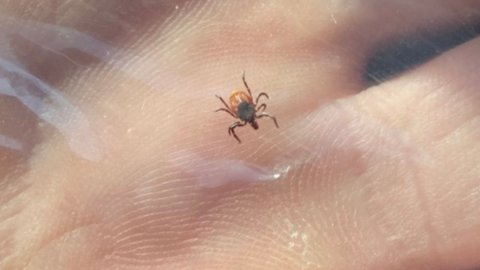 ContributedDozens of ticks as part of a study with the Marshfield Clinic Research Institute were submitted from the Bemidji area.
 -
 Christopher Smith, conservation committee chair for the Minnesota Herpetological Society, discusses how salamanders use dead and dying trees. The series is produced by Mark Jacobs.
 -
 Lorie Shaull/KAXEThe Minnesota Pollution Control Agency is surveying people's fish-eating habits to help limit contaminants in water bodies and make fish safer to eat.
 -
 Contributed/Daniel DewaldCisco and other cold water fish died by the thousands in the large, shallow lake as water temperatures soared to an average of 77 degrees in late July and early August 2026.
 -
 Contributed/Adobe Stock via Minnesota News ConnectionPublic health experts said states can better prepare for future illness outbreaks by keeping a sharp eye on climate change.


