



Aurora Waasakone Community of Learners in Bemidji
East Rapids Elementary in Grand Rapids
North Shore Community School near Duluth
“Hello from North Shore Community School on the north shore of Lake Superior. This is the phenology report for the week of Feb. 21, 2026. My name is Julia, and I am your phenologist for this week!
“We are enjoying the gain of 21 minutes of daylight from February 21-28, with sunrise now happening before 7:00 a.m. The last time we had a sunrise before 7:00 a.m. was Nov. 3, 2025! On our school break the week of February 16, we experienced a blizzard with up to 18 inches of snow and a vast amount of drifting due to 50-60 mile per hour winds. Schools up the North Shore were closed on Wednesday and Thursday. Many homes and businesses experienced power outages. On Tuesday, February 24, we accumulated about 2 more inches of snow.
"On Tuesday, February 17, Ms. Urban went to the Sax-Zim Bog and saw Boreal Chickadees, a flock of Pine Grosbeaks, and Grey Jays. On Thursday night, February 26, Ms. Urban heard a [Northern] Saw-Whet Owl singing at her house. They make beeping sounds over and over, it sounds like a construction vehicle backing up.
“Mrs. Rolfe has noticed that ever since we had the blizzard on February 23, that she has seen many more deer on the roads. The snow is so deep now, that the yearlings are having a very difficult time getting through the deep snow, forcing the deer to use the roads to be able to walk. In general, most deer will have shed their antlers by February 24. All the tree squirrels (fox, flying, red and gray) have started their mating season this past week. If you could see in a black bear den, you might see that there are black bear cubs now, being about a month old and weighing less than three pounds, snuggled close to their sleeping mothers.
"The fourth week of February is the best time to prune apple trees, oak trees and grape vines. It is also a great time to start begonias and geraniums indoors. Many of us have spring fever already!
"Sadie and Rozalyn spotted a tiny red spider crawling on a tree near the nature trail on February 25.
“This concludes the phenology report. Have a great couple of weeks and be observant!"
Long Lake Conservation Center near Palisade
This report is brought to you by Charlotte and Orion of Our Lady Of Victory Catholic School in Fergus Falls from Long Lake Conservation Center on Feb. 23.
“Hi, this is Charlotte and Orion from Our Lady of Victory Catholic School in Fergus Falls. During our trip to Long Lake Conservation Center from February 23-25, The high temperature was 31 degrees and the low was zero. At the bird feeders we saw Downy Woodpeckers, Red-bellied Woodpeckers, Pine Grosbeaks, chickadees, nuthatches and squirrels. We heard reports of redpolls in the area but did not see any at Long Lake. The Long Lake naturalists said they also have not seen Snow Buntings this winter.
“We looked for thaw circles at the base of trees. Some trees still had deep snow all the way around and some had large thaw circles that showed the grass. Out on the lake, the ice was making loud cracking noises.
“Deer trails are very easy to see in the snow. We talked about maybe using them to look for sheds and other ideas for how and when to find deer sheds. We saw many other kinds of tracks in the snow including squirrel, mouse or vole, and turkey.
“We had a great time exploring nature and we want to remind everyone to unplug, get outside and LIVE CONNECTED!”
This phenology report is brought to you by Kash and Daylee from Coulee Connections in Lacrosse, WI on their trip to Long Lake.
“Hi, this is Kash and Daylee from Coulee Connections in Lacrosse, WI. During our trip to Long Lake Conservation Center from February 25-27, the high temperature was 44 degrees and the low was 7.
“We saw large groups of crows. We also heard them cawing loudly and saw their tracks down by the lake. Deer were seen both evenings at about 5 p.m. by the bird feeders. The most we saw at one time was 13!
“Another animal we saw a lot of were squirrels: Red, black and gray. They were very active, eating and chasing. We noticed several moth cocoons on the buildings and watched a few chickadees pick them off and eat them. Early spring tree buds were seen on the red maple and aspen.
“We had a great time exploring nature and we want to remind everyone to unplug, get outside and LIVE CONNECTED!”
Little Falls Middle School
"This is Emmit and Evan reporting from Little Falls Middle School. This is our phenology report for the week of March 1.
“We had a sighting of a huge flock of crows, over 100, that are hanging out in the pine trees behind Mr. Kaddatz’s house. Although we see crows all year, some of the northern birds migrate south, and then travel back in large groups.
“We had a sighting of a black bear that was up and moving around.
“The fluctuating temperatures have turned our snowpack into a rock-hard layer covering our yards.
“Every field seems to be full of large herds of deer every evening.
“The willow trees and dogwood are a bright red color, and the male willow trees are starting to form fuzzy white and gray catkins on their branches.
“We have started taking turns bringing the UV light home for the night. It will be interesting to see what different people discover with it.
“Male Downy Woodpeckers are tapping on trees in an attempt to find a mate, and we have seen Red-bellied Woodpeckers at our feeders.
“There are some deep and obvious deer trails crisscrossing through the woods.
“A student found two dead ermine and a chipmunk together. It is a bit of a mystery as to what might have lead to their deaths.
“We had an interesting trail camera video of a coyote marking its territory and then scratching and pawing at the snow to spread its scent.
“Another classmate was able to watch a coyote pouncing and catching a mouse or vole.
“That is our report for this week, until next week, keep exploring, keep discovering, and keep connecting with the great outdoors.”
Linwood Elementary School in Wyoming, MN
"Greetings from the fourth-grade phenology team in the Linwood School Forest. This is Wesley, Hayden, and Izzy reporting on our observations from the week ending Feb. 27.
“This week, we observed 4 Trumpeter Swans flying over our school forest. We heard them before we saw them.
“We also observed that if we look very closely at our lilac buds, we can see a tiny leaf just starting to emerge from the bud. This is only happening on a few of the buds right now.
“We looked closely at some oak branches that Mr. Steffen brought into the classroom. We think they are northern pin oak based on the sharpness of the leaves.
“In the forest, we saaw that much of the shrubs and trees in the undergrowth have had their buds eaten off by deer. We know it is deer because of the deer prints around the plants.
“That is all from the Linwood School Forest, and remember: There is no place like Linwood!”
Prairie Creek Community School in Northfield
Thor: “Hi, this is Thor-”
Orion: “And this is Orion-”
Thor: “And we’re from Prairie Creek Community School-”
Orion: “Way down south in Northfield, Minnesota.”
Thor: “Ezri, Michelle and Hugo all saw Vs of large white birds this week. Our best guess is Trumpeter Swans.”
Orion: “There were also a lot of raptor sightings including many eagles, Red-tailed Hawks, a small owl, and a kestrel.”
Thor: “Grace reported a hawk near a nest, possibly with a baby.”
Orion: “The birds have been calling before dawn.”
Thor: “Merlin identified a Red-bellied Woodpecker, Northern Flicker, robin, starlings, sparrows, Blue Jays and, of course, cardinals.”
Orion: “It also heard a cowbird, a blue bird and a Red-winged Blackbird but we haven’t confirmed those yet.”
Thor: “Amelie and Natalie noted a lot of turkeys.”
Orion: “And many of us saw deer - including a fawn and a large group of over 100.”
Thor: “We’ve also had our first skunk sightings - or should I say, ‘SMELLINGS!’”
Orion: “It’s been a roller coaster for temperature - warm then cold.”
Thor: “It was warm enough for me to get a few bike rides in!”
Orion: “It was also warm enough for us to tap our maple trees.”
Thor: “Last year, our sap had a high sugar content of 5% - we’ll test this year’s sap this afternoon.”
Orion: “This has been Prairie Creek-”
Thor: “One more step along the phenology journey.”
What have you seen out there? Let us know: email us at comments@kaxe.org or text us at 218-326-1234.
For more phenology, subscribe to our Season Watch Newsletter and podcast or visit the Season Watch Facebook page.
Funding for this project was provided by the Minnesota Environment and Natural Resources Trust Fund as recommended by the Legislative-Citizen Commission on Minnesota Resources (LCCMR).
-
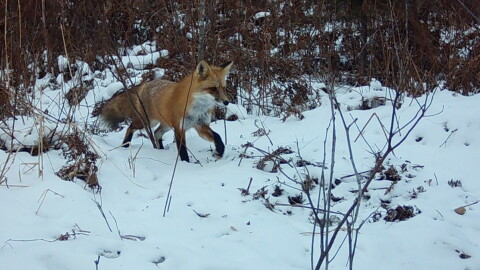 Grace Malinowski, program coordinator, discusses the Offal Wildlife Watching Project. The Community Science series is produced by Mark Jacobs.
 -
 The disease, which causes internal bleeding and sudden death, was confirmed Sept. 9, 2026. It does not affect humans.
 -
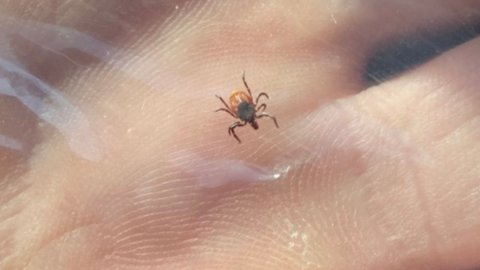 ContributedDozens of ticks as part of a study with the Marshfield Clinic Research Institute were submitted from the Bemidji area.
 -
 Christopher Smith, conservation committee chair for the Minnesota Herpetological Society, discusses how salamanders use dead and dying trees. The series is produced by Mark Jacobs.
 -
 Lorie Shaull/KAXEThe Minnesota Pollution Control Agency is surveying people's fish-eating habits to help limit contaminants in water bodies and make fish safer to eat.
 -
 Contributed/Daniel DewaldCisco and other cold water fish died by the thousands in the large, shallow lake as water temperatures soared to an average of 77 degrees in late July and early August 2026.


