



Long Lake Conservation Center near Palisade
This report is brought to you by Blakely, Valentine, Stella and the students from Sacred Heart School in Freeport, St. Mary's in Melrose and St. John's and St. Andrews.
“During our trip from February 18-20, we enjoyed a fresh blanket of snow and pleasant late-winter high temperatures in the low 30s.
“Our group enjoyed looking at the tracks in the fresh snow and even saw a mouse run out of the snow. The chickadees were heard singing their ‘cheeseburger’ song - a sure sign that spring is on its way.
“At the feeders we saw a Red-bellied Woodpecker, Hairy Woodpeckers and the season’s first Common Redpolls. They didn’t stick around long, but it was nice to see them. The red and grey squirrels were fun to watch at the window feeders. They sure eat a lot of seeds.
“Naturalist Danny tracked a porcupine on the south side of the lake. That’s the first porcupine sighting in quite a long time.
“One of the highlights of the trip was seeing spiders in the snow in the woods. We think that one was a species of funnel weaver, and the other is believed to be a type of fishing spider. It’s also possible that they were wolf spiders. ‘Snow spiders’ are specially adapted to cold with a natural antifreeze in their bodies. They move on top of the snow to hunt insects that can’t move because of the cold.
“Just like the spiders, we had fun in nature and we want to remind everyone to unplug, get outside and LIVE CONNECTED!”
Little Falls Middle School
“This is Lea, Katelynn, and Mya reporting from Little Falls Middle School. This is our phenology report for the week of Feb. 22.
“On Feb. 13 we heard a Cardinal singing loudly in the morning. It won’t be long before there is a chorus of birds each day before school.
“We also had our first sighting of a Red Tailed Hawk on Feb. 13.
“A classmate has a trail camera set up near a deer carcass. We have been able to see up to 6 Bald Eagles at a time feeding on it, and can see how their feathers change during each phase of life. We have also seen a Coyote approach the area.
“In the woods we have heard the calls of a Pileated Woodpecker, and they are entering into mating season.
“Mr. Kaddatz observed a male cardinal giving a seed to a female this week. He has never seen this before, and assumes it is part of a courtship display.
“The gray squirrels have become more active and aggressive, and males are chasing each other around our yards. We also have noticed the squirrel nests, or dreys, that are up in the trees.
“We had a live yellow woolly bear caterpillar found outside, and also a small ‘webby’ cocoon in a fir tree.
“There are large and noisy groups of crows flying around, especially around dawn and dusk.
“There have also been small and noisy groups of Trumpeter Swans flying overhead.
“Our first sign of spring are the branches of the red osier dogwood, as they are a bright red color this time of year.
“When people are driving around in the late afternoon and evening, they are reporting seeing large herds of deer out in the fields.
“We did get a report of a Black-backed Woodpecker in the area. This is a very rare sighting. Mr. Kaddatz has only seen one in his life.
“That is our report for this week, until next week, keep exploring, keep discovering, and keep connecting with the great outdoors.”
Linwood Elementary School in Wyoming, MN
"Greetings from the fourth-grade Phenology Team in the Linwood School Forest. This is Clara, Lydia, and Sophie reporting on our observations from the week ending Feb. 20.
“This week we observed a winter heat wave with temps into the 50s. Most of our snow in sunny places melted and left us with a huge lake on the playground.
“We also observed that the buds on our lilac tree are a reddish brown and the end of each branch has 2 buds on it.
“We also saw that our fallen red maple may be in fact a silver maple according to its buds. They are red clusters which, according to our bud book, means it is a silver maple - but we’re no experts... yet!
“It was reported to us that two squirrels got trapped in the dumpster at school. Our custodian helped them out by using a piece of wood as a little squirrel ramp.
“That is all from the Linwood School Forest, and remember: there’s no place like Linwood!”
Prairie Creek Community School in Northfield
Letty: “Hi, I’m Letty-”
Grace: “And I’m Grace-”
Letty: “And we’re from Prairie Creek Community School-”
Grace: “Way down south in Northfield, Minnesota.”
Letty: “This morning, Michelle heard a few cardinals singing before dawn!”
Grace: “Spring is on the way.”
Letty: “The willow trees are turning brighter yellow.”
Grace: “That’s another sign of spring!”
Letty: “There have been a ton of deer.”
Grace: “Ezri saw an eagle eating a deer.”
Letty: “An eagle almost hit Natalie’s car.”
Grace: “Many of us have also seen eagles.”
Letty: “But not as close as Natalie did!!”
Grace: “I saw a quail walking across a street and a possum in the road.”
Letty: “Hugo saw a baby squirrel.”
Grace: “Oscar saw a pheasant and a dead buck.”
Letty: “This has been Prairie Creek-”
Grace: “One more step along the phenology journey.”
What have you seen out there? Let us know: email us at comments@kaxe.org or text us at 218-326-1234.
For more phenology, subscribe to our Season Watch Newsletter and podcast or visit the Season Watch Facebook page.
Funding for this project was provided by the Minnesota Environment and Natural Resources Trust Fund as recommended by the Legislative-Citizen Commission on Minnesota Resources (LCCMR).
-
 The disease, which causes internal bleeding and sudden death, was confirmed Sept. 9, 2026. It does not affect humans.
 -
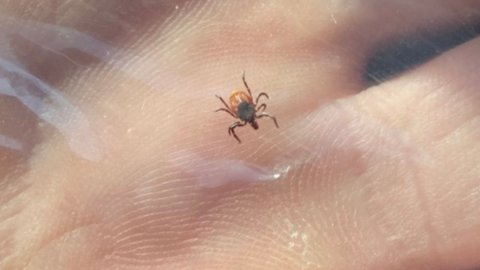 ContributedDozens of ticks as part of a study with the Marshfield Clinic Research Institute were submitted from the Bemidji area.
 -
 Christopher Smith, conservation committee chair for the Minnesota Herpetological Society, discusses how salamanders use dead and dying trees. The series is produced by Mark Jacobs.
 -
 Lorie Shaull/KAXEThe Minnesota Pollution Control Agency is surveying people's fish-eating habits to help limit contaminants in water bodies and make fish safer to eat.
 -
 Contributed/Daniel DewaldCisco and other cold water fish died by the thousands in the large, shallow lake as water temperatures soared to an average of 77 degrees in late July and early August 2026.
 -
 Contributed/Adobe Stock via Minnesota News ConnectionPublic health experts said states can better prepare for future illness outbreaks by keeping a sharp eye on climate change.


