



North Shore Community School near Duluth
“Hello from North Shore Community School on the north shore of Lake Superior. This is the phenology report for the week of Jan. 24, 2026. My name is Nora, and I am your phenologist for this week!
"On Sunday, Jan. 25, the local news reported that the temperature in Duluth was below zero for 85 continuous hours. On Monday, Jan. 26, Ms. Felton’s class noticed a rainbow sundog had formed around the sun. Sun dogs form when the light from the sun passes through ice crystals that have formed in the upper atmosphere. Sometimes sun dogs appear as bright lights on either side of the sun, and other times they look like a rainbow circling the sun. Also on this day, it was reported that Lake Superior had 30% ice coverage. From Jan. 24-31 we have gained 16 minutes of daylight!
"Harlequin Ducks and Buffleheads were spotted by Canal Park this past weekend! On Friday, Jan. 30, Ms. Lounsberry’s class heard a Pileated Woodpecker calling in the school forest. A moment later, a second one responded!
"Sunday, Jan. 25, Mrs. Rolfe spotted a bobcat by the Old North Shore Road and Berquist Road. She was excited as she hadn’t seen a bobcat yet this winter. On Monday, Jan. 26, Mrs. Pierson-Evans spotted a wolf crossing Highway 61 just west past Lakewood Road. It was hit by the car in front of her. She turned around to check on it, and it got up and moved towards the woods. She could see it was not using its right hind leg, but it was able to move forward. Mr. Jim drove by the spot a few hours later and noted there wasn't any blood, and the wolf was gone. He said the tracks were huge!
“On Thursday, Jan. 29, Mrs. Rolfe’s class was out for EE and found orange jelly fungus on some logs they were going to burn.
“This concludes the phenology report. Have a great week and be observant!”
Little Falls Middle School

“This is Emmett and Trent reporting from Little Falls Middle School. This is our phenology report for the week of Feb. 1.
“The bitter cold weather this past week has made it much harder to get out and make observations.
“On the coldest day of the winter, we had a sighting of a single robin sitting in on the ground.
“This bitter cold weather is hard on most animals, but especially on the opossums living around here, as they are not well adapted to cold weather.
“There are still flocks of Cedar Waxwings going from tree to tree in search of remaining fruit.
“We had a unique sighting of a radio collared wolf on a trail camera. It was located near Camp Ripley, where they do monitor a pack of wolves.
“The juncos were very active throughout the day at bird feeders. Even though they typically feed on the ground, they have started using the feeders too.
“We have heard and seen Great Horned Owls this past week.
“Most of our fields and roadsides have tall mullein plants that are easy to spot. Although the mullein plants are dead, they are still busy spreading their seeds as chickadees help by spilling them as they try to pick them out.
“A classmate had a raccoon sighting this week. Even though it is somewhat rare to see them this time of year, they will wander from their dens occasionally during the winter.
“We have seen red foxes and even a rare sighting of a bobcat this week.
“Crows and Bald Eagles are common sightings along sides of roads, often feeding on roadkill animals.
“That is our report for this week, until next week, keep exploring, keep discovering, and keep connecting with the great outdoors.”
Prairie Creek Community School in Northfield
Natalie: “Hi, I’m Natalie-”
Amelie: “And I’m Amelie-”
Natalie: “And we’re from Prairie Creek Community School-”
Amelie: “Way down south in Northfield, Minnesota.”
Natalie: “Well, Amelie, there is one way to describe this past week-”
Amelie: “COLD! Really, really cold.”
Natalie: “The ice was cracking and the snow was squeaky.”
Amelie: “Our creek is frozen all the way – except for the deepest part which was under a drift.”
Natalie: “I feel sorry for the kid who found that out!”
Amelie: “Three words: cold and wet!”
Natalie: “They also found a deer leg in the drift – so that was fun.”
Natalie: “There have been a TON of rabbits around. And we’ve seen a lot of rabbit scat.”
Amelie: “We have seen many Bald Eagles – some are alone and some are in pairs.”
Natalie: “Hugo reported Wild Turkeys-”
Amelie: “And Oscar reported 100 deer on his long, early drive to school.”
Natalie: “At forest school, we had fun following tracks and figuring out what they might be.”
Amelie: “We’ve seen juncos and chickadees and heard some woodpeckers.”
Natalie: “Michelle saw a flock of over 30 robins. They have been around her neighborhood all month.”
Amelie: “Next week, our fifth graders will be at Wolf Ridge ELC up in Finland. I’m so excited.”
Natalie: “I can’t wait to hear what phenology see and hear up there!”
Amelie: “This has been Prairie Creek-”
Natalie: “One more step along the phenology journey.”
Listener Talkbacks
What have you seen out there? Let us know: email us at comments@kaxe.org or text us at 218-326-1234.
For more phenology, subscribe to our Season Watch Newsletter and podcast or visit the Season Watch Facebook page.
Funding for this project was provided by the Minnesota Environment and Natural Resources Trust Fund as recommended by the Legislative-Citizen Commission on Minnesota Resources (LCCMR).
-
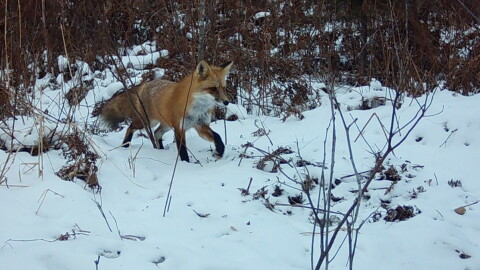 Grace Malinowski, program coordinator, discusses the Offal Wildlife Watching Project. The Community Science series is produced by Mark Jacobs.
 -
 The disease, which causes internal bleeding and sudden death, was confirmed Sept. 9, 2026. It does not affect humans.
 -
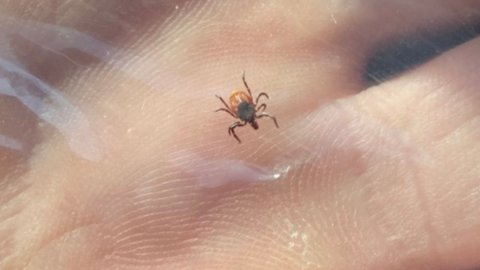 ContributedDozens of ticks as part of a study with the Marshfield Clinic Research Institute were submitted from the Bemidji area.
 -
 Christopher Smith, conservation committee chair for the Minnesota Herpetological Society, discusses how salamanders use dead and dying trees. The series is produced by Mark Jacobs.
 -
 Lorie Shaull/KAXEThe Minnesota Pollution Control Agency is surveying people's fish-eating habits to help limit contaminants in water bodies and make fish safer to eat.
 -
 Contributed/Daniel DewaldCisco and other cold water fish died by the thousands in the large, shallow lake as water temperatures soared to an average of 77 degrees in late July and early August 2026.


