



Emerald ash borer in deep cold
North Star Elementary School in Virginia
North Shore Community School near Duluth
“Hello from North Shore Community School on the north shore of Lake Superior. This is the phenology report for the week of Jan. 17, 2026. My name is Gavin and I am your phenologist for this week!
"On Friday, Jan. 16 and Saturday, Jan. 17, we accumulated 5-6 inches of light, fluffy snow. On the morning of Monday, Jan. 19, Duluth recorded a negative 41-degree windchill. Frostbite can set in within 5-10 minutes. Many students reported observing ‘sea smoke’ on Lake Superior. Sea smoke occurs when the air temperature is colder than the water temperature. On Tuesday, Jan. 20, the ice coverage for Lake Superior was reported at 10%. Also, by the end of this week, our area will experience the coldest air since 2021.
"On Sunday, Jan. 28, Ms. Urban noticed flocks of ducks on Lake Superior, including Common Goldeneyes and Red-breasted Mergansers. Monday, Jan. 19 brought several female Pine Grosbeaks to Mrs. Rolfe's neighbor's bird feeder along with three bright red males!
“On Tuesday, Jan. 20, Ms. Young’s class saw small tunnels in the snow, with large, feather-shaped ice crystals forming at the openings. The crystals tell us that small animals are living under the snow in that spot. As they breathe, the warm air from their breath rises until it passes through the hole in the snow. The warm air cools as it exits the protection of the hole, and the moisture in the creature’s breath condenses to create feather-shaped ice crystals. On Wednesday, Jan. 21, Ms. Helgesen’s class saw signs of active snowshoe hares at their bunny restaurant. They noticed scat, bite marks and tracks leading toward their restaurant. Also on Wednesday, Ms. Markon’s class found lots of evidence of active snowshoe hare. They found three sticks completely nibbled, with no bark left!
"Mrs. Markon’s kindergarten class started measuring the snowbank outside their classroom window on Tuesday, Jan. 20. It measured 72 and 1/2 inches tall. Since they are measuring in an L shaped corner, this makes that spot a perfect place for snow to pile higher and higher as it is mostly protected from the wind. On Wednesday, Jan. 21, a rare winter phenomenon was spotted over Lake Superior: a cold air winter funnel. This occurs when a narrow, weak vortex forms when very cold air meets warmer ground air-often due to a polar vortex or high-pressure system funneling Arctic air South. This indicates that Lake Superior is much warmer than the air temperature.
“This report is being recorded on Thursday, Jan. 22 instead of Friday, Jan. 23. There is a high probability that school will be cancelled tomorrow due to the extreme cold temperature and wind chill forecast of negative 40 to negative 50 degrees for this evening and Friday morning. Stay safe and stay warm!
“This concludes the phenology report. Have a great week and be observant!”
Long Lake Conservation Center near Palisade
This report is brought to you by Ray, George, Jake and the new Minnesota Master Naturalists who visited LLCC from Jan. 17-21.
Long Lake Conservation Center said: "This report is brought to you by Tegan, Paycen and the students from Bertha-Hewitt Elementary who braved the cold for a fun outdoor adventure. They even tested a theory that you can pound a nail with a frozen banana. It was a delicious experiment. There might have been a few frozen bubbles, too. This is B-H's 51st year coming to Long Lake."
“During our trip to Long Lake Conservation Center on Jan. 22-23, it was cold. Really, really, really cold with the high temperature of -7 and a low of –30 degrees. It was the coldest temperature of the year. The last time it was this cold was February 13 , 2021, when it reached 31 below.
“Many schools in the state were closed, but it didn’t stop us from getting outside and exploring. In the ‘warmth of the day’ we bundled up, played snow snakes on the lake, and went cross country skiing.
“We learned that when it gets really cold, trees that are holding lots of moisture can crack and explode. No trees exploded during our trip.
“We tested a theory that you can pound a nail with a frozen banana and it actually worked. We tested another theory to see if bubbles froze and they did.
“Although we went exploring, the mammals seemed to be bundled up. We only noticed a few chickadees, nuthatches, a Red-bellied Woodpecker and red and gray squirrels. They grabbed a quick meal of seeds and quickly went back to warm up.
“It’s always fun to explore nature, and we encourage everyone to unplug, bundle up, get outside and LIVE CONNECTED!”
Little Falls Middle School
“This is Kylee, Brielle, and Peyton reporting from Little Falls Middle School. This is our phenology report for the week of Jan. 25.
“We are still seeing a small flock of robins hanging around Little Falls. There still seems to be a lot of fruit on trees to keep them fed this winter.
“We have heard the Great Horned Owls and also had a Barred Owl sighting.
“The fruit of the sumac trees is a dark red color right now. We know birds eat them, but we have yet to see a bird feeding on sumac.
“With the colder weather, you can really see how the birds puff up their feathers to try to trap air for insulation.
“A large number of our goldenrod plants have a round gall on their stem. This is caused by the goldenrod gall fly, and the larvae can be found inside the spongy gall.
“Some of these galls have holes in their side, which indicates a chickadee or Downy Woodpecker has probably found the larvae and had a meal.
“We are searching all rocks and trees to try to see as many different species of lichen as we can find this week.
“We had a sighting of a lone Mourning Dove and a Pileated Woodpecker.
“A lot of our animals, primarily rabbits, have been hanging out under our white cedar trees.
“We have seen a few more red foxes this week as they are starting mating season and becoming more active during the day.
“There have been random Asian beetles and box elder bugs appearing in our homes, as they have apparently woken up from hibernation.
“That is our report for this week, until next week, keep exploring, keep discovering, and keep connecting with the great outdoors.”
Listener talkbacks
What have you seen out there? Let us know: email us at comments@kaxe.org or text us at 218-326-1234.
For more phenology, subscribe to our Season Watch Newsletter and podcast or visit the Season Watch Facebook page.
Funding for this project was provided by the Minnesota Environment and Natural Resources Trust Fund as recommended by the Legislative-Citizen Commission on Minnesota Resources (LCCMR).
-
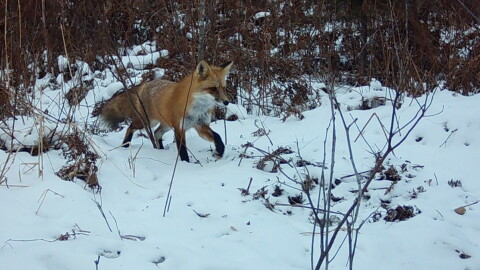 Grace Malinowski, program coordinator, discusses the Offal Wildlife Watching Project. The Community Science series is produced by Mark Jacobs.
 -
 The disease, which causes internal bleeding and sudden death, was confirmed Sept. 9, 2026. It does not affect humans.
 -
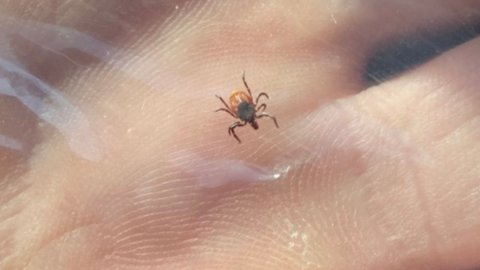 ContributedDozens of ticks as part of a study with the Marshfield Clinic Research Institute were submitted from the Bemidji area.
 -
 Christopher Smith, conservation committee chair for the Minnesota Herpetological Society, discusses how salamanders use dead and dying trees. The series is produced by Mark Jacobs.
 -
 Lorie Shaull/KAXEThe Minnesota Pollution Control Agency is surveying people's fish-eating habits to help limit contaminants in water bodies and make fish safer to eat.
 -
 Contributed/Daniel DewaldCisco and other cold water fish died by the thousands in the large, shallow lake as water temperatures soared to an average of 77 degrees in late July and early August 2026.


