



North Shore Community School near Duluth
“Hello from North Shore Community School on the north shore of Lake Superior. This is the phenology report for the week of Jan. 3, 2026. My name is Adelyn, and I am your phenologist for this week!
"January is known as the Great Spirit Moon according to the Ojibwe. On Saturday, Jan. 3, we woke up to a dusting of snow. That evening, there was a full moon. There were 8 hours and 53 minutes of daylight. The amount of daylight is slowly lengthening. On Sunday, Jan. 4, our area accumulated about 1-2 inches more of fluffy, light snow. Also on this day, it was noted that the water in the Duluth Harbor was starting to freeze. On Wednesday, Jan. 7, Ms. Jackson’s class noticed the snow was very wet, and easy to form into shapes. This is probably because the temperature was 34 degrees, and the above freezing temperatures made the snow a different consistency. On Thursday, Jan. 8, we woke up to dense fog with visibility of one quarter mile or less. The fog remained all day long.
“On Thursday, Jan. 1, Ms. Pierson-Evans spotted 8 Golden Eagles at the end of Park Point sitting in a tree, and one eagle flying. On Saturday, Jan. 3, Ms. Urban saw lots of waterfowl at Canal Park including a Bufflehead, a Harlequin Duck, and hundreds of Goldeneyes and flocks of Mallards. On Tuesday, Jan. 6, Ms. Young’s class saw the tracks of a grouse walking through the school forest.
“On Monday, Jan. 5, Ms. Markon’s class saw a tunnel going into the snow with lots of leaves and debris spread out around the hole. On Tuesday, Jan. 6, Ms. Beagle’s class found three deer beds and a spot where deer had been foraging for food. The forage area had lots of disturbed snow and leaves, and muzzle prints where the deer had been searching for snacks. Ms. Beagle’s class also found a dead mouse stuck in a tree. They are wondering if a raven stashed it there for later. On Wednesday, Jan. 7, Ms. Jackson’s class spotted snowshoe hare tracks as they were out snowshoeing for EE class.
"On Wednesday, Jan. 7, Bennet noticed two small spiders crawling on a tree in the school forest. They were moving around and active, not hibernating!
“This concludes the phenology report. Have a great week and be observant!”
Long Lake Conservation Center near Palisade
“Hi, this is Emma Kippley-Ogman with the Legends and Lore Winter Writers’ Retreat at Long Lake Conservation Center. During our visit from Jan. 4-7, the low temperature was 16 degrees and the high was 35.
“This week we noticed many birds – a female Hairy Woodpecker pecking out a rhythm on an old birch tree, Red-bellied Woodpeckers on the trees near the dining hall, Pileated Woodpeckers calling and flying through the trees, a raven calling and another one picking up and flying off with a snowball in its beak, Blue Jays, White- and Red-breasted Nuthatches, a Pine Grosbeak and Black-capped Chickadees.
“We saw a vole scampering across the snow, and a red squirrel chasing a gray one away from the leftover pancakes. We saw deer tracks and scat.
“We noticed birch seeds on the snow, and bright green and orange lichens of many textures on the trees. We noticed thaw circles at the bases of trees. On our way here, despite temperatures in the 20s, rain fell in freezing pellets, coating car windshields and stinging our faces. One morning, the rime frost from an overnight fog outlined every oak leaf like a crayon drawing and every twig and needle.
“We had a great time writing and sharing; hearing from remarkable local storytellers Beth Hautala, Hope Flanigan, and Michael Goldberg, and learning with the naturalists of Long Lake; hiking, skiing and making pine needle baskets, and we want to remind everyone to unplug, get outside, and LIVE CONNECTED!”
Little Falls Middle School

“This is Emily and Maegen reporting from Little Falls Middle School. This is our phenology report for the week of Jan. 11.
“There was a single robin aggressively chasing Cedar Waxwings away from fruit on atree.=
“We have seen adult and juvenile Bald Eagles, along with crows, feeding on roadkill deer.
“We had sightings of a Rough-legged Hawk and a Sharp-shinned Hawk, which were birds 70 and 71 on our bird species count for the school year.
“We got to see pictures of the juvenile Sharp-shinned Hawk feeding on a House Sparrow it had caught. We learned that they must pluck the feathers off their prey before eating.
“Our feeder activity has really increased, with Purple Finches, juncos, chickadees, goldfinches, Red- and White-breasted Nuthatches, cardinals, Blue Jays, Red-bellied Woodpeckers, and Downy Woodpeckers being frequent visitors.
“Our newest discovery this week was the tiny Fairy Pin fungus growing on Turkey Tail fungi. These tiny black stalks are a parasitic fungus.
“A few classmates spotted a deer mouse while they were skiing. It quickly dove under the snow, headed back to the subnivean zone.
“We did have observations of juncos hopping into a snow tunnel made by rabbits near some shrubs.
“A couple different people found smallholes in the snow, that were probably air vents that led to tunnels used by voles.
“A classmate had a situation where a group of Blue Jays were loudly alerting others to their presence when they were out by a bird feeder.
“We had a fun sighting of a gray squirrel balanced on the tiny tips of branches, eating the small seeds of an Amur Maple.
“That is our report for this week. Until next week, keep exploring, keep discovering, and keep connecting with the great outdoors.”
Linwood Elementary School
"Greetings from the fourth-grade Phenology Team in the Linwood School Forest. This is Liliana, Izzy, and Liam reporting on our observations from the week ending Jan. 9.
“This week, we observed a pair of Bald Eagles high up in a cedar tree. They were cackling loudly at something on the ground.
“We also observed that rabbits have been chewing on the bark of our fallen red maple. We know it was rabbits because we can see their footprints and droppings all around the tree.
“We also saw that many of our oak trees still have leaves hanging on. We wonder, ‘Why do oak trees hold onto their leaves well into winter?’
“In the forest, we saw tiny little bugs on top of the snow that looked like gnats. We never knew that bugs could survive outside during the winter.
“That is all from the Linwood School Forest, and remember: There’s no place like Linwood!”
Caledonia High School in Houston County
“Hi, this is Keonte, Jonah, and Cooper reporting from Caledonia High School in Caledonia, MN. On Jan. 9, we noticed most of the snow has melted after we received ⅞” of rain, which is the most rain on record in January.
“Red oaks still have their leaves.
“Birds have been active at feeders. Black-capped Chickadees are beginning to sing. Deer have been shedding their antlers. A Belted Kingfisher has been staying close by the open water at Beaver Creek. Wild Turkeys have been walking ridge tops in search of acorns.
“The end of December brought blizzard conditions.
“This has been Keonte, Jonah, and Cooper reporting from Caledonia High School. Never stop questioning.”
What have you seen out there? Let us know: email us at comments@kaxe.org or text us at 218-326-1234.
For more phenology, subscribe to our Season Watch Newsletter and podcast or visit the Season Watch Facebook page.
Funding for this project was provided by the Minnesota Environment and Natural Resources Trust Fund as recommended by the Legislative-Citizen Commission on Minnesota Resources (LCCMR).
-
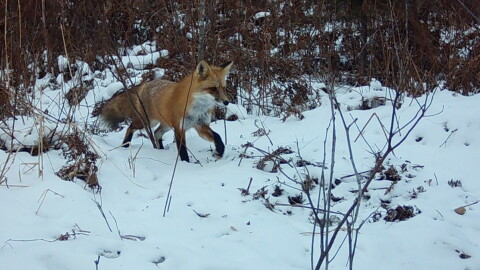 Grace Malinowski, program coordinator, discusses the Offal Wildlife Watching Project. The Community Science series is produced by Mark Jacobs.
 -
 The disease, which causes internal bleeding and sudden death, was confirmed Sept. 9, 2026. It does not affect humans.
 -
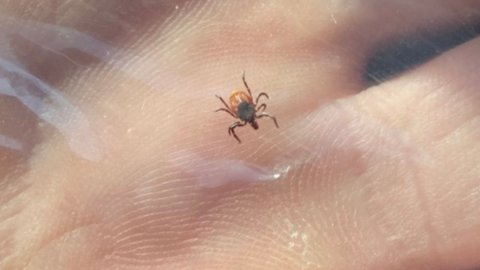 ContributedDozens of ticks as part of a study with the Marshfield Clinic Research Institute were submitted from the Bemidji area.
 -
 Christopher Smith, conservation committee chair for the Minnesota Herpetological Society, discusses how salamanders use dead and dying trees. The series is produced by Mark Jacobs.
 -
 Lorie Shaull/KAXEThe Minnesota Pollution Control Agency is surveying people's fish-eating habits to help limit contaminants in water bodies and make fish safer to eat.
 -
 Contributed/Daniel DewaldCisco and other cold water fish died by the thousands in the large, shallow lake as water temperatures soared to an average of 77 degrees in late July and early August 2026.


