



North Shore Community School near Duluth
“Hello from North Shore Community School on the north shore of Lake Superior. This is the phenology report for the week of Dec. 6, 2025. My name is Caleb, and I am your phenologist for this week!
"On Tuesday, Dec. 9, 2025, we woke up to 3-4 inches of light, fluffy snow. When Ms. Jackson’s class went out to explore the creek on our school nature trail, they noticed that the ice was slushy. Many students were walking on the creek and under the bridge without any ice cracking. But, when they poked at the ice with a large stick, the ice would break. As of Wednesday, Dec. 10, temperatures were remaining below average. We are experiencing a cold start to winter that we haven’t had in nearly two decades. The last time Duluth started this cold was in 2007 when the average high was 7.4 degrees Fahrenheit. The coldest start to December was in 1972 with an average daytime high of -4.2 degrees Fahrenheit.
"On Wednesday, Dec. 10, Mrs. Rolfe’s class went to Chickadee Landing to observe birds at the bird feeder. They only saw 5 chickadees come to the feeder, but as they listened, they heard so many more than they ever saw. They estimated that there were at least 20-30 chickadees chirping. They had never heard so many at one time at Chickadee Landing before. Their calls are a complex communication system used to warn other birds about predators, announce new food sources, and coordinate flock movement. The number of ‘dees’ from the call of a chickadee indicates the level of perceived threat, with more ‘dees’ used for smaller, faster, and thus more dangerous, predators like a sharp-shinned hawk. When a human is nearby, they may add a few extra ‘dees’ to their call because, to them, you are a large, potential threat. On Thursday, Dec. 11, Finn and Hans saw 3 grouse in the school forest. They also observed lots of grouse tracks and scat.
"On Tuesday, Dec. 9, Ms. Urban was walking on the nature trails and saw the tracks of deer and mice. Ms. Young’s class saw the tracks of a snowshoe hare. On Wednesday, Dec. 10, Jaxton spotted a rabbit den on the school nature trail while his class was out for EE. There were tracks leading in and out of the den. Also on this day, Will spotted an eagle circling above in the sky above the trees.
“This concludes the phenology report. Have a great week and be observant!”
Long Lake Conservation Center near Palisade
This report is brought to you by Neepa, Trinity and Mukwa from Dream of Wild Health in Minneapolis. Dream of Wild Health is an indigenous organization with a mission to restore health and well-being in the Native community by recovering knowledge of and access to healthy Indigenous foods, medicines and lifeways.
“Our trip to Long Lake Conservation on Dec. 12-14 was the coldest trip here this winter! The highs started at 15 degrees on Friday, but temperatures stayed below 5 degrees for the rest of our trip, with the low reaching -20! It was the coldest day here since Feb. 12 of this year.
“Despite the cold, we still had a great time exploring outside! One of the highlights was the amazing Geminids meteor shower on Dec. 13! Caused by cosmic debris known as meteoroids, this shower happens once a year and is known for being one of the strongest and most visible showers here in Minnesota. Some meteoroids were visible for over 4 seconds!
“During the day, we also got the chance to see lots of signs of wildlife while we explored nature on foot, on skis, and on snowshoes. Some exciting finds were the rabbit droppings, coyote tracks, as well as mouse tracks leading into burrows under the ground where they spend most of their time keeping warm during the winter below the frost line.
“Despite the cold, we were also able to spot several different bird species throughout our trip, with the woodpeckers being especially active on our suet feeders. More specifically, we were able to identify 4 different species of woodpeckers including Downy, Hairy, Pileated, and Red-bellied Woodpeckers.
“Overall, we had an amazing time getting to learn and try new things and we want to remind everyone to unplug, get outside, and LIVE CONNECTED!”
Little Falls Middle School

"This is Cora and Olivia reporting from Little Falls Middle School. This is our phenology report for the week of Dec. 14.
“A classmate was moving some items from a woodpile, and found a large mouse nest built out of insulation.
“Mr. Kaddatz had a bat in his house this week, he was able to get it outside, but is now curious about where it came in from.
“We had a couple Barred Owl sightings and have also heard them calling at night.
“We spotted a group of 7 deer together in a field; could they be yarding up already?
“There was a large flock of Cedar Waxwings feeding on the fruit trees outside our classroom window.
“There are small cone like objects growing on willow trees, that are actually willow cone galls. Each one has a small larva inside along with numerous hibernating insects and spiders.
“There are also strange objects on tree branches that looks like animal droppings on a stick. It is actually a gall caused by black knot fungus.
“One of our classmates was lucky enough to find a pseudoscorpion in her house. Even though they look intimidating, they are harmless and eat other pests.
“A classmate chased a vole running across the snow before it disappeared into a tunnel near a tree trunk.
“Cottontail rabbits are a very common sight around sundown, and we also had a rare sighting of a jackrabbit.
“We had a sighting of a muskrat on the ice of a lake. It appeared like it couldn’t find its hole back into the water.
“That is our report for this week, until next week, keep exploring, keep discovering, and keep connecting with the great outdoors.”
Rockford Middle School
"Hello, this is Payton, Barrett, Keira, Hannah, Marshall, Savannah, and Ethan from Ms. K’s sixth grade class at Rockford Middle School. We are reporting on Dec. 5-13.
“Our temperatures have been all over the place ranging from a high of 31 degrees and a low of -8 degrees. There’s been a mix of cloudy and sunny days.
“We finally got our wish for a lot of snow. It is starting to feel like we live in a snow globe, with snow flurries almost every day.
“We noticed that the oak trees are holding on to some of their crisp, brown leaves. Ethan saw fresh bunny tracks in his backyard; Keira saw a Trumpeter Swan couple along with a flock of geese. Oliver and a couple classmates noticed that some Bald Eagles have been flying back and forth over the Crow River a few days in a row. We heard the Black-capped Chickadees singing out in our school forest, but had trouble seeing them. Beckett saw 2 flocks of Trumpeter Swans. Ms. K noticed geese flying east. The left side of the ‘V’ was three times longer than the right side of the ‘V’.
“Ian reported that Lake Sarah had about 5-6 inches of ice and people were out there fishing and skating. On Wednesday, Dec. 10, we got about 6 inches of snow. Overnight the sky was illuminated and gave off opalescent vibes.
“Thank you for listening. We will be back with more phenology findings in the new year after our winter break. Bye!”
What have you seen out there? Let us know: email us at comments@kaxe.org or text us at 218-326-1234.
For more phenology, subscribe to our Season Watch Newsletter and podcast or visit the Season Watch Facebook page.
Funding for this project was provided by the Minnesota Environment and Natural Resources Trust Fund as recommended by the Legislative-Citizen Commission on Minnesota Resources (LCCMR).
-
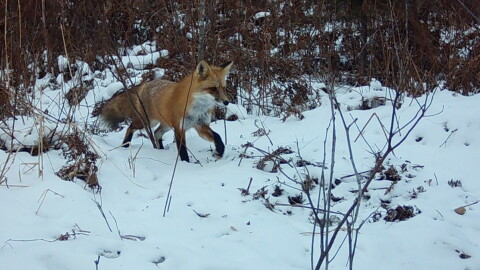 Grace Malinowski, program coordinator, discusses the Offal Wildlife Watching Project. The Community Science series is produced by Mark Jacobs.
 -
 The disease, which causes internal bleeding and sudden death, was confirmed Sept. 9, 2026. It does not affect humans.
 -
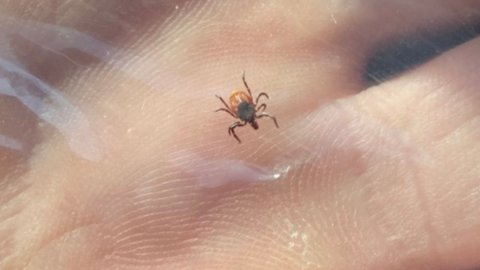 ContributedDozens of ticks as part of a study with the Marshfield Clinic Research Institute were submitted from the Bemidji area.
 -
 Christopher Smith, conservation committee chair for the Minnesota Herpetological Society, discusses how salamanders use dead and dying trees. The series is produced by Mark Jacobs.
 -
 Lorie Shaull/KAXEThe Minnesota Pollution Control Agency is surveying people's fish-eating habits to help limit contaminants in water bodies and make fish safer to eat.
 -
 Contributed/Daniel DewaldCisco and other cold water fish died by the thousands in the large, shallow lake as water temperatures soared to an average of 77 degrees in late July and early August 2026.


