



North Star Elementary School in Virginia
“This is Lyla, Walter, Ben, and Maddie with a report from North Star Elementary on Dec. 5, 2025.
“This is Lyla with a weekly weather report. The average snow depth in our schoolyard is about 6 inches. We saw the first sub-zero temperatures for the year on the morning of Dec. 4. Ms. Jouhala reported that it was -6º this morning at her house. Mrs. Morley had -4º at her house and noticed many chimneys with smoke coming out this morning. At Mr. Galloway’s house, it was -20º. Nurse Alex reported -16º at her house. Kris in the cafeteria described the morning as cold and crisp.
“Walter here with an ice report for you. Silver Lake in Virginia is 97% covered in ice. There is a spot by the power plant that almost never freezes because of the warm water that drains from it. There have been people ice fishing out in the middle of the lake. The ice has to be at least 4-6 inches thick to hold a person and their gear.
“This is Ben with a bird report. I saw a Mallard flying overhead yesterday. Oscar saw a raven and Abby saw two crows and heard them cawing at each other. Ravens and crows are similar, but you can tell the difference by their size (ravens are bigger), their tail shape (ravens have diamond-shaped tails and crows have fan-shaped tails) and their vocalization (ravens make a croaking noise and crows make a cawing noise).
“This is Maddie with a mammal report. Ms. Sandstede is glad that the bears have stopped tearing down her bird feeders. Mr. Mike saw a snowshoe hare that was mostly white this week.
“This has been a report from North Star Elementary in Virginia. Keep exploring the great outdoors!”
Cohasset Elementary School
North Shore Community School near Duluth
“Hello from North Shore Community School on the north shore of Lake Superior. This is the Phenology Report for the week of Nov. 29, 2025. My name is Ilo, and I am your phenologist for this week!
"On Tuesday, Nov. 25, we experienced the first measurable heavy, wet snow of about 7-8 inches. On Saturday, Nov. 30, a round of lake effect light, fluffy snow of about 5-6 inches was accumulated. From Dec. 1-8 we lost 10 minutes of daylight. Winter solstice is Dec. 21 and the daylight hours will start to get longer again. On Sunday, Nov. 31, Ms. Urban went skiing for the first time this season! On Monday, Dec. 1, Ms. Felton’s class noticed the stream was mostly frozen over, except for one spot that had visible moving water underneath. The ice was easily broken by poking it with a stick. The next day on Tuesday, Dec. 2, the preschoolers noticed the same spot in the stream had only a small layer of ice.
"Mrs. Rolfe’s neighbor reported that, on Sunday, Nov. 30, he had a Northern Shrike flying about in his yard. The bird was probably hunting for its next meal. On Monday, Dec. 1, Braelynn from Ms. Jackson's class spotted an eagle that looked like it was trying to find some food for winter. Mrs. Rolfe’s class was out on the school nature trail looking for a good spot to create some nature art, on the Orange Trail, when they spotted a stunning Long-eared Owl sitting on a stump. We were within 10 feet of the owl, with the owl almost at sixth-grade student’s eye level. The owl stayed for the entire time that we were out for EE. Migrating Long-eared Owls are nocturnal and can travel long distances. Birds banded in the northern U.S. and southern Canada have been recovered in Mexico. Research suggests that female Long-eared Owls are more likely to migrate than males. Based on this information Mrs. Rolfe’s class believes that the owl they saw was a male.
"On Monday, Dec. 1, Ms. Gallagher’s class found a deer bed in the school forest. The students saw leaves and some ice that had collected on the bottom, where the deer’s body heat warmed up the snow and, when it refroze later, it became ice. On Saturday, Nov. 29, for the first time Nora saw two river otters in her aunt's creek in Little Falls, Minnesota. After our first snowfall, on Nov. 30, Mrs. Rolfe found signs that a cottontail rabbit had spent the night in her unused dog house. On Wednesday, Dec. 3, the preschoolers saw a vole running across the snow and then tunneling underneath. It had a fairly long, dark brown body with a short tail.
“This concludes the phenology report. Have a great week and be observant!”
Long Lake Conservation Center near Palisade
This report is brought to you by Maisy, DK, Rylie, Natalie, Charlie, Milo, Lily and the students from Andover Elementary.
“Our trip to Long Lake Conservation Center on Dec. 1-5 was COOOOOOOLD! The low was 12 degrees below zero. This was the coldest day of the season so far and the first below zero reading since Jan. 19 of 2025.
“The cold didn’t stop us from exploring nature. One of the highlights was seeing a Pine Grosbeak. The last sighting was a couple of weeks ago when a flock of grosbeaks were migrating through. It is not common to see Pine Grosbeaks at Long Lake.
“During our explorations of the woods and wetlands on foot and by snowshoe, we saw hundreds of animal tracks and trails, plus a whole lot of scat - that’s science for poop. We saw a deer bed, plus deer, bunny, coyote, squirrel tracks and mouse and vole tunnels under the snow. The fancy science word for those tunnels is subnivean trails.
“Our group saw a couple of very large Pileated Woodpeckers on the suet, and chickadees, nuthatches and gray squirrels at the feeders.
“We saw a snow spider in the bog. The two most common types of spiders that are active on top of the snow are Dwarf Spiders and Wolf Spiders. The one we saw was a Wolf Spider. These are pretty big and scary looking but are harmless to people and eat lots of bugs.
“At night, we saw the December “Cold Supermoon”. It was 10 percent bigger than normal because it’s about 17,000 miles closer to the Earth. We heard the lake “creak and crack” loudly as ice formed. A Long Lake teacher measured the thickness of the ice 20 feet from shore. It is 5 inches thick.
“We had a great time in the snow and want to remind everyone to unplug, get outside and LIVE CONNECTED!”
Little Falls Middle School

“This is Emma and Brodi reporting from Little Falls Middle School. This is our phenology report for the week of Dec. 7.
“One surprising discovery this week was a mosquito on Dec. 2. We were thinking it might have been hibernating in something that was brought indoors.
“We thought we may have seen our first Pine Siskin of the winter, but did not get a positive ID, so we are not going to add it to our bird list.
“This year our class is doing a school year bird count, and we are currently up to 68 birds that have been spotted. We are hoping to make it to 100 by the end of the school year.
“Deer, rabbits, squirrels, and many songbirds look puffed up as the weather has gotten much colder, and they are trapping air for insulation.
A student found a rose plant with rose hips, but it also had some spiky growths. We have never seen this before, but it could be a gall.
“There are a large number of vole tunnels and mouse tracks in the snow. The voles typically scurry around while the mice leave hopping tracks.
“Both of these rodents are spending time in the subnivean zone beneath the snow, as it is much warmer and safer than at the surface.
“A classmate spotted a Northern Shrike perched high at the top of a tree and was able to observe and photograph it for several minutes.
“We have seen Bald Eagles eating roadkill deer, and have found short-tailed shrews feeding on deer carcasses.
Now that the leaves are gone, we can see black knot fungus galls on tree branches
“We have seen and heard several small groups of Trumpeter Swans as they fly overhead.
“That is our report for this week, until next week, keep exploring, keep discovering, and keep connecting with the great outdoors.”
Linwood Elementary School
"Greetings from the fourth-grade phenology team in the Linwood School Forest. This is Liam, Hayden, and Reeva reporting on our observations from the week ending Dec. 5.
“This week, we observed that we have snow cover that seems like it might stay all winter. It started as rain, but as the temperature dropped it turned to snow.
“We also observed the wind was blowing from the northwest on Wednesday and it brought very cold air with it. It was about –10 degrees on Thursday morning when we woke up.
“With all the snow, we were able to look for animal tracks in the forest. We saw squirrel, rabbit, turkey, and (we think) wood rat prints.
“In the forest, we followed some deer tracks through the trees. We saw where it stopped to dig in the snow, and we think it was eating something. We wonder how animals survive all winter when the snow gets deep!
“That is all from the Linwood School Forest, and remember: There’s no place like Linwood!”
Caledonia High School
“Hi, this is Layton, Jaycie, and Brayden reporting from Caledonia High School in Caledonia, MN.
“On Dec. 4, we noticed the cold supermoon. We had our first negative-degree day. It dropped to around -9. Ice covering smaller, shallow bodies of water: No ice yet on the main channel of the Mississippi River.
“Red oaks still have their leaves. White oaks have dropped their leaves. We have noticed white pine needles shedding.
“Coyotes are being more active. We are also seeing them during the day. We noticed increased bird activity the day after the snowstorm last weekend, including bigger groups of Blue Jays at feeders. This was our first major snowfall on Nov. 29.
“This has been Layton, Jaycie, and Brayden reporting from Caledonia High School. Never stop questioning."
Ian Welsh
“Happy Holidays, KAXE — I think I’ve captured a couple of sundogs this subzero morning! The rainbow effect was caused by ice particles just above ground.”
What have you seen out there? Let us know: email us at comments@kaxe.org or text us at 218-326-1234.
For more phenology, subscribe to our Season Watch Newsletter and podcast or visit the Season Watch Facebook page.
Funding for this project was provided by the Minnesota Environment and Natural Resources Trust Fund as recommended by the Legislative-Citizen Commission on Minnesota Resources (LCCMR).
-
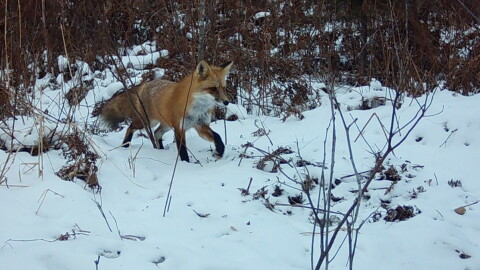 Grace Malinowski, program coordinator, discusses the Offal Wildlife Watching Project. The Community Science series is produced by Mark Jacobs.
 -
 The disease, which causes internal bleeding and sudden death, was confirmed Sept. 9, 2026. It does not affect humans.
 -
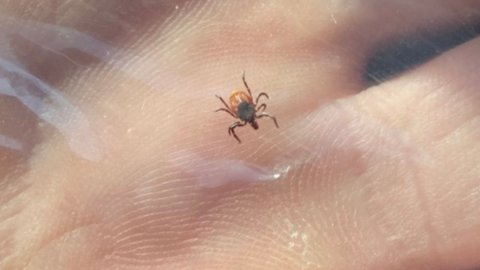 ContributedDozens of ticks as part of a study with the Marshfield Clinic Research Institute were submitted from the Bemidji area.
 -
 Christopher Smith, conservation committee chair for the Minnesota Herpetological Society, discusses how salamanders use dead and dying trees. The series is produced by Mark Jacobs.
 -
 Lorie Shaull/KAXEThe Minnesota Pollution Control Agency is surveying people's fish-eating habits to help limit contaminants in water bodies and make fish safer to eat.
 -
 Contributed/Daniel DewaldCisco and other cold water fish died by the thousands in the large, shallow lake as water temperatures soared to an average of 77 degrees in late July and early August 2026.


