


DEER RIVER — A stone eagle sits on a black stone pillar with a picture of Helen Jean (Charwood) Bryan outside of the small tan and green White Oak Casino in Deer River.
The new monument honors the 50th anniversary of Bryan v. Itasca — a landmark U.S. Supreme Court case. Bryan and her husband Russell Bryan were the lead plaintiffs in the case. Decided in June 1976, the case paved the way for the tribal gaming industry.
Phil Johnson, general manager at White Oak Casino, said the biggest reason for the monument is to educate people.
“If you go talk to even our own Native kids, I bet you 80% of them don’t even know about this stuff,” Johnson said.

Even Breanna Miettinen, the Bryans’ granddaughter, didn’t know about the case until her college years.
“It wasn’t something that she ever was looking for recognition about,” Miettinen said. “It wasn’t anything that she shared on down with everyone else.”
The monument was unveiled during a commemoration event on June 14, exactly 50 years after the Supreme Court decision. Miettinen and her brother Corey Miettinen spoke at the event to honor their grandmother, who died in 2022 at age 82.
“I wanted to focus more on remembering her as my grandmother and as a community member, and just who she was to all of us,” Breanna Miettinen said. “Someone who cared deeply, for all of our family and her community and stuff.”

Other speakers included Johnson, tribal civics instructor Levi Brown and Leech Lake Tribal Chairman Faron Jackson. Spiritual leader Andrew Jackson blessed the event.
The case started when the Bryans were taxed $147.95 by Itasca County on their mobile home on the Leech Lake Band of Ojibwe Reservation.
The Bryans went to the Leech Lake Reservation Legal Services Project — now known as the Anishinabe Legal Services—and worked with the organization to file a lawsuit. The attorneys there argued the state did not have the authority to tax the Bryans, as they were on tribal land.
At that time, laws were clear that a state couldn’t tax real property: property that is permanently attached to the land, like buildings, trees and the land itself. However, it was an open question on whether the state could tax a mobile home. Due to its mobility, a mobile home could be considered personal property instead of real property.

Arguing the state couldn’t tax personal property, the Bryans lost the case in both the district and state courts. The courts found that through Public Law 280, states have the authority to impose taxes on tribal members.
Public Law 280, enacted in 1953, moved criminal jurisdiction over Native Americans on reservations from the federal government to the state government in six states. This included Minnesota, but excluded the Red Lake Nation, which is a sovereign nation.
“States at the time, probably believed they had a lot of authority over the Public Law 280 lands," said Cody Nelson, executive director of Anishinabe Legal Services. “It was just completely unclear on what kind of civil authority states would have.”
The Bryans argued in front of the Supreme Court that Congress did not give states tax collection powers with Public Law 280.The law briefly discussed civil laws: disputes between private parties, like contract violations or property disputes. However, Congress had passed other tribal laws explicitly authorizing states to collect taxes from Native Americans.
In a unanimous decision on June 14, 1976, the court sided with the Bryans. It said the state can’t tax personal property and went further to assert states can’t enforce civil laws on tribal land.
In the court opinion, Justice William Brennan wrote, "of special significance for our purposes, however, is the total absence of mention or discussion regarding a congressional intent to confer upon the State an authority to tax Indians or Indian property or reservations."
Eleven years later, another U.S. Supreme Court case, California v. Cabazon Band of Indians, cited Bryan v. Itasca. The later case argued that because gambling laws in California were civil regulatory laws, the state could not enforce the laws on tribal lands.


“[Cabazon] was truly a landmark case in terms of the creation of tribal gaming and kind of led up to the Indian Gaming Regulatory Act in ‘88,” said William Ethier, CEO of Leech Lake Gaming. “It was absolutely paramount to tribal gaming as we know it today.”
Nelson of Anishinabe Legal Services called the case pretty incredible.
“From the legal scholars I’ve read, it's one of the biggest for economic impacts to cases, pro-tribal cases in the U.S. Supreme Court in U.S. history,” Nelson said.
According to the National Indian Gaming Commission, tribal gaming generated$46.2 billion in revenue in 2025. Johnson said it was the Bryans' determination that led to this.
“They weren’t going to lay down for what they believed in,” White Oak general manager Johnson said.“ They just pushed hard and they kept pushing until they got where they needed to be.”

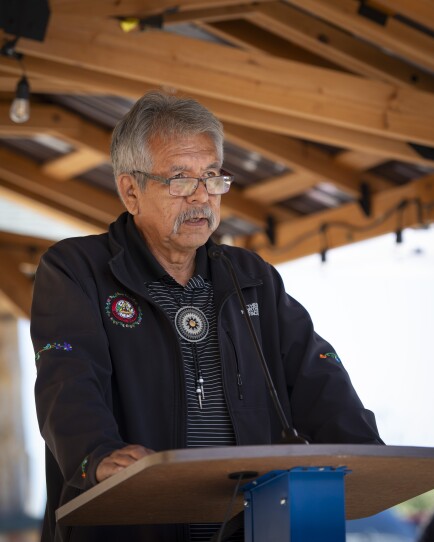

Both said the case's impact goes further than tribal gaming.
“Tribal gaming has positively affected many tribal nations across the country, providing economic support, providing opportunity, things of that nature,” Ethier said. “A lot of our dollars end up following through to education programs and human service programs.”
The impact spreads to others outside of the tribe, Ethier said.
“We employ nearly a thousand people in our gaming entity here [Leech Lake] —not just tribal members, but just community members. We’re in rural Minnesota, so the impact we have on the economy locally, I mean, it’s huge.”
The monument at White Oak stands to recognize this impact. It states Helen Bryan “will forever be remembered as a true hero within our community, and for the lasting impact her efforts had on tribal sovereignty and Indian gaming.”


