



Cherry School near Iron Junction
“Hi, this is Levi, Charlie, Lily, and Deegan reporting from Cherry School in Iron Junction, Minnesota on March 31, 2026.
“We have been noticing that the temperature has been going up and down. Also, there is way more daylight. We hear more bird sounds outside.
“On March 25, Charlie saw a Red-winged Blackbird flying above some cattails on the way to the Twin Cities.
“On March 29, Ms. Aufderheide saw four Red-winged Blackbirds in Chisholm.
“On March 29, Kaden saw one American Robin in his yard near Cherry.
“On March 29, Gavin saw about five Canadian Geese near Iron Junction. Two were in a flock and the other three were alone.
“On March 28, Lily saw two swans on a pond near Cherry.
“On March 26, Walker noticed a flock of about 15 swans in a field near Kelsey.
“We have started tracking bud burst in the school forest and are monitoring speckled alder, paper birch, American hazelnut, and beaked hazelnut. On Thursday, March 26, we noticed that all of the buds were still closed on all four species.
“Today, March 31, we noticed that most of the buds are still closed. However, a couple buds at the tip of the beaked hazelnut have broken and catkins on the American hazelnut have become larger.
“On the speckled alder, about 30% of the catkins looked larger than last week and had some yellow color. Some of them released pollen when we flicked them. Last week the catkins were smaller and red colored.
“This concludes our phenology report. This has been Levi, Charlie, Lily, and Deegan reporting from Cherry School. Nature Rules!”'
North Shore Community School near Duluth
“Hello from North Shore Community School on the north shore of Lake Superior. This is the phenology report for the week of March 28, 2026. My name is Lydia, and I am your phenologist for this week!
“In the last week from March 28 through April 4, we gained 22 minutes of daylight.
“On Saturday, March 28, Ms. Jackson noticed that her garden tulips had sprouted from the ground. They were about one inch above the soil. Mrs. Rolfe also saw that her irises had sprouted. Piper’s irises had sprouted on Monday, March 30. Ms. Jackson’s class’s tagged tree report is that the gray alder is the only one that has reported a change this week. The students noted that the gray alder had 10% breaking leaf buds. Also, of their class’s four tapped maple trees, 23.5 cups of sap were collected. Mrs. Rolfe’s class tapped two maple trees on March 31. They collected 4.4 cups in just 24 hours. On Wednesday, April 1, Ms. Jackson’s class collected an additional 32 cups of sap.
“Avett noticed that all the snow had melted in his front yard on Monday, March 30.
“There have been several families reporting their first sightings of robins. A Merlin falcon was heard in Lakeside, near Cooke Street on Saturday, March 28. On Tuesday, March 31 Ms. Young’s class heard Sandhill Cranes bugling and Ms. Urban saw her first American Kestrel of the season sitting on a power line as she drove home from school.
“Gray and fox squirrels have begun birthing pups. On Tuesday, March 31 Owen saw a fox in his backyard in Two Harbors.
“Mrs. Rolfe saw a black fly outside on her deck on Saturday, March 28.
“On Wednesday, April 1, there was black ice on the highway as Ms. Jackson drove to school. She saw one vehicle that had slid off the road. The temperature was a few degrees below freezing and there had been a slight drizzle of rain. Be careful during these conditions because black ice is not visible until it's too late.
“This concludes the phenology report. Have a great week and be observant!”
Little Falls Middle School
“This is Brodi and Emma reporting from Little Falls Middle School. This is our phenology report for the week of April 5.
“The juncos are still here in Little Falls, and have been joined by bluebirds, Golden-crowned Kinglets, and Purple Finches.
“In the woods we have spotted the leaves of hepatica and wild strawberry.
“The male robins have been fighting around our yards and open fields. It has been a common sight to see them fluttering and swirling around each other.
“A classmate found a woolly bear caterpillar, and we have discovered several
stoneflies around town.
“We had an exciting sighting of a Brown Creeper, and have also used the Merlin app to ID Song and Tree Sparrows, along with the surprisingly beautiful song of the European Starling.
“There were thousands of mayfly nymphs swimming near the shore of Pike Creek at Lindbergh State Park. They looked like fish or tadpoles from a distance
“We have seen the white sides of different diving ducks on river and have seen Wood Ducks in ponds and back channels.
“One student heard a strange bird calling, and discovered it was a Barred Owl, as she was able to spot it in a tree. It was not making the typical call we often hear.
“The Mallards have taken up residence in town where they nest in yards, and it is common to have to stop and wait for them to cross the road in front of you.
“The Sandhill Cranes have moved in to most fields around town, and we are starting to see Great Blue Herons in ponds and quiet water.
“The Pileated and Red-bellied Woodpeckers are loudly calling in the woods.
“There were two different huge flocks of Snow Geese flying overhead. At least 200 birds were estimated.
“That is our report for this week, until next week, keep exploring, keep discovering, and keep connecting with the great outdoors.”
Linwood Elementary School in Wyoming, MN
"Greetings from the fourth-grade phenology team in the Linwood School Forest. This is Harley, Hunter, and Jacob reporting on our observations from the week ending April 1, 2026.
“This week we observed that if we look very closely, we can see our lilac buds starting to open. If we peel the bud apart, we can see the purple at the center. We think the bud opening looks kind of like green lips.
“We also observed that our cottonwood buds have swelled and turned from green to more brownish. We think they look like little pinecones. John Latimer came to visit our school this week and he pointed out an oriole nest in our cottonwood at the end of a branch.
“We also saw that our red and silver maple buds have started to open slightly. We can see yellow inside one, telling us it is a male, and red inside another, telling us it is a female.
“That is all from the Linwood School Forest, and remember, there is no place like Linwood!”
Prairie Creek Community School in Northfield
Theo: “Hi, I’m Theo-”
Sam: “I’m Sam-”
Ellen: "And I’m Ellen-”
Theo: “And we’re from Prairie Creek Community School-”
Sam: “Way down south in Northfield, Minnesota.”
Ellen: “On March 26, our frog spotter heard the frogs behind her house.”
Theo: “We are seeing bud break on many trees.”
Sam: “The maples are blooming – and we boiled down our sap!”
Ellen: “The forsythia is in bloom and the squill and spring beauties are blooming.”
Theo: “We’ve noticed a lot of geese and gulls migrating.”
Sam: “Sadly, Hugo found a dead junco on his deck. It was probably attacked.”
Ellen: “Caroline noted more mosquitos and Wood Ducks.”
Theo: “Michelle saw a worm on April 2 and a crow with a stick in its mouth on March 22.”
Sam: “Grace saw a lot of herons nesting on the Mississippi River-
Ellen: “And Ingrid saw an Eastern Bluebird.”
Theo: “This has been Prairie Creek-”
Sam: “One more step along the phenology journey.”
Listener Talkback: Gus
What have you seen out there? Let us know: email us at comments@kaxe.org or text us at 218-326-1234.
For more phenology, subscribe to our Season Watch Newsletter and podcast or visit the Season Watch Facebook page.
Funding for this project was provided by the Minnesota Environment and Natural Resources Trust Fund as recommended by the Legislative-Citizen Commission on Minnesota Resources (LCCMR).
-
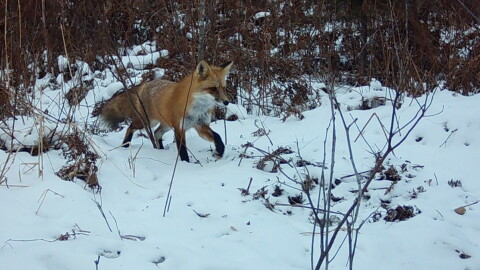 Grace Malinowski, program coordinator, discusses the Offal Wildlife Watching Project. The Community Science series is produced by Mark Jacobs.
 -
 The disease, which causes internal bleeding and sudden death, was confirmed Sept. 9, 2026. It does not affect humans.
 -
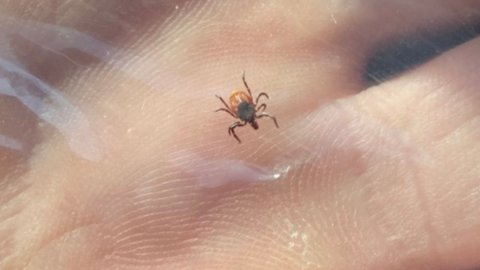 ContributedDozens of ticks as part of a study with the Marshfield Clinic Research Institute were submitted from the Bemidji area.
 -
 Christopher Smith, conservation committee chair for the Minnesota Herpetological Society, discusses how salamanders use dead and dying trees. The series is produced by Mark Jacobs.
 -
 Lorie Shaull/KAXEThe Minnesota Pollution Control Agency is surveying people's fish-eating habits to help limit contaminants in water bodies and make fish safer to eat.
 -
 Contributed/Daniel DewaldCisco and other cold water fish died by the thousands in the large, shallow lake as water temperatures soared to an average of 77 degrees in late July and early August 2026.


