



North Shore Community School near Duluth
“Hello from North Shore Community School on the north shore of Lake Superior. This is the phenology report for the week of Feb. 28, 2026. My name is Elouise, and I am your phenologist for this week!
“On Saturday, Feb. 28, Mr. Otten noticed the snow at his house had gotten crunchy after the warm temperatures on Friday. On Sunday, March 1, Ms. Urban drove up the shore and noticed decent ice coverage on Lake Superior- all the way to Lutsen! The length of the day in Duluth increases by approximately 101 minutes from the start to the end of March. The daily increase of daylight increases by over 3 minutes each day. On March 1, 2026, Duluth had 11 hours, 6 minutes of daylight, and will become 12 hours, 47 minutes by March 31, 2026. This rapid gain is independent of the switch to Daylight Saving Time, which occurred on Sunday, March 8, 2026. The increase is driven by the Earth's tilt toward the sun as the spring equinox approaches.
“On Thursday, March 5, and Friday, March 6, during the early morning we had freezing rain that covered the roads and trees with a layer of ice.
“On Friday, Feb. 28, Gavin saw a Pileated Woodpecker flying as he was driving home. He was excited as he hadn’t seen one in a long time. On Saturday, Feb. 28, Ms. Emily heard chickadees singing their spring “cheeseburger” song. On Sunday, March 1, Owen saw a Peregrine Falcon on the Two Harbors train bridge. On Monday, March 2, students in Ms. Gallagher’s class riding Bus 1 saw a group of Wild Turkeys on the way to school. On Tuesday, March 3, Mayme heard an owl hooting at her house.
“Mrs. Rolfe noticed a willow tree near her home that has buds that have developed into fuzzy, catkin-like flowers.
“The first total lunar eclipse of the year was Tuesday, March 3. It was visible in all of North America and will be the last total lunar eclipse anywhere on Earth until New Year's Eve 2028-2029. During the total lunar eclipse, the moon appeared to take on a red hue, giving rise to the name ‘blood moon’. On Wednesday, March 4, Finn found a live grub in the stump. It was moving! Also on Wednesday, Ms. Helgesen’s class saw a wooly bear caterpillar climbing up the outside of the greenhouse. It was black with one red stripe. On Thursday, March 5, Mr. Dover’s class measured 18.5 inches of snow at their class spot.
This concludes the phenology report. Have a great week and be observant!”
Long Lake Conservation Center near Palisade
This report is brought to you by Moosay, Zoe and the students from Sejong Academy Korean Immersion School in St. Paul.
“During our trip to Long Lake Conservation Center from March 3-6, the high temperature was 47 degrees Fahrenheit and the low was 22.
“Turkeys were in strut near campus and we saw garter snakes outside of their hibernaculum for the first time this year. They didn’t venture far, but this is a sign that the worst of winter is behind us.
“A magpie was spotted and we had reports in the area of black bears out and about. The snow is melting quickly and there are areas of green grass.
“On the lake we noticed that the leaves were melting into leaf shapes in the ice. Lu saw a deer outside of his window, and a few ladybugs inside. During a hike, we found a clump of deer fur, and saw a fuzzy caterpillar, jelly mushrooms on a stick, tiny orange mushrooms, lots of tracks and scat, and an owl pellet that had hair in it.
“The mornings were foggy, but beautiful. The woodpeckers were very active at the feeders. We saw Hairy, Downy and Red-bellied Woodpeckers. We thought that the Red-bellied Woodpecker’s song sounded like a Pokémon.
“We had a great time exploring nature and we want to remind everyone to unplug, get outside and LIVE CONNECTED!”
Little Falls Middle School
“This is Emily and Maegen reporting from Little Falls Middle School. This is our phenology report for the week of March 8th.
“We heard our first robin singing on the morning of the March 3. This date matches up with our first robins for the past 3 years, but we have not seen any large groups, so we are not 100% sure it is a bird that migrated.
“We did see our first Pine Siskin of the year last week. We typically have large flocks of them here for the winter.
“The crab apple tree outside our classroom is still loaded with apples, but there are just as many covering the ground beneath it.
“The warm weather this past week has brought snow fleas to the surface of our remaining snow.
“A classmate heard a large group of coyotes yipping and barking at night.
“The melting snow has revealed several old vole trails crisscrossing through the subnivean zone.
“In our areas with pine trees, we have noticed the red squirrels have become more aggressive this week as they are also entering mating season.
“There have been numerous sightings of swans and geese in fields and open water.
“The chickadees and cardinals are both singing in the mornings. It won’t be long until they are joined by all of our migrating birds.
“Students who have brought the UV light home have mainly focused on different Lichens that they can find, but we have had some strange objects at night that we have not been able to ID.
“The large flock of crows is still around and roosting in the pine trees. They make quite a ruckus when they approach at sundown and also in the morning.
“That is our report for this week, until next week, keep exploring, keep discovering, and keep connecting with the great outdoors.”
Linwood Elementary School in Wyoming, MN
"Greetings from the fourth-grade Phenology Team in the Linwood School Forest. This is Haylee, Eva, and Olivia reporting on our observations from the week ending March 5.
“This week we observed that we can tell the difference between last year’s growth on our silver maple tree because the bark is much smoother and has a reddish color compared with the rougher and grayer bark of older growth.
“We also observed that our Norway or red pine has bundles of 2 needles which is different than the 5 needles on a white pine. We couldn’t find a white pine around the school but we are still looking.
“We also saw if we crush the needles of our white spruce it has a strong odor. We couldn’t really agree on what it smelled like, with some of us enjoying the smell and others not so much.
“In the forest, we saw a lone Trumpeter Swan fly over silently. It was followed by 3 more that were trumpeting very loudly. We think the 3 were looking for the single swan.
“That is all from the Linwood School Forest, and remember: There’s no place like Linwood!”
Prairie Creek Community School in Northfield
Caroline: “Hi, I’m Caroline-”
Ingrid: “And I’m Ingrid-”
Caroline: “And we’re from Prairie Creek Community School-”
Ingrid: “Way down south in Northfield Minnesota.”
Caroline: “The piebald robin that was at our school last year is back!! He returned on March 3.”
Ingrid: “Ellen saw a black squirrel and Sam saw a white squirrel.”
Caroline: “Natalie saw a hawk with a red head.”
Ingrid: “There are eagles on a nest near our school.”
Caroline: “We found a wooly bear alive.”
Ingrid: “The ice on the river is breaking up.”
Caroline: “We gathered two gallons of sap and it is 4% sugar this year.”
Ingrid: “There are turkeys roosting in Hugo’s trees.”
Caroline: “I saw two bunnies fighting.”
Ingrid: “There are pussy willows opening up.”
Caroline: “Natalie saw two egrets in a field… at least we think they were egrets.”
Ingrid: “We saw and heard Sandhill Franes when we were outside for ‘read aloud’ on Tuesday.”
Caroline: “This has been Prairie Creek-”
Ingrid: “One more step along the phenology journey.”
Caledonia High School in Houston County
“Down here in Caledonia, I just saw our first Turkey Vulture, Sandhill Cranes, Red-winged Blackbirds, and Common Grackles over the weekend. I also saw Red Maples beginning to flower near the Mississippi River. Have a great week!”
What have you seen out there? Let us know: email us at comments@kaxe.org or text us at 218-326-1234.
For more phenology, subscribe to our Season Watch Newsletter and podcast or visit the Season Watch Facebook page.
Funding for this project was provided by the Minnesota Environment and Natural Resources Trust Fund as recommended by the Legislative-Citizen Commission on Minnesota Resources (LCCMR).
-
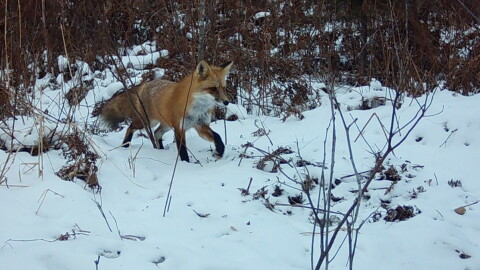 Grace Malinowski, program coordinator, discusses the Offal Wildlife Watching Project. The Community Science series is produced by Mark Jacobs.
 -
 The disease, which causes internal bleeding and sudden death, was confirmed Sept. 9, 2026. It does not affect humans.
 -
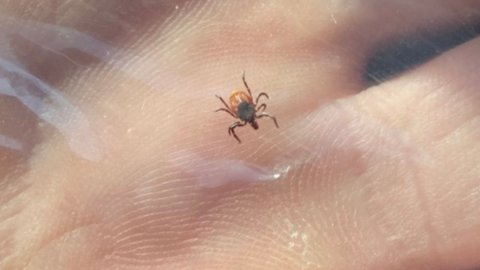 ContributedDozens of ticks as part of a study with the Marshfield Clinic Research Institute were submitted from the Bemidji area.
 -
 Christopher Smith, conservation committee chair for the Minnesota Herpetological Society, discusses how salamanders use dead and dying trees. The series is produced by Mark Jacobs.
 -
 Lorie Shaull/KAXEThe Minnesota Pollution Control Agency is surveying people's fish-eating habits to help limit contaminants in water bodies and make fish safer to eat.
 -
 Contributed/Daniel DewaldCisco and other cold water fish died by the thousands in the large, shallow lake as water temperatures soared to an average of 77 degrees in late July and early August 2026.


